Credit challenges rise; standards don’t necessarily change in tightening environment
Interest, inflation raise costs, reduce margins
Lenders in Spokane say several economic factors have made it increasingly more expensive for borrowers when trying to obtain a loan, including high inflation, high interest rates, and an erosion of COVID-era stimulus funds that allowed many to save, pay off loans, and invest.
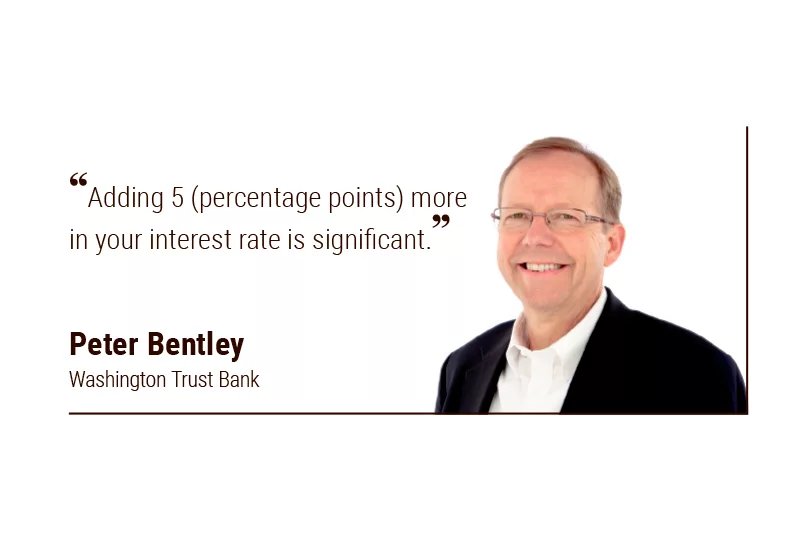
“We had a long period of time where interest rates were pretty low,” says Peter Bentley, chief credit officer for Spokane-based Washington Trust Bank. “I think that’s where businesses struggle in how much it costs to borrow money today. And that’s what the Fed is trying to do. They’re trying to make borrowing costs high to slow down the economy.”
The base interest rate that financial institutions charge for corporate loans, the prime rate, stood at about 3.5% for a long time, says Bentley. Now that rate is 5 percentage points higher, at 8.5%.
“Adding 5 (percentage points) more in your interest rate is significant,” he says.
According to a Federal Reserve survey, U.S. banks reported tighter credit standards and weaker loan demand from both businesses and consumers in the second quarter.
Bentley suggests that the Fed’s report is pointing toward large national banks and isn’t necessarily reflective of the Spokane region.
Within economic cycles, some banks will be more aggressive in putting loans on the books when the economy is good, and when they see the economy potentially slowing, banks will return to their normal underwriting metrics that can be perceived by businesses as a tightening of credit standards, he says.
“A lot of the bigger banks are making their standards tighter to qualify for a loan,” he says. “But that is normal if they think the economy is going to turn and people are going to struggle. They want to make sure they’re in a position that they are not going to put on a bunch of new bad loans.”
Washington Trust Bank mostly stays consistent in its borrowing metrics regardless of highs and lows in the economy and hasn’t made changes to its standards, he says.
Since March of 2022, the Federal Reserve has increased the federal funds rate 11 times to return inflation to its 2% objective.
According to the Bureau of Labor Statistics, U.S. inflation was at 3.7% for the 12-month period ending in September, down from a record high 9.1% a year ago.
The effective rate is currently between 5.25% and 5.5%. On Wednesday, Nov. 1, the Federal Reserve left interest rates unchanged, yet signaled a possible increase in the future.
According to personal finance website Bankrate.com, as of Nov. 1, a typical conventional mortgage rate is 8.06%, up from just under 7% in July.
Obtaining a business loan might also be more difficult for first-time borrowers and small business loans, which have fewer avenues of cash flow, loan officers say.
Dan Pearse, Spokane Valley-based Numerica Credit Union’s vice president and regional commercial team leader, says, when evaluating a potential borrower, his team looks for multiple sources of repayment. On a commercial property loan for example, it would be ideal for the property to have cash flow on its own, however, if rents were to tighten, loan officers need to know there is a backup cash flow plan in place.
“With interest expenses being up significantly, it tightens cash flows on properties in real estate lending,” Pearse says. “Diverse sources of secondary cash flow, support, and good equity in each project is something we’d look for. Seasoned investors already probably know that.”
Because of the high interest rates and compressed margins, real estate investors often will need additional equity injected into projects to make sure that the cash flow is adequate to service the loan, he says.
“The simplest example is for someone who is buying an income property with the higher levels of debt service, while prices have not really come down, it’s leading borrowers to put significantly more equity into a project to make the cash flow pencil,” he says.
In many cases, people’s cash reserves have eroded over the past couple of years, making it challenging for people to inject capital into new projects, Pearse says.
“Savings have eroded across the country,” he says. “Institutions across the country have seen erosion of their deposit balances as people either look for other places to take their cash or have gone through their cash because of inflation.”
One avenue new potential business owners can take to mitigate the traditional equity requirements to start a business and get it off the ground is to look at Small Business Administration-backed loans, he says.
Pearse says Numerica hasn’t changed its lending requirements. While loan volumes for the credit union and for all lending institutions in the second half of the year have slowed, he says it’s not a function of the credit union making changes.
“Overall, it’s a function of a slowdown in the economy,” he says. “I think our economy is still robust, but there’s a little bit of a slowing of purchases.”
Greg Deckard, CEO of Spokane Valley-based State Bank Northwest, says the community bank hasn’t seen a significant decrease in loan demand and hasn’t had past-due payments from its agricultural and small business loan borrowers. State Bank hasn’t changed its lending standards and still has plenty of liquidity for lending, he says.
“National banks, they’re relying on overall economic growth to fulfill their growth needs,” Deckard says. “We’re not as related to overall economic conditions as the larger banks. It has an impact on us, but we haven’t lessened our underwriting.”
Matt Utesch, Spokane-based Canopy Credit Union’s retail and underwriting director, says it focuses on borrowers’ intentions for a loan and their history of repayment. During downturns, some financial institutions that don’t underwrite each loan or work with their customer will simply make arbitrary rules, such as rejecting borrowers that don’t meet a credit score threshold.
“We don’t like denying loans, but when we do, it’s not us saying no forever,” he says. “It’s me saying no for right now, here’s what I can do, or come in for a financial coaching session.”