Meet & Greet: Naomi Bender, director of tribal relations, Spokane Colleges
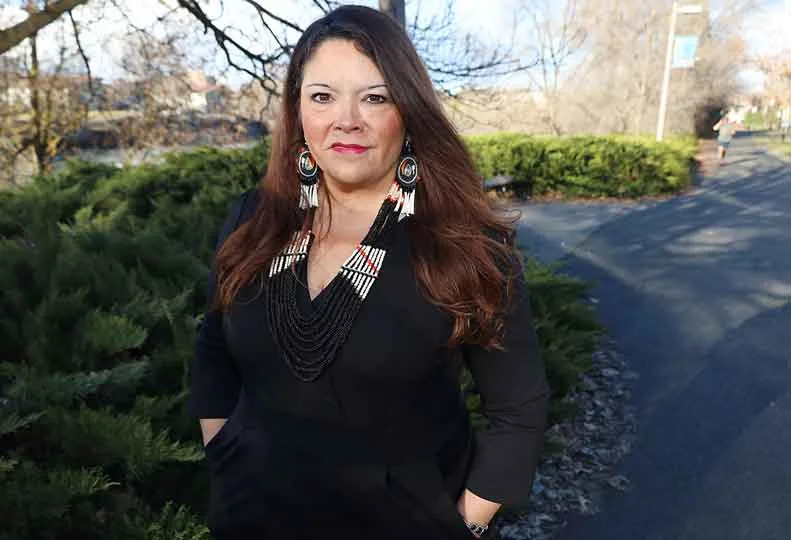
In January, Naomi Bender was appointed the inaugural director of tribal relations for Spokane Colleges to serve as a liaison between the educational institution and the indigenous tribes of the Inland Northwest.
Bender, 51, is an indigenous Quechua Peruvian with over 20 years of experience in higher education specifically focused on Native Health Sciences. She joins Spokane Colleges after serving as the director of Native American Health Sciences and director of the Center for Native American Health at Washington State University’s Spokane campus.
During her time at WSU, Bender helped to develop the nation's first indigenous healing perspective certificate to assist Native and non-Native learners in providing health care to indigenous populations. She also led the creation of the nation’s first indigenous-developed clinical health simulation exam room.
Before coming to Spokane, Bender was based at the University of North Dakota as a program manager at the school’s Center for Rural Health and School of Medicine & Health Sciences, where she helped develop over 20 programs during her tenure.
Bender holds a doctorate of education, a master’s degree in organizational communication, and a bachelor’s degree in criminal justice.
The Journal recently met with Bender to talk about her first 60 days in office, why she chose a career in higher education, and what she hopes to accomplish in her new role.
How did you come to choose a career in higher education?
After I graduated college, I was hired by the North Dakota Highway Patrol. But as my daughter, who has autism, aged, I noticed there wasn’t a good educational system for her in Williston, where I was stationed. So I made the conscious decision to leave the job altogether and get her in a better educational system.
When I made the transition, I wanted to potentially become a teacher or work for a large organization that gave back to the community. During my first or second year in graduate school, I was losing my indigenous grandmother to ALS (Lou Gehrig’s disease). We took her to eight different physicians, and no one could give the answers we needed. It became quite clear to me that there was more work for me to do. I needed to do my part as best as I could to help change a system, even if it was a small part of the system. And I knew I had the ability.
After focusing on health care in higher education, why take on a more general role?
I will say that as a director of tribal relations, my roles and responsibilities are not necessarily focused on one discipline. The role and responsibilities of a tribal relations director is really to cultivate, foster, and sustain trusting and meaningful relationships with tribal sovereign nations.
I’m blown away at a few things. One, Spokane Colleges has over 100 disciplines, and there’s also all these beautiful opportunities that the tribes are telling me they really want to develop with the Spokane Colleges. The reality is that a lot of our Native students will enter into two-year schools as an affordable stepping stone toward their career.
It's also an opportunity for us to consider new curriculums, new benchmarks, new initiatives that are driven by the tribes. I’ve just met with three tribes in our region, and every single one of them wants us to develop a more robust program for natural resources. They are hiring folks from out of state, and they’re great. But they want to be able to gear up and get their tribal youth excited about natural resources, fisheries, and wildlife. That’s a huge request right now.
Another is workforce concerns. There’s a lot of folks who are retiring. So who are we going to be bringing in? My first 60 days has been wild just listening to the tribes. It’s exciting. They’re very excited about working with Spokane Colleges.
What do you envision to accomplish in the near future?
Dr. Brockbank has given me two major goals. One is to develop a tribal advisory board so that we can begin this work. That is probably the best goal he could have given me, because I can’t do this work in isolation and we really need it coming from our tribal members.
The second goal he gave me was really be thoughtful and consider my own work plan for my position in my unit. I think leaders are appreciative that I’m here, but maybe don’t have a full grasp or understanding of what the director of tribal relations does. There are some misnomers that tribal relations directors only work with tribal nations and my boss. That’s not the case; it’s not even close. That’s a fraction of what I do.
My job is to go out and work with tribal community members of those tribal nations and listen to the needs of their native children, their native adult learners, their elders. Anything from health care to natural resources, energy concerns, climate environment concerns, and Medicaid reimbursements.
I envision that once we have a tribal board put together, we will then begin seeing actions coming into place. We will be enacting a lot of these initiatives that might sound like good ideas, and cultivate them and build their foundations strong enough so that once we build up, let’s say a program or a healing center or whatever it may be, that’s its sustainable over time. That’s my goal. It’s been my goal with every program I’ve ever worked on.
What challenges do you foresee?
There are always challenges. There are people from a policy-driven Western lens who say, This is the way we’ve always done things, and this is the way we need to continue to do things. I’m somebody who comes in and says, That might have been your way for the last 20, 30, 50 years, but if you’re actually thinking about moving that dial working with Native students in ways that honor their ways, then oftentimes my first question to those leaders is, are you informed about this?
They’re making decisions based on common practice in their world. I often think that people don’t know what they don’t know, and it’s my job as a director of tribal relations to come and help support and educate and better inform folks so they can make a better comprehensive decision with me and tribal leaders at the table.