Memory cafés offer judgment-free settings
Weekly gatherings provide people with dementia, caregivers social opportunities
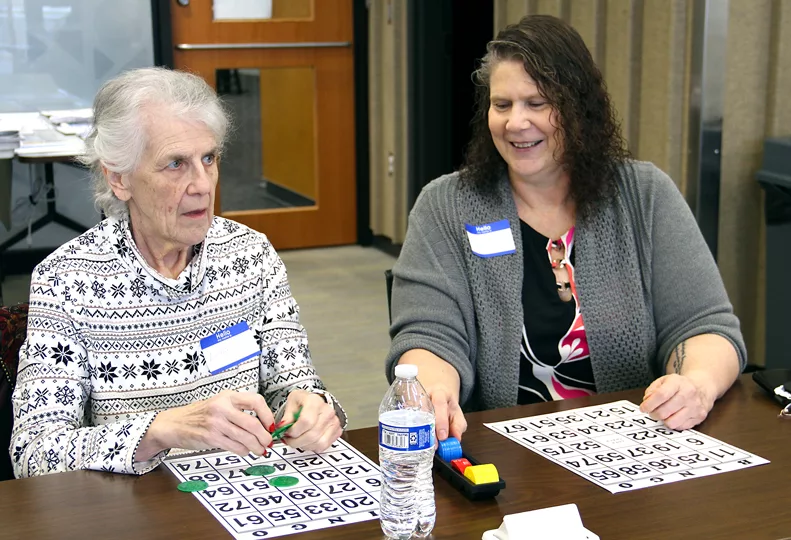
Lois Bamonte and her daughter Tamara Helmer play bingo at the Spokane Valley monthly Memory Café.
| Jase Picanso“G-25!” Candice Whelen called out, her eyes fixed on the tiny bingo ball in her hand. She paused, scanning the room to see if the number landed. About 10 people sat around a cluster of tables, skimming the bingo cards in front of them. Light from the overcast January day filtered through the library meeting room’s floor-to-ceiling windows.
A woman smiled as she glanced over the columns on the board in front of her. B… I… G… 43… 56… 25. She placed a chip on her card. Her husband followed a few moments later. “Ooh!” he exclaimed with a small laugh as he placed a chip on the matching number on his board.
Near the door, a spread of dementia resource pamphlets lined a table beside lemon cookies and hot drinks.
“Bingo!” a woman announced from across the table. The room buzzed with cheers.
This game of bingo is one of the few Memory Café events hosted in the Spokane area, aimed at combating dementia-related isolation by providing a low-pressure space where people experiencing dementia and caregivers can socialize without fear of judgment or expectation.
Spokane County Library District librarian Corrine Wilson learned about Memory Cafés during a 2020 webinar that highlighted their success in the Netherlands since the ‘90s.
“Memory Café is a social opportunity for folks with dementia and their caregivers to come together and do something fun, and also to form a community with other caregivers and other folks with dementia,” Wilson says. “They don’t have to explain what they’re going through, because people are having very similar experiences. And for folks with dementia, they don’t have to be embarrassed or pretend they remember more than they do.”
She shares a story of a married couple who came to a Memory Café, and the husband insisted he didn’t have dementia. Over time as they continued attending, Wilson explains, he began noticing memory lapses and realized what was happening. When she spoke with him about it, he told her, “It’s really going to be fine. All my buddies from the military here have dementia. My wife will remind me of what I forget, and I’ve got all of these cool friends that I just hang out with every week.”
Live concerts, rock painting, senior fitness, and other group activities are just some of what Memory Cafés offer. They meet weekly at the North Spokane Library and monthly at the Spokane Valley Library and at the Central YMCA.
“I like the things we do here, being able to get out of the house and just do something,” says Lois Bamonte, a regular participant at the Spokane Valley Memory Café. “I’m actually getting bored with TV.”
Bamonte attends the monthly sessions with her daughter, Tamara Helmer, who is working toward a bachelor’s degree in behavioral health. Helmer's final capstone project focuses on improving activity opportunities for people living with dementia.
“So many times when it comes to dementia, medical personnel and society in general forget that they’re individuals,” Helmer says. “They start to see the disease instead of the person, and forget that my mom has a history. Just because she has a medical condition doesn’t mean she doesn’t still love to do things, even if she starts to forget them.”
Memory Cafés are intentionally flexible. Participants can come and go as needed, engage at their own pace, and attend without formal diagnosis requirements. The focus is not on therapy or treatment, but on shared activity and connection for people living with dementia at any stage and their caregivers, though access to such opportunities remains limited.
“There's the senior center for people who are more active, but when it comes to the dementia stuff, there's just this big gap where people are at home, isolated, and there needs to be something. If you can bring more awareness, I think it can organically grow to more and more,” Helmer says.
Sean Jonz, program manager for the Alzheimer’s Association in Eastern Washington, says the organization hopes to open a new Memory Café location on Spokane’s South Hill within the next year, though expansion depends on volunteer capacity. The Spokane Valley and Central Spokane locations are organized by volunteers who work directly with the association.
“We’re always looking for volunteers,” Jonz says. “We can only expand our programs as much as we have volunteers who can facilitate and run our programs. We’re always looking to expand.”
The North Spokane memory café location specifically hosts off-site outings and hands-on experiences, including trips to a fish hatchery, Riverfront Park carousel rides, miniature golf, pickleball, and ice cream socials. Other activities range from storytelling and cultural food events to interactive games and tactile presentations, all designed to help foster a sense of community among attendees.
For Wilson, the goal has always been to make Memory Cafés feel approachable.
“We don’t ask what your diagnosis is,” Wilson says. “We just invite you in and have fun with you.”
At a Memory Café, there’s no wrong way to participate. Whether it’s a game of bingo or a chat over cookies and coffee, everyone is welcome to be themselves and to be part of a community that understands and supports them.