SFCC primes students for evolving workforce
New initiative integrates AI with IT, cybersecurity paths
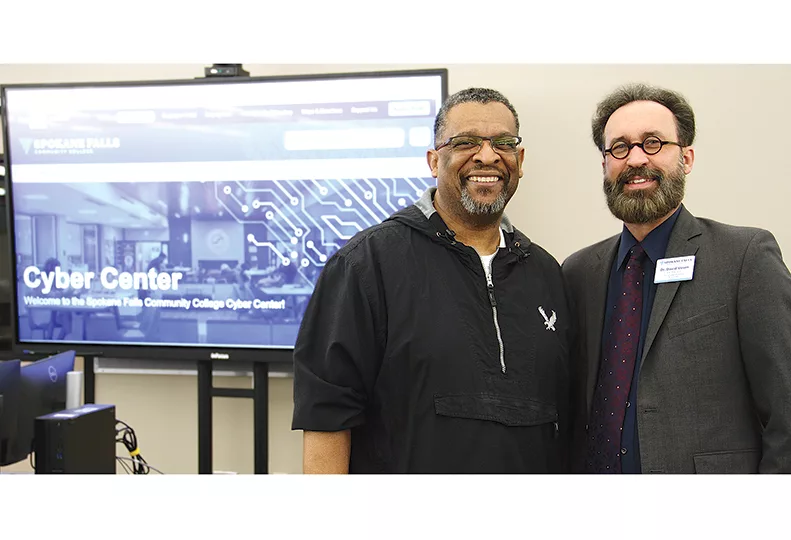
Spokane Falls Community College computer science program leaders Mark Neufville and David Vosen are working with employers here to help shape the new curriculum.
| Jase PicansoAs artificial intelligence quietly becomes an everyday tool across industries, Spokane Falls Community College is moving toward educating students on how to work alongside it in their future careers.
Starting in the 2026–27 academic year, SFCC will launch a new AI emphasis and certificate program designed to prepare students and working professionals for an AI-shaped job market. The initiative will support the region's startup ecosystem by training qualified employees that appeal to companies seeking talent here. The program is backed by a $150,000 Washington state grant aimed at expanding workforce-focused training in response to rising employer demand for AI skills.
“It’s a program we need to have,” says Mark Neufville, a computer science professor and program lead for the new AI initiative. “We need to incorporate it within the education space, because the job market and the workforce dictates that to us. Since we’re a community college, our main focus is supplying the community with qualified employees.”
Funding has been awarded to support an AI area of emphasis in SFCC’s Associate of Applied Science degree in information technology and cybersecurity, as well as a standalone AI certificate, through the High Demand Enrollment Fund by the Washington State Board of Community and Technical Colleges.
AI adoption has accelerated rapidly across industries especially in the last year. About 78% of organizations reported using AI in 2024, up from 55% the year prior, according to Stanford University’s 2025 AI Index. Despite persistent fears of mass job displacement, recent analyses suggest AI has had little impact on overall employment numbers so far.
Instead, AI is increasingly being folded into everyday work, according to a Pew Research Center survey conducted in September 2025, that found that 21% of U.S. workers say at least some of their work is done with AI, up 16% from a year earlier.
“AI is pretty much implemented in every career field out there today. I don’t really see people being employable without some form of AI knowledge or skills,” says Neufville.
Rather than creating a standalone degree, SFCC is designing for integration directly into its existing IT and cybersecurity degree. Program development is expected to take about a year, with the first students enrolling in fall 2026.
“It’s an AI fundamentals course, and that course is going to be open to the entire campus,” Neufville explains. “We’re teaching students how to use AI, how to leverage it, what they should and should not do ethically, and how it’s going to translate from academics to the workforce.”
Grant funding will support curriculum development, faculty training, and the purchase of equipment to work with large language models and course data sets. Funds also will support the expansion of internships and job placement partnerships with regional employers in cybersecurity-related fields, including technology, health care, and manufacturing.
“The demand for AI and machine learning specialists has surged, and Spokane is rapidly emerging as a leader in advanced manufacturing, automation, and AI,” says Sarah Martin, dean of science, technology, engineering, and math (STEM). “This grant positions us to expand our curriculum and prepare students with the skills they need to compete in tomorrow’s workforce.”
Since technology proficiency is emerging as a baseline requirement across all industries, especially in fields like cybersecurity, SFCC program leaders are working with employers here who are helping to shape the new curriculum.
“We have an advisory board made up of business leaders in Spokane who drive our direction on what kind of knowledge they want to see our students coming out with,” says David Vosen, co-chair of the computer science department at SFCC. “A lot of this is coming directly from the workforce sector.”
Program leaders also emphasize that a focus on ethics and the responsible use of AI is woven throughout the curriculum.
“That’s something our employers are very concerned about,” says Vosen. “We took that very seriously and we’re doing that in our ethics class and make sure students are thinking through what they’re doing, rather than just saying, ‘Go for it.’”
Vosen and Neufville both say that AI is an increasingly important and complicated tool for cybersecurity as criminals adopt automated hacking tools, deepfakes, and AI-generated phishing attempts.
“Hackers, criminals are using AI,” Vosen says. “We can’t control how criminals use technology, but we can control the fact that we need our students to learn how to think and defend against it.”
Instructors are expecting the curriculum to change frequently to adapt to quickly evolving technology.
“Our curriculum shifts from term to term,” Vosen says. “It’s hard for us to even use a textbook because things are changing so fast.”
To keep pace, the program will emphasize applied, scenario-based learning designed to mirror real-world challenges.
“The only way to effectively teach that stuff is through real-life scenarios,” Neufville explains.
Looking ahead, the program will expand beyond teaching technical skills to give students the knowledge to navigate an AI-driven world safely and responsibly, he says.
“The more informed you are, the better you can protect yourself,” Neufville says. “Not everyone is going to take our program, and we probably can’t protect everyone. But we can give people the knowledge to be more informed and that’s what we’re trying to do with this class.”