Making home design senior friendly
Universal-access features help aging homeowners keep their independence
Some contractors here say they're embracing an emerging market for home designs and improvements aimed at helping people stay in their homes as they age.
Brian Beyer, a principal in JBI Properties LLC, a Spokane Valley home builder, emphasizes an aging-in-place concept, called universal design, in the homes he builds.
Universal design focuses in large part on accessibility even as people lose mobility due to age or injury, Beyer says. The concept includes at-grade entries at a home's front door and garage, wide doorways and hallways, higher electrical outlets and lower light switches, kitchens with side-opening ovens and counter space on both sides, and bathrooms with wheelchair-accessible showers.
Beyer says integrated universal-design features likely would provide more value to a home than retrofitting a conventional home with conspicuous access features such as a wheelchair ramp for a typical above-grade entry threshold.
"When you do it at the design stage, it's a matter of positioning things," such as an at-grade entry threshold, he says.
Universal design is in its infancy here, but it's becoming a major topic at home-builder conferences, and it's gaining momentum in architectural schools, Beyer says.
The Spokane Home Builders Association offers courses sanctioned by its national organization to member remodelers who want to attain the organization's certified aging-in-place specialist (CAPS) designation.
Joel White, SHBA executive officer, says, "We've had a lot of members take those courses, and several hold the CAPS designation."
White says home modifications for aging in place are expected to become a fast-growing segment of the building-remodeling industry as baby boomers reach retirement age.
"People want to stay longer in their homes, and these courses educate members in ways to make that a reality," he says.
Designs for all ages
JBI Properties recently completed two new homes in the Spokane area designed under the universal-design concept by Beyer's partner, architect John Minden. One is a two-story, 2,100-square-foot house on Five Mile Prairie that's listed for sale for $249,000. The other is a 1,400-square-foot, single-story ranch-style house on the South Hill that's listed for $245,000.
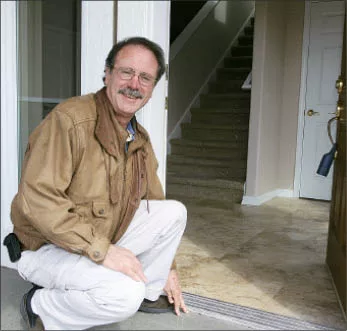
As he explains some of the universal design features at the Five Mile Prairie house, at 9614 N. Orchard, Beyer says, "There's nothing about the house that an ambulatory person wouldn't be comfortable with."
He says at-grade, front-door and garage entrances not only accommodate people dependent on wheelchairs and walkers, but also make it easier for people of all ages and abilities to move furniture and appliances, strollers, bicycles, and groceries into or out of the home.
All doors in the home are 36 inches wide to accommodate wheelchairs and walkers, and they have lever-action handles that are easier for people with arthritis to use than round door knobs.
Hallways are a minimum of 42 inches wide, and all rooms, including bathrooms, are designed to allow a 5-foot turning radius for a wheelchair or walker.
Under universal design, stairways also are at least 42 inches wide with room for a mechanized lift.
The Orchard Road house has a hydraulic elevator, a feature that cost $30,000.
Beyer says multistory homes, though, can be designed with stacked closets or storage spaces where an elevator later could be installed.
The kitchen is equipped with full-extension drawers, pullout shelves, and sliding racks in the base cabinets, all of which are designed to put stored items within easy reach, he says.
Beyer says the built-in, countertop-level oven with side-opening door is appreciated by potential buyers regardless of their ages and abilities.
The universal-design kitchen also features continuous countertops between the side-by-side refrigerator, sink, range, and oven, which allow the user to slide items where needed.
The master bathroom has a walk-in shower with outside controls to enable a mobility-impaired person to adjust the temperature and water pressure before entering the shower.
Similarly, bathroom counters have knee space underneath to allow people to use the sinks from a seated position. Toilets, meanwhile, are raised to chair height and have 3 feet of clear space on at least one side to promote maneuverability and access.
Light switches and thermostats are mounted about 6 inches lower than conventionally, and power outlets are about 4 inches higher than the norm, both of which allow easier reach by mobility-impaired people, he says.
In multistory homes, the laundry area is designed for front-loading washers and dryers and is on the same floor as the master bedroom, eliminating the need to carry laundry between floors, Beyer says.
Not including an optional elevator, universal design adds less than 5 percent to the construction cost of a conventional home with otherwise comparable space and amenities, he says.
Beyer says he doesn't want to be labeled a niche builder.
"To me, I'm just the opposite," he says. "If you build for the ambulatory market, it's more restricted than if you build for everyone."
Senior modifications
Jim Prophet, who owns Accessible Home Construction, a Spokane specialty home-remodeling business, says that ideally, people should address age-related accessibility issues ahead of time, but most seniors don't invest in such items until they have an immediate need.
"I get referrals from social workers for most of the remodeling work I do, usually after a crisis," Prophet says.
Most of his largest retrofitting jobs involve building wheelchair ramps, and he also occasionally replaces conventional bathtubs with handicap-accessible showers with bench seats and adjustable-height showerheads.
For certain seniors who prefer tubs to showers, Prophet recommends a tub seat that extends beyond the edge of a tub. Used in combination with grab bars, the seat enables a person to enter the tub from a seated position, reducing the risk of injuries from falling in the tub.
Another common home modification needed by mobility-impaired seniors is a toilet with a seat at least 17 inches off the floor and grab bars within easy reach to aid the transition between standing and sitting, he says.
Other relatively inexpensive household aids for seniors include handheld shower nozzles and lever door handles, Prophet says.