RiverBank goes green with cannabis fintech alliance
Small bank expects to expand fiscal footprint with new partnership
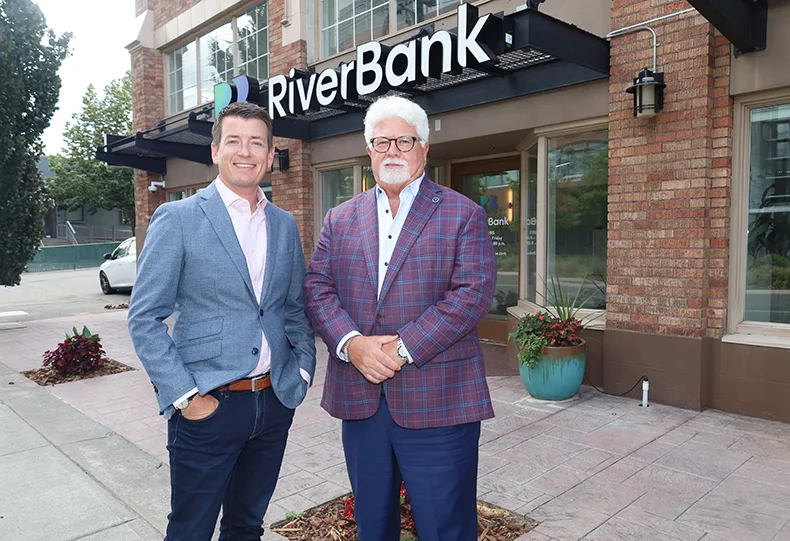
RiverBank CEO Mike Wilson and Kevin Hart, CEO of Green Check Verified, meet outside the bank's headquarters after their two companies launched a fintech partnership.
| Karina EliasRiverBank Holding Co. has teamed up with cannabis banking compliance company Green Check Verified Inc. in a partnership that aims to grow the Spokane-based organization’s deposits, lending power, and national footprint, without building a single new location.
According to Mike Wilson, CEO of RiverBank, the collaboration marks the financial institution's first formal partnership with a fintech company and serves as part of a broader bet on technology-fueled growth that the bank has been committed to since its founding in 2006.
So far, RiverBank has opened nearly 200 new accounts for cannabis-related companies across the country. Wilson expects that figure to climb quickly.
“A lot of these customers that need a banking relationship … Green Check is the best option to be able to meet their needs,” he says.
Green Check Verified is a fintech company focused on cannabis banking compliance and services. Its software integrates with point-of-sale and seed-to-sale systems across the cannabis supply chain—from growers and manufacturers, to testing labs and dispensaries—ensuring that each transaction follows state, county, and city-specific compliance laws.
While Green Check’s software handles compliance tracking and customer onboarding, RiverBank provides the actual banking services: holding customer funds, processing transactions, and generating a new source of deposits.
Wilson likens the partnership to that of the mobile payment service platform, Venmo.
“It’s very similar here,” he says. “In this instance, Green Check has expertise in these cannabis related businesses and those businesses go to the Green Check site … and the actual dollars sit here on the balance sheet of RiverBank in the background.”
For RiverBank, the partnership with Green Check is a strategic move to grow deposits and support lending power in Spokane. By attracting deposits from cannabis businesses nationwide, RiverBank increases the funds available on its balance sheet. That, in turn, expands its capacity to make loans, particularly to businesses and borrowers in the Spokane area. More deposits also means more interest income and fee-based revenue, helping the bank grow sustainably, without branch expansion.
"If we can be the bank on the back end of that relationship that builds a bank interface for what fintech needs, we're interested in doing that, and that has the potential to bring in deposits here to RiverBank," Wilson says. "Those deposits get held on our balance sheet, and we grow our ability to be a strong community bank to work with borrowing customers here in Spokane."
Although cannabis remains illegal at the federal level, it is legal for medicinal or recreational use in 41 states, Wilson notes.
In Washington state, recreational use of cannabis became legal in 2012, and the first cannabis retailers opened in 2014. Although not widespread, several financial institutions in the Evergreen State provide banking services to cannabis businesses, including Spokane Valley-based Numerica Credit Union, which has been providing banking services to the cannabis industry since 2014.
Kevin Hart, founder and CEO of Green Check Verified, says the company has partnered with over 182 financial organizations across the country. RiverBank is the first Eastern Washington partnership.
“With the partnership with RiverBank, we are going after all the open market and the folks that are underserved today,” says Hart.
Green Check Verified currently processes $1.3 billion in cannabis related transactions each month, a figure that grows between $100,000 to $200,000 monthly, he says.
The cannabis industry is recognized as a major employment sector nationwide, Hart contends. He notes there are 40,000 plus direct cannabis businesses and about 120,000 indirect cannabis businesses—all of which need the same level of banking and banking services in an integrated fashion, he asserts.
“When you look at the entire supply chain, it’s not just that local dispensary that needs banking services, it’s the people that work with them,” Hart notes. “It makes it safer for them at a community level as well. There’s a profound ripple effect when you can bank a cannabis business. Everything associated with that business operates much more smoothly.”
Bonita Springs, Florida-based Green Check Verified was founded in 2016 after Hart, an enterprise software engineer and former CEO of Apple computer repair company Tekserve Inc., was approached to build a payment processing system for a medical marijuana dispensary. It was during this visit that he learned that the majority of the cannabis industry didn't have access to mainstream banking services. As a result, the industry conducts the majority of its business, about 75%, in cash, he says.
According to Whitney Economics, a global business and economic firm, total cannabis sales in the U.S. in 2024 reached $30.1 billion.
“When I found out about the access to banking services and capital, we did a complete 180 and took a red eye home … I filled a composition book with just different ideas of how can we approach the problem, and why do banks say no versus why can’t cannabis businesses be treated almost like a normal business?” he says.
Although cannabis remains illegal at the federal level, banking it is not, Hart says. The Financial Crimes Enforcement Network has provided guidance on how banks can serve cannabis clients legally, provided they follow a strict set of reporting and compliance protocols, he notes. However, he found that banks were still too risk-averse or confused to enter the space. In the early days, when he and his team would approach bankers and say they wanted to talk with them about cannabis banking, they couldn’t even get the word ‘banking’ out before bankers did a full stop, he says.
Hart pivoted his approach by focusing on education rather than sales and building a compliance-first software platform that bridges the gap between cannabis businesses and banks. Its system integrates directly with a business’s point-of-sale and seed-to-sale tools, monitors transactions in real time, and maps each one to relevant state and local regulations, he says.
“Instead of changing minds, we went after winning hearts,” Hart says. “And there’s a difference. Especially when you’re doing something new and innovative.”
Green Check now has about 10,000 customers and is growing.
Wilson at RiverBank says the partnership with Green Check has been years in the making. A key player in that effort has been the bank’s core processing system provider Data Center Inc., which develops banking software for community banks across the country. According to Wilson, DCI has been instrumental in building the infrastructure needed to support the partnership with Green Check.
“DCI would certainly say that if community banks are going to flourish even further in the future, they absolutely do need to be leaders in the adoption of tech,” Wilson says.
RiverBank also took a mindful approach to how it handles cannabis deposits, Wilson says. While some banks opt to pool fintech funds in a single “for the benefit of” account, Riverbank decided to take a more granular route by creating individual accounts for each cannabis business on its books.
“It’s the proper way to build it, in our opinion,” Wilson says. “It gives us full visibility into those customers and to be able to run the program in a compliance-first way.”
With nearly 200 cannabis business-related accounts opened since May, Wilson expects the partnership to continue to grow both in volume and geographic reach. While it’s the first and only fintech partnership at the moment, more could be on the horizon, he says.
“We’ve always operated a little differently than other community banks,” Wilson says. “(In the last 19 years) technology is clearly something that we leaned into and has become a larger part of banking relationships and banking service offerings ever since.”
RiverBank is located at 202 E. Spokane Falls Blvd., in Spokane's University District. It employs about 40 staff and offers both business and personal banking services, with a primary focus on business banking.