Gonzaga prepares to launch new institute following $1M donation
Programs will aim to elevate civil discourse, interdisciplinary dialogue
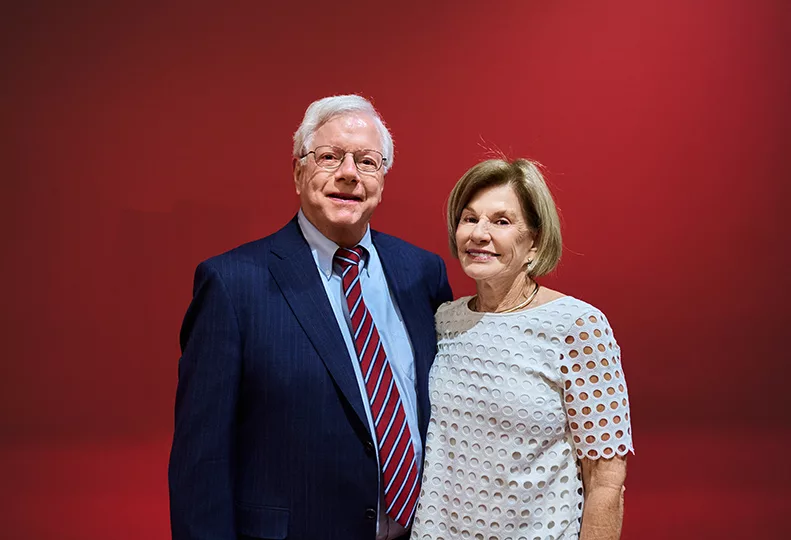
Tom and Nancy Woodley have donated $1 million to Gonzaga University to establish the Woodley Institute for Civil Engagement and Humanistic Dialogue.
| Gonzaga UniversityAs the American political climate becomes increasingly polarized and a decline in civil dialogue sows greater division across the country, Gonzaga University has been quietly working on the creation of an on-campus institution intended to serve as a regional hub for practicing civil discourse, engaged discernment, and the pursuit of the common good.
The university's vision is now possible with a $1 million gift from Tom Woodley — a 1969 Gonzaga graduate — and his wife Nancy Woodley to establish the Woodley Institute for Civil Engagement and Humanistic Dialogue.
Because of its core values as a Jesuit, humanistic university, Gonzaga is well-positioned to lead the way in modeling these practices, according to university core director and English professor Ann Ciasullo, who has overseen faculty across various humanities departments working together to create the blueprint and vision for the institute.
The institution will serve both students and the public, offering public lectures on pressing issues, featuring topics including digital engagement and conflict, support student-faculty research projects, and faculty training and mentorship, she says. The Woodleys had previously also created a scholarship fund for political science students, Ciasullo adds. Those students, referred to as Woodley Scholars, will likely play a key role within the institute through research or other projects, she says.
An exact date has not yet been set for the official launch of the institute, Ciasullo says, but she anticipates the university will hold a ceremony in the spring and the center will be in operation by the start of the 2026-2027 school year.
“Students right now are very reticent to voice their opinions because they don’t want to offend anyone,” says Ciasullo, who has been teaching for close to 30 years. “They’re sometimes scared to speak up, and then oftentimes they don’t know how to do it. We’re hoping this (institute) will reinforce the work that some of us do in the classroom, which is teaching students how to think, how to state their opinion, and how to disagree.”
A humanistic approach and Ignatian discernment are central to the values of the institution, says Ciasullo. A humanistic vision is deeply interested in what it means to be human, and why humans act the way they do, she says. Ignatian discernment is a spiritual practice that promotes active listening "within your heart and soul," and not making assumptions about what others may or may not believe.
“We want to approach the person with an open heart,” Ciasullo says. “With a kind of generosity and with a desire to truly listen to what they are saying. To really consider all sides before making a decision. Which is pretty much opposite of the social media world we live in, where everything is an immediate and, typically, angry or outraged response.”
Tom Woodley says he is grateful for his undergraduate career at Gonzaga University, which allowed him to go on to Georgetown Law, another Jesuit institution, and lead a 45-year career in Washington, D.C., focused on free speech and labor law. He says he hopes the institute will encourage students to serve in federal, state, or local government or even become political leaders who serve with integrity and trustworthiness.
“The institute is timely because, unfortunately, we’re in a day and age now where there’s so much division within our country,” says Tom Woodley. “Too many of our politicians and government leaders are engaging in vitriol and animosity, and disrespect in their rhetoric.”
Nancy Woodley, who holds a master’s degree in community health counseling and currently serves on the national and regional boards of the Ignatian Volunteer Corps, says she is pleased with Gonzaga’s faculty, who model the Ignatian values of discernment and deep listening in all the institute’s classrooms.
“We’re hoping that it will infiltrate a lot of the campus and allow for free speech,” Nancy Woodley says. “Because they have found across the board that students are a little reluctant to speak up now and be judged for their opinions. I see it as all-encompassing with faculty, staff, students, and older people, and that excites me.”
The idea for the institute began about six years ago, says Jeff Geldien, Gonzaga's assistant vice president of major and planned giving, as society continued to wrestle with heightened political discourse issues. The concept officially formed three years ago as a priority within the school's strategic plan under then-President Thayne McCulloh.
Through conversations between the university and the Woodleys over the years, it was clear that the Woodleys were interested in making an impact on society through Gonzaga students capable of critical thinking and discernment, Geldien says.
“Both of these skills are needed in order to navigate today’s complex society,” Geldien says. “Tom and Nancy made it clear they wanted to continue to help Gonzaga lead the way in building something through the Catholic-Jesuit framework that could help solve the issues surrounding discourse, speech, and how we work together and communicate through differences.”
The idea of such an institute is not new, says Ciasullo. Over the last year or so, similar centers have been popping up across college campuses while existing institutions have been activated to respond to the current social and political climate. For instance, the University of Michigan just unveiled a similar center, she says, while existing centers or concepts include the University of Arizona’s National Institute for Civil Discourse, Ohio State University’s Center for Ethics and Human Values, and the Georgetown Dialogues Initiative that launched last year, at Georgetown University.
“There’s nothing like this in the region,” Ciasullo says. “That’s part of what makes us excited about it. Maybe Gonzaga can put its stamp on this and really build this institute to become a premier institute for the region.”