Volunteers work to make Spokane dementia-friendly
Group raises awareness, connects people with resources
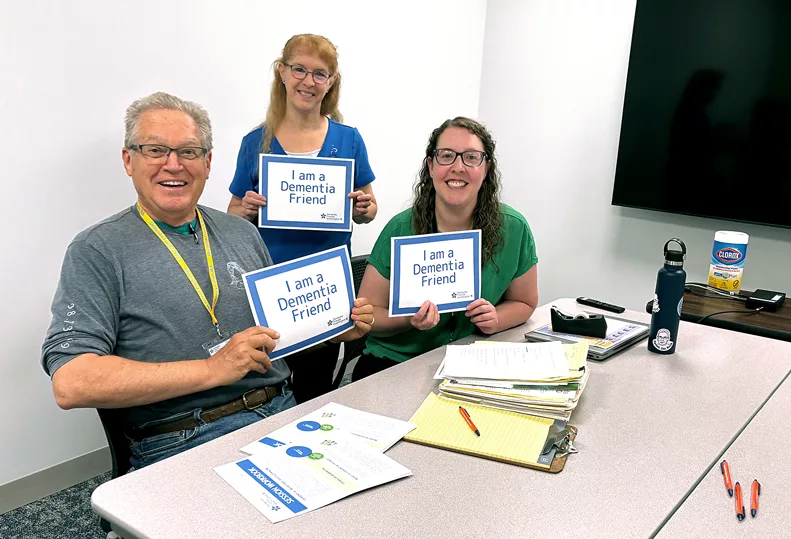
Bruce Dentler poses with fellow Dementia Friend volunteers who work on the faith committee.
| Jase PicansoBruce Dentler had just begun volunteering as a long-term care ombudsman advocating for adults in home facilities in 2018. During that time, he learned that the Alzheimer’s Association and Aging & Long Term Care of Eastern Washington were working to create a community-wide network for dementia information, training, and referrals. For Dentler, a former geriatric physician, the effort immediately resonated not only professionally, but personally.
Dentler’s mother lived with dementia for more than a decade. His father was a pastor, and faith communities were central to their family’s life. But as his mother’s dementia progressed, church became overwhelming. The noise, crowds, and difficulty remembering names caused her to slowly withdraw from attending.
“I watched my mom gradually withdraw from church life,” Dentler says. “That was such a big part of her life — my father’s life, my mother’s life. I thought, 'That's a real shame.'"
His interest in volunteering also grew out of his experience as a physician. For over 20 years, Dentler often saw families left without guidance after a dementia diagnosis.
“One of the things I heard oftentimes in my practice was families were bereft,” he says. “They didn’t know where to turn for emotional support, community resources, or guidance. There was a lack of awareness — both in the medical community and among families — about what was available and where they could go for help.”
Dentler first volunteered as the ombuds community representative for the Spokane Dementia Action Team, which later became the Spokane Regional Dementia Friendly Community. His role eventually evolved into leadership of the faith sector committee, where he helps congregations understand and support people living with dementia.
The Spokane Regional Dementia Friendly Community works to raise awareness, improve services, and connect people to resources for managing dementia — from medical and financial support to arts and cultural opportunities. The initiative is led by Aging & Long Term Care of Eastern Washington in partnership with the Alzheimer’s Association and Providence Health & Services.
“In 2020, (ALTCEW) set up what they call the Spokane Regional Dementia Friendly Community task force,” Dentler says. “About 25 people decided we would use information from earlier community forums to figure out how we could improve awareness of services available for people with dementia.”
Volunteers can bring their skills to the task force in a variety of ways. They can join a subcommittee, contribute ideas, help with administrative tasks, or train to become a Dementia Friends Champion leading hour-long sessions to raise awareness and understanding of dementia. Volunteers who are working on dementia certification for any business or organization can also help those groups earn official recognition.
Savannah Reams-Taylor, ALTCEW’s marketing and outreach coordinator, started as a volunteer on the community engagement subcommittee, helping develop the community action plan based off of earlier community forums.
“Working for an agency that's really trying to help people, and then being able to volunteer with the Dementia Friendly Community, where we have this focus that it really makes a larger impact, " says Reams-Taylor. “You know, the efforts that benefit people living with dementia are important to more than just people living with dementia; it can help with all kinds of different cognitive brain changes that people might go through or navigate.”
Behind the scenes, Tara Hill Matthews, dementia resource catalyst for Aging & Long Term Care, and Sean Jonz, program manager for the Alzheimer’s Association in Eastern Washington, meet regularly to coordinate outreach and training.
“We are besties,” Matthews says, laughing, describing the partnership between ALTCEW and the Alzheimer’s Association. “We work really closely together on a lot of dementia-related projects.”
The two organizations work hand-in-hand to coordinate programs and outreach across the community, ensuring that information and resources reach the people who need them most.
“We want to make sure we’re eliminating barriers for people to get information about Alzheimer’s and dementia,” Jonz says. “It’s great that resources exist, but if you don’t know what they are or how to access them, they don’t really help.”
ALTCEW breaks barriers by helping older adults and people with disabilities remain living safely in their homes for as long as possible. Matthews says the agency’s case management and community education programs connect families to services before they reach a crisis point.
Matthews also leads caregiver workshops and Dementia Friends sessions — hour-long programs that build understanding and empathy around dementia. The sessions are open to community members and serve as part of the training for those interested in volunteering.
“One of the biggest things volunteers tell me they gain from this work is a sense of community,” Matthews says. “It’s a really close-knit group full of passionate people working toward the same goal. And people gain knowledge too, you learn best by teaching.”
Looking ahead, organizers hope to involve more people living with dementia and their care partners.
“It’s important to us to follow the rule of thumb: nothing about us without us,” Matthews says. With the number of people living with dementia expected to double by 2060, she adds, “It’s up to all of us to understand dementia and support those affected no matter what sector we’re in.”
For many volunteers, that shared mission is the real connection point — and what keeps them coming back.
Stay Informed. It’s Free.
Subscribe to our newsletters and get the latest news and insights delivered to your inbox.
We respect your privacy.
Unsubscribe anytime.
Thank you!
You’re subscribed. Keep an eye on your inbox for the latest updates.