
Sponsored Content ...
Cross-Laminated Timber Applications for Every Project
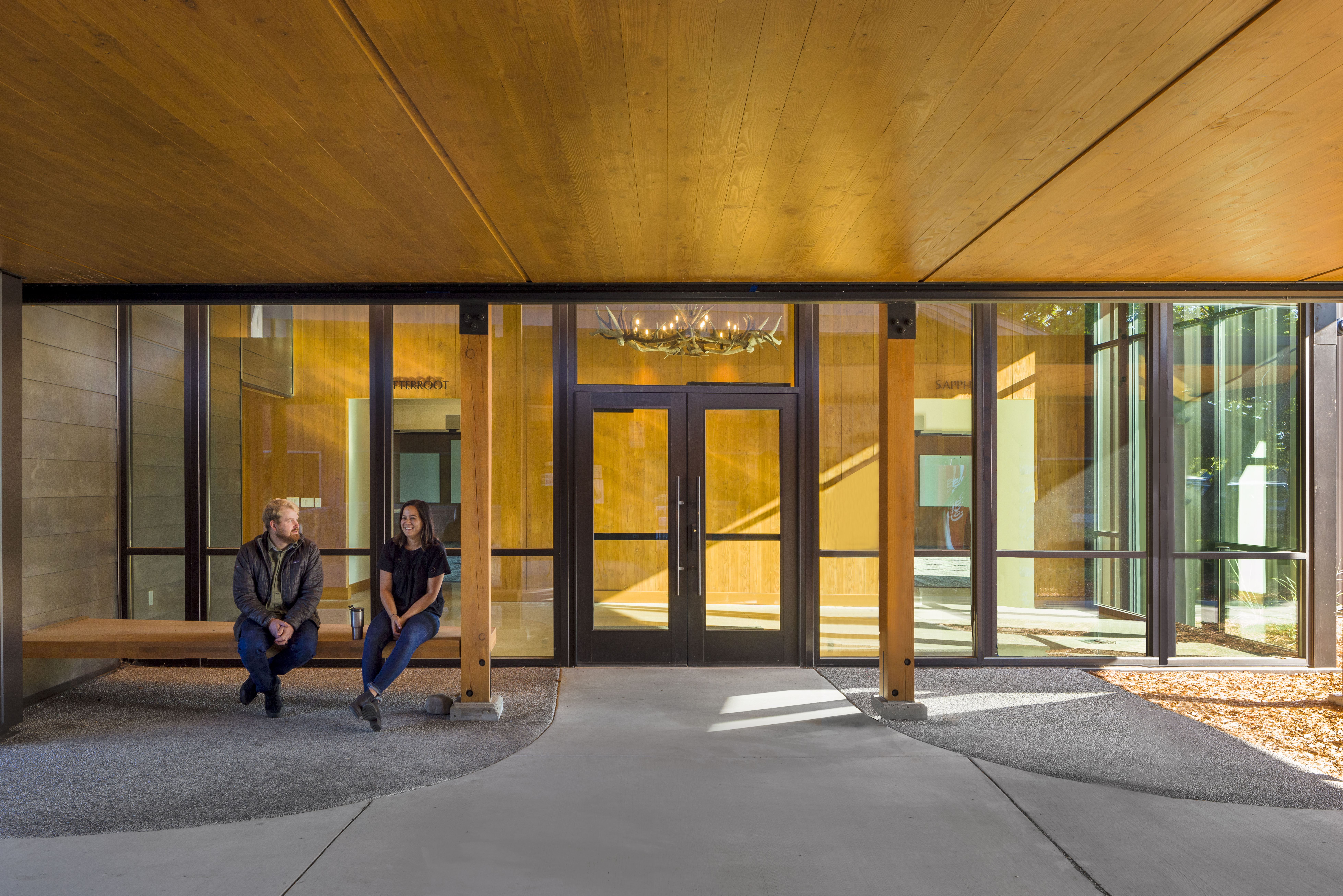
If you’re considering using CLT in your next project, discuss it with your engineering team early in the planning process to determine if it aligns with your goals and project constraints.
Cross-laminated timber (CLT) is gaining increased use among architects and engineers due to its numerous structural applications in various building projects. While CLT panels are typically used for horizontal elements, such as roofs and floors, they are becoming increasingly common for vertical elements, including walls and cores.
In other words, there are CLT applications for almost every project in the built environment.
CLT falls under the umbrella of mass timber, a category that also includes other panelized products such as mass plywood, as well as linear systems like nail-laminated timber (NLT) and dowel-laminated timber (DLT). While these products share similarities, CLT construction is distinctly different. In CLT, fabricators assemble wooden planks into rectangular panels consisting of several layers of dimensioned solid-sawn lumber or structural-composite lumber boards. These boards are stacked orthogonally in an alternating orientation and glued together on their broad faces. This orthogonal layering allows CLT to span bi-directionally within the plane—properties that make it one of the most versatile of the mass timber panel products.
Where Can You Use CLT?
CLT can benefit structural applications in several ways. The following chart provides some ideas that might work well in your next project.
Floors. Floor panels are the most common use of CLT. Typical configurations consist of post-and-beam construction for single-span systems or post-and-panel construction where the panels span in two directions and are supported directly on posts. Floor systems often incorporate a thin concrete topping slab.
Roofs. CLT roof panels are installed in the same manner as floor panels. Since CLT comes in large panels, a roof can be installed to enclose the structure from inclement weather in a short amount of time. CLT roof panels can also form two orthogonal, cantilevered overhangs for soffits without the need for additional reinforcing. Panels can also span up to 40 feet, which is a significant benefit in low-snow-load regions.
Walls. CLT panels are also excellent solutions for both non-load bearing and load-bearing walls. Due to the dimensional stability of the alternating layers of wood, CLT can achieve long spans with relatively thin and lightweight panels. For exterior walls, the panels can contribute to the insulation within the building envelope.
Shear Walls and Diaphragms. CLT is increasingly used in structural shear wall and diaphragm applications due to its high in-plane strength and stiffness, which enable efficient resistance to lateral loads from wind and seismic events. In shear wall systems, CLT panels act as large, rigid elements that transfer forces through panel (or rocking) action and ductile connections, providing predictable and reliable performance.
As floor and roof diaphragms, CLT panels distribute lateral loads to vertical resisting elements while maintaining dimensional stability and reducing deflection at the same time. These characteristics, coupled with fast on-site assembly, make CLT a competitive alternative to traditional concrete and steel systems.
Cores and Shafts. CLT cores and shafts are quickly erected, providing both load-bearing support and being part of the lateral force-resisting system. Both elevator and stair shafts can also have two-hour fire resistance ratings without needing additional drywall or shaft liner systems.
Plan Early
Though there are several applications and benefits to CLT, it is not the only solution for every building. However, if you are considering using it in your next project, discuss it with your engineering team early in the project cycle to determine whether CLT aligns with your goals and constraints.
We would love to know how you’ve incorporated CLT into your projects. We’re currently using CLT for a variety of applications and are always happy to share our ideas and hear about your project plans.
This article provided by the Morrison-Maierle Structural Staff. Learn more about the company at www.m-m.net.
_web.webp?t=1786611739)
_web.webp?t=1785394978)
_web.webp?t=1786604468)
_web.webp?t=1786604468)