Post Falls manufacturer snags Air Force contract
ATC to upscale components for aerospace, defense uses
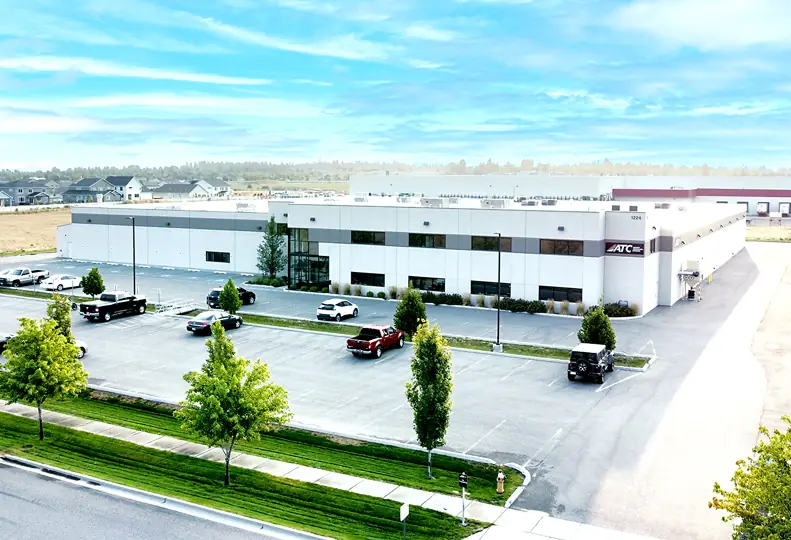
ATC Manufacturing's 67,000-square-foot facility at 1224 N. Lean, in Post Falls, was purpose-built for the company in 2015.
| ATC Manufacturing Inc.ATC Manufacturing Inc., a trade name of Post Falls-based Advanced Thermoplastic Composites Inc., will seek to prove that thermoplastic composite components can be scaled up in size for aerospace and defense uses after being awarded a nearly $7 million contract by the Air Force Research Laboratory in March.
The $6.7 million contract, for a program titled Thermoplastic Composites for Large High-Rate Aircraft Structures, is a research and development collaboration between thermoplastic components manufacturer ATC; defense technology company Anduril Industries Inc., of California; and advanced composite materials supplier Toray Advanced Composites USA Inc., of California; says Brian Shanahan, research and development program manager at ATC.
“The goal is to demonstrate large stamp formed continuous fiber thermoplastic composites for next generation Air Force and defense aircraft,” Shanahan says. “The scope (of the contract) includes work such as material testing, material qualification, subscale prototyping, and then eventually demonstrating the full-scale structures for (Air Force Research Labratory).”
The Air Force Research Laboratory is the U.S. Department of the Air Force’s primary scientific research and development center, according to the laboratory’s website. ATC started the proposal contracting process last spring, Shanahan says.
He declines to disclose specific terms of the contract.
Thermoplastic composites are manufactured using high temperatures and pressures to stamp form sheets of raw material into three-dimensional parts, Shanahan says. These composites are lighter and often stronger than metal analogues and can be manufactured significantly faster.
The parts can be re-pressed and recycled — saving companies money — and are resistant to corrosion, he says.
ATC currently manufactures smaller thermoplastic composite components, such as brackets, clips, and beams for aerospace and defense industry clients nationwide. Very few facilities in the nation have the capacity to produce parts larger than a person’s arm, he asserts.
The company will begin operating a new, larger hydraulic press system in the first half of 2027.
“The contract enables use of the large-format hydraulic press system that’s engineered specifically for our materials and stamp forming these high-rate thermoplastic composites,” explains Shanahan. “It'll have approximately a 10-foot-by-5-foot part envelope, which is significantly larger than most thermoplastic presses in the U.S., and opens a new avenue for ATC and our customers to enable high-rate production of larger parts.”
These larger parts would be used as primary structure components, including load-bearing pieces of an aircraft such as the internal structure of a wing or the skeleton of a fuselage. Thermoplastic composite components can replace metallic parts currently used.
“We know the materials are proven, and we know the processes are proven — ATC is very capable,” he contends. “This whole contract is about stepping up in size. Our goal, with our partners and with the Air Force, is to go bigger.”
Shanahan declines to disclose specifically how ATC, Anduril, and Toray will work together. Anduril Industries develops advanced autonomous systems and contracts with the U.S. military, and Toray Advanced Composites supplies high-performance materials, including thermoplastic composites, to aerospace and other industries, according to the companies’ websites.
“We’re delivering demonstrators to the Air Force, so as an (original equipment manufacturer), Anduril can provide guidance to make those demonstrators relevant,” Shanahan says.
ATC was founded in 2004 and has 90 employees at the company’s 67,000-square-foot, purpose-built headquarters and manufacturing facility at 1224 N. Lean, in Post Falls. The facility is ATC’s only location, Shanahan says.
The manufacturing company will hire several employees to fill engineering and engineering technician roles to support the scope of work ATC owes the Air Force Research Laboratory in the short term. Producing larger parts for clients in the future will require a manufacturing expansion, at which point ATC plans to add significantly more roles across the company.
“Short-term, (the expansion) will be engineering-focused. Later on, a production expansion would impact roles in any department of the business,” he says.
Shanahan declines to disclose how much revenue the company earned in 2025, but says revenue is trending up as demand for ATC’s parts grows.
ATC is a partner manufacturer of the American Aerospace Materials Manufacturing Center Tech Hub, a Spokane-Coeur d'Alene manufacturing consortium seeking to build a national test bed for next-generation aerospace prototypes in the region, the Journal previously reported.
In a bid for federal funding through the U.S. Department of Commerce, the consortium had previously proposed to bring the world’s largest composites press to their 386,000-square-foot former Triumph Composite Systems Inc. building, at 1514 S. Flint in Airway Heights.
However, ATC’s awarded contract, work with the Air Force on the thermoplastics program, and the new hydraulic press are separate from the consortium’s funding and test bed efforts, Shanahan says.
The consortium’s director, Patrick McHail, didn’t respond to the Journal’s requests for comment.
“We stamp form thermoplastic composites every day, so we know the material, and we know the processes,” Shanahan adds. “This is all about going bigger.”

Stay Informed. It’s Free.
Subscribe to our newsletters and get the latest news and insights delivered to your inbox.
We respect your privacy.
Unsubscribe anytime.
Thank you!
You’re subscribed. Keep an eye on your inbox for the latest updates.