Historic wealth transfer boosts probate work here
Spokane-area estate planning attorneys are in strong demand
Probate work is rapidly increasing at some Spokane-area estate planning law firms as attorneys begin to see the effects of the nation’s historic transfer of wealth from baby boomers to their heirs.
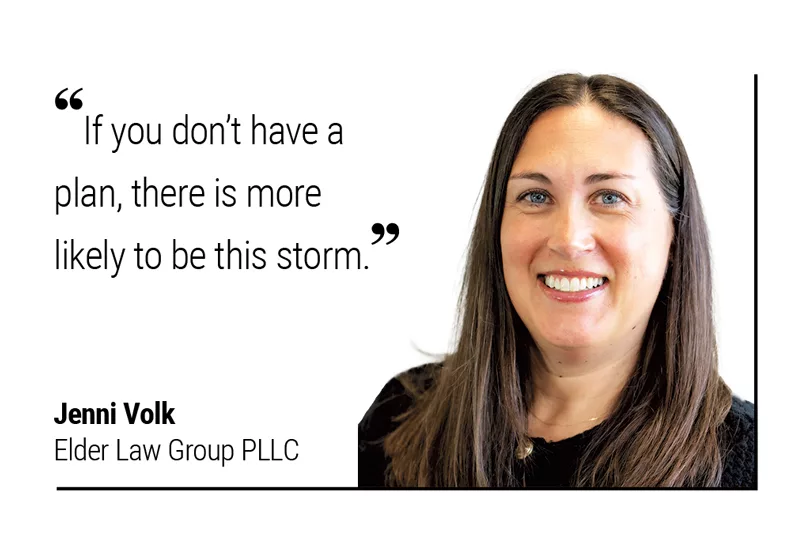
Spokane-based Elder Law Group PLLC, which does business as ELG Estate Planning, has experienced a 50% increase in probate work across its three offices over the past two years, says attorney Jenni Volk.
Matthew Luedke, owner and managing attorney at Spokane Valley-based Elevated Estate Planning PS, says probate work has more than doubled in the past two years, leading him to hire more staff to keep up with demand.
Probate is the legal, court-supervised process following the death of someone that involves the validation and administration of their will. Both Luedke and Volk attribute the increase in probate work to an aging population that is reaching end-of-life planning, and families who are beginning to transfer homes, bank accounts, and other assets to their heirs.
“This is quite frankly the early stage of this,” Luedke says.
Baby boomers — people born between 1946 and 1964 — control more than half of U.S. household wealth, an estimated $78 trillion, according to the American Bar Association Probate & Property Journal. The demographic's average life expectancy is climbing past 78 while the group simultaneously holds unprecedented financial resources as they enter their later years. Over the next decade, the report says that as mortality rates for baby boomers rise and their estates transition to their beneficiaries, the courts will be flooded in a "probate storm" of contested inheritance disputes.
Both Luedke and Volk agree on several factors that can increase the likelihood of disputes when estates are being administered. The rise of complex family structures, such as second marriages, blended families, and gray marriages, where at least one spouse is aged 50 or older, are catalysts for estate disputes if plans aren’t clearly documented, Volk says.
“There’s definitely more complicated scenarios in the world of estate planning,” Volk says. “I think because of that, if you don’t have a plan, there is more likely to be this storm.”
Complex family structures often create a lack of clarity, which can lead to disputes.
Luedke says he frequently hears about later-in-life marriages, known as gray marriages. When one spouse dies and leaves their assets to their partner, the surviving partner is not obligated to distribute assets to any surviving children from a previous marriage. In some cases, the surviving spouse will pass assets to their own children, excluding their deceased partner's heirs, he says. In blended family scenarios, Luedke says stepchildren sometimes grow resentful of a stepparents' ownership of real estate that was established as family property before the new marriage began.
“For me, estate planning is purely about one thing, and that’s clarity,” Luedke says. “After you die, you can’t add any more clarity; you have to provide all of it upfront.”
Probate disputes also can arise in the form of undue influence and lack of capacity. For example, if an aging parent moves in with their adult child who provides years of care for the parent before they pass away, there can be a presumption that if the child receives a larger share of the inheritance, that the larger share was induced by that relationship, he says.
“That because they were providing care for them, they kind of had them under their thumb, so they could influence them,” Luedke explains. “That’s a good presumption, but it's also not very realistic.”
Lack of capacity cases are more difficult to prove because the bar for proving capacity within trusts and wills is low, Luedke says. A person simply needs to know who they are, what assets they own, and who the assets will be left to, with an attorney acting as the witness, he explains. In scenarios when a person isn't showing much capacity, a physician or psychiatrist is needed to evaluate the person’s state of mind.
The popularity of artificial intelligence and do-it-yourself wills are also compounding issues and confusion. DIY wills from an online platform may seem easy, but are usually not properly executed or in compliance with Washington state law, Volk says.
“Most of the time, it’s not properly signed, witnessed, notarized, or whatever it needs to be in that particular situation,” Volk explains.
Additionally, a DIY will might not have the planning tools that estate planners use in Washington state to avoid estate taxes and other levies, she says. For example, when someone dies with $3 million or more in assets, their estate is subject to a tax. An estate planner can help reduce or avoid taxes, she says.
“They’re losing money,” she says. “They’re not taking advantage of the laws that would help protect them.”
Luedke notes a growing trend of individuals reaching out with estate planning ideas generated by AI chatbots that are inappropriate for their specific needs. He specifically points to people requesting a Wyoming LLC — a legal structure designed for surgeons to guard against malpractice lawsuits — despite these individuals not having a high-risk profession or relevant assets.
"What they are doing is they are doing quote-unquote research on (ChatGPT) and it's providing them with things that sound really good," Luedke says. "Unfortunately, I actually have a harder time convincing them that what they are reading on ChatGPT is wrong. In part, unfortunately, because people are too comfortable with the hallucinations that they're being fed."
As the demographic continues to transition, both Volk and Luedke agree that the best way to avoid probate, or probate litigation, is to have a concrete plan.
Elevated Estate Planning has found that the average probate case filed in Spokane County in early 2024 cost $8,000 and lasted over 600 days. Many cases filed then are still active today, Luedke says.
While probate is sometimes unavoidable, estate planning tools, trusts, powers of attorney, and beneficiary designations can help families transfer assets more efficiently and reduce the likelihood of disputes, both Volk and Luedke contend.
Estate planning is also evolving to reflect changing priorities, Volk says. In addition to wills and trusts, many clients are asking about planning for pets, health care decisions, and long-term care needs.
“You have to do all of these while you’re healthy,” Volk says.
As the largest intergenerational transfer of wealth in U.S. history continues to unfold, Volk and Luedke both say the best way to avoid probate complications is to clearly document intentions before questions about capacity, inheritance, and family dynamics arise.


Stay Informed. It’s Free.
Subscribe to our newsletters and get the latest news and insights delivered to your inbox.
We respect your privacy.
Unsubscribe anytime.
Thank you!
You’re subscribed. Keep an eye on your inbox for the latest updates.