Sleepless nights inspire Spokane invention
Engineer develops sleep aid, gains sales traction in market
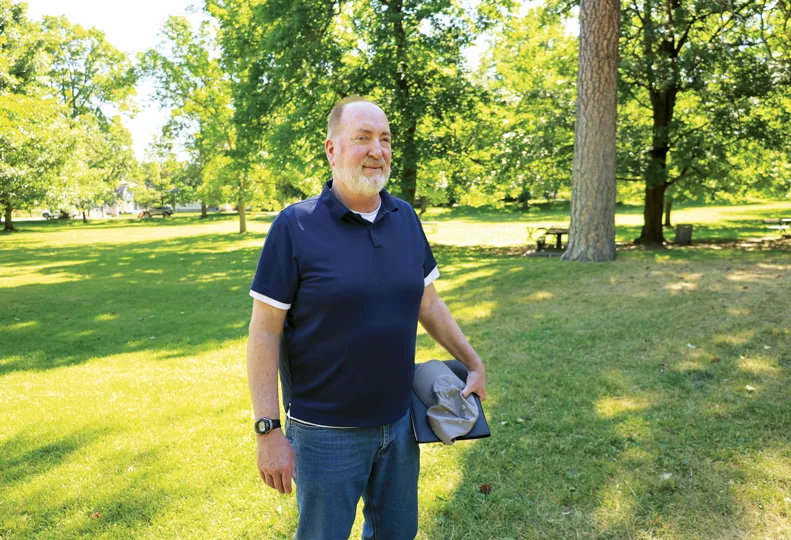
Spokane inventor James Marsh says sales of his sleep aid device, SleepVibe, are gaining momentum since the product went to market in 2024.
| Karina EliasSleepVibe Inc. has increased sales of its sleep aid device by more than 300% over the past year through podcast advertisements and support from sleep apnea doctors and first responders across the Inland Northwest who are discovering the benefits of the company’s namesake invention, says CEO and founder James Marsh.
The SleepVibe sleep aid is a lightweight and silent device the size of a deck of cards that combines binaural beats with a low-power magnetic field that Marsh says is designed to promote a deeper sleep experience. To operate the device, it must be connected to a power source and positioned no further than 18 inches from the user's head. It can be used by two people at the same time, he adds.
Binaural beats are an auditory phenomenon that occurs when two acoustic signals of different frequencies are played simultaneously to each ear. The brain takes the difference of those tones and perceives a third tone or beat, Marsh explains. Brain activity then syncs to the third, lower, beat, and depending on the level of that frequency, can promote deep sleep, meditation, creativity, and other benefits, he says.
There are decades of research suggesting that binaural beats have therapeutic effects, he says, adding that binaural beats show potential benefits for sleep, anxiety, and mood.
The company is operated remotely by Marsh, two part-time marketing staff, and a part-time operations manager.
Since taking SleepVibe to market in 2024, the device has generated positive feedback from sleep-deprived customers across various sectors, who report deeper sleep, vivid dreams that are remembered throughout the day, and fewer nighttime awakenings, Marsh says. One customer told Marsh it stopped her husband from “snoring like a chainsaw," he says. Another client, who travels around the world, says it has significantly reduced her jet lag.
The sleep aid is sold online for $389 and includes a 30-day money-back guarantee. The return rate is less than 5%, Marsh claims. The device has completed safety testing through an independent lab that follows U.S. Food and Drug Administration standards, and is manufactured at a Spokane Valley-based company, he explains.
To further grow sales, Marsh is focusing on professionals with unpredictable schedules, such as military members and firefighters, who must frequently interrupt their rest for nighttime emergencies and then face the challenge of falling back asleep.
Marsh declines to disclose the Spokane-based startup's revenue, but says he expects to increase sales again by 300% over the next six to 12 months.
The patent-pending technology is being evaluated in sleep studies by second-shift nurses through Washington State University’s Sleep and Performance Research Center, Marsh says. The two-month clinical study observes participants' sleep without the device for one month, then observes their sleep progress using the device the following month, he says.
Preliminary study findings include reports of increased deep sleep, reduced nighttime awakenings, and improved sleep continuity, he says. The study, which began late last year, is expected to wrap up in August, at which point the accumulated data from all of the participating groups will be analyzed.
SleepVibe’s origins trace back to 2020, when Marsh and his wife, Athena “Teena” Tainio, were sleeping only one to three hours a night. Tainio, the former president and CEO of Tainio Biologicals Inc., an agricultural biotech manufacturing company in Cheney, had first begun experiencing symptoms of fatigue in 2017. While the couple consulted many physicians over the years, they were unable to give Tainio a firm diagnosis, referring to her condition broadly as a debilitating neurological disorder, Marsh says.
With caregivers unavailable during the pandemic, Marsh became Tainio’s full-time caregiver and stayed awake out of fear she might fall as she walked around their home in the middle of the night, unable to rest. The couple tried different sleeping aids, including medication and binaural beat sound files on YouTube and Spotify, without success.
After hearing how a friend’s serious alcohol addiction was successfully addressed through transcranial magnetic stimulation therapy, Marsh explored the potential of magnetic fields. Transcranial magnetic stimulation involves a noninvasive procedure that uses magnetic pulses to stimulate nerve cells in the brain. The therapy is used to treat certain addictions, anxiety, depression, obsessive-compulsive disorder, and other mental health conditions.
Seeing how his friend had benefited from the treatment, Marsh decided to build a device that combined a low-power magnetic field with binaural beats.
“I was so sleep-deprived, it was instinct,” Marsh says about his idea to pair a magnetic field to binaural beats.
Later, Tainio started receiving assistance through a caretaker, allowing Marsh time to develop a prototype. He eventually settled on using a low-frequency magnetic field inspired by the Schumann resonance, a naturally occurring electromagnetic phenomenon generated by lightning activity around the Earth.
“It echoes in the atmosphere and forms this resonant frequency around 9 hertz,” Marsh explains. “That’s just a magnetic field that Earth is bathed in.”
A test of the prototype on himself resulted in nine hours of consecutive sleep without waking or moving, he claims. Marsh followed the test with the creation of more prototypes for use among his friends, who all reported better sleep. Many didn’t want to return the device, he adds.
“They said it’s the best sleep they had in decades,” Marsh says. “I thought, “OK, maybe I got something.”
Tainio, whom he had created SleepVibe for, began to use the device, which allowed her to sleep more deeply and longer throughout the night.
Marsh formally established SleepVibe the year following Tainio's death in 2022. Commercial sales began in 2024.
As the WSU sleep study concludes this summer, the company is planning to seek new avenues for growth, Marsh says, adding that he's driven by SleepVibe’s potential to help others.
“That’s really what keeps me going,” Marsh says. “Sleep is so critical, and it just changes people’s lives.”