
Providence reorganizes behavioral health staffing
Meeting the needs of shifting population prompts restructuring
As behavioral health patients at Providence Sacred Heart Medical Center age and their medical needs grow more complex, the hospital is redesigning its staffing strategy for inpatient psychiatric services, says Tamara Sheehan, senior director of behavioral health services for the Inland Northwest region at Providence .
Beginning July 14, Providence will transition dozens of positions across its psychiatric triage team, adult geropsychiatric unit, and psychiatric emergency department to a new care model that replaces mental health counselors with certified nursing assistants and replaces psychiatric triage workers with licensed therapists. The changes are designed to better align workers’ training with patients who are older and increasingly more medically fragile, have more co-occurring medical conditions, and need more hands-on assistance with daily activities, Sheehan says.
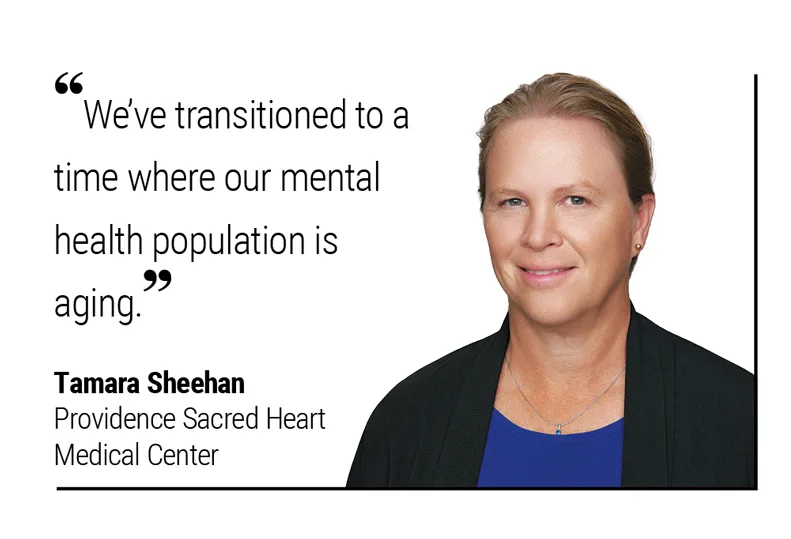
“We’ve transitioned to a time where our mental health population is aging, and we needed to move to a more medical model than we had before,” Sheehan says.
Under the new model, Providence’s psychiatric triage team, which evaluates patients arriving at the adult and pediatric emergency departments for behavioral health needs, will be staffed by 14 licensed therapists rather than psychiatric triage counselors.
Meanwhile, mental health counselors working in the adult geropsychiatric unit and psychiatric emergency department will be replaced with 28 certified nursing assistants who have specialized behavioral health training. The transition will affect 42 positions in total, but staffing levels will remain unchanged, says Allie Hyams, chief communication officer at Providence.
The hospital diagnoses and treats conditions including anxiety, attention-deficit/hyperactivity disorder, autism, bipolar disorder, depression, hallucinations, schizophrenia, and suicidal thoughts and attempts.
Providence provides more than 1,200 emergency behavioral health assessments annually, while the adult geropsychiatric unit — an area of medicine that focuses on the prevention, evaluation, diagnosis, and treatment of mental and emotional disorders in older adults –– has over 400 admissions annually, Sheehan says. The geropsychiatric department at Providence admits and treats patients 18 years and older.
According to the World Health Organization, the demographic of mental health patients is shifting older. Loneliness and social isolation are key risk factors for mental health conditions later in life, with 14% of adults 70 years and older who are living with a mental health condition. In the U.S., the number of older adults with mental health disorders is expected to double by the year 2030, reports the National Council on Aging.
The hospital began reevaluating its care model after noticing the changing needs of many patients seeking treatment. Compared to five or 10 years ago, many patients treated in the hospitals’ behavioral health units were younger and had fewer co-occurring medical conditions, she says. Today, many of the patients receiving behavioral health treatment require assistance with toileting, mobility, fall prevention, and other hands-on care.
While currently, Providence's care model incorporates mental health counselors, the term can be misleading. Mental health counselors — which are registered through the Washington State Department of Health — only provide redirection for patients, but not mental health therapy, Sheehan explains. Mental health counselors can redirect patients, encourage them back to their rooms, and observe escalating behaviors that could disrupt the common area, she says. The new model of care features licensed therapists, who are master’s level clinicians who can conduct assessments, provide psychotherapy, teach coping skills, develop individualized care plans, lead group therapy, and provide education, she says.
“We upgraded the program in two different ways,” she explains. “One, is providing what is necessary to adequately care for those patients from a safety and needs perspective, but then also be able to provide more intense individualized and group therapy skills and some psychoeducation.”
Hyams adds that the new care model will also include treatment and assessment of pediatric patients. The psychiatric triage team serves both the pediatric and adult emergency departments; moving forward, personnel providing behavioral health assessments will be licensed therapists, she says.
The current pediatric psychiatric center at Providence Sacred Heart Children’s Hospital offers two separate day treatment programs focused on emotional and behavioral health.
The hospital's behavioral health care model changes follow the closure of Providence's Psychiatric Center for Children and Adolescents in September 2024. The facility first opened in 1984 to provide treatment to children 12 to 17 years old requiring inpatient hospitalization. The closure was attributed to a nationwide shortage of inpatient mental health professionals, according to the Washington State Nurses Association.