Universities support AI-powered automation
U of I, NIC programs help manufacturing companies implement new technology
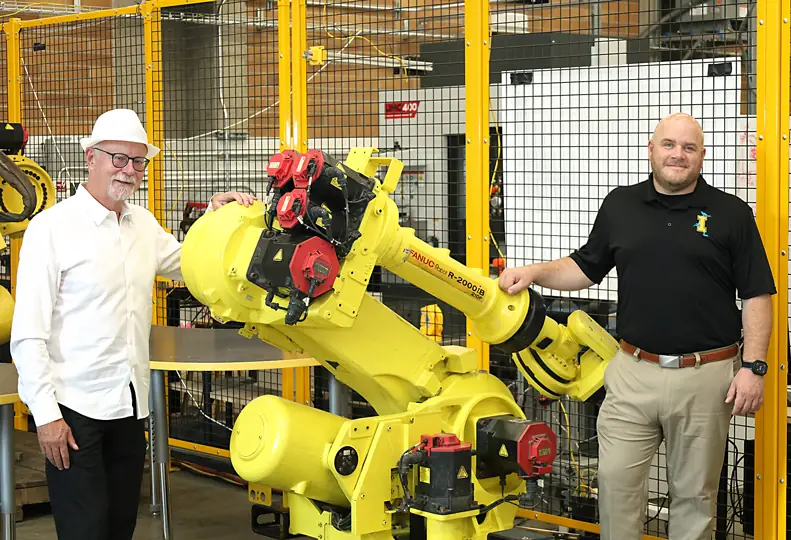
John Shovic, left, and Kevin Wing combine AI programming and machine vision systems with robotic arms to better automate manufacturing assembly lines.
| Ethan PackManufacturing companies here are using artificial intelligence hardware and software to increase automation efficiency and higher education institutions in North Idaho are partnering with businesses to keep the momentum going, says John Shovic, director of the University of Idaho’s Center for Intelligent Industrial Robotics on the North Idaho College campus, in Coeur d’Alene.
The Center for Intelligent Industrial Robotics works with North Idaho College’s Industrial Robotics and Automation program to train engineers through master's- and doctorate-level projects conducted on behalf of regional manufacturing companies, Shovic explains. Students involved in the two programs are helping regional manufacturers bring and expand artificial intelligence to assembly lines.
For some Inland Northwest manufacturers, AI already is helping support data analysis and optimization, versatile AI-enabled robot arms on assembly lines, and cameras that allow machines to recognize defective products, says Shovic.
“This whole manufacturing revolution isn't an AI manufacturing revolution, but it’s an AI and automation manufacturing revolution,” he says. “AI is part of it, but automation is the other part of it, and there's a lot of synergy between those two.”
Regional companies including Liberty Lake-based Altek Inc.; Pullman, Washington-based Schweitzer Engineering Laboratories Inc.; H&H Molds Inc., of Spokane Valley; Coeur d’Alene-based Idaho Forest Group LLC; in addition to Metal Rollforming Systems Inc. and Inland Empire Paper Co., both of Spokane, contract with the schools' programs to solve assembly line and automation challenges using AI, he says. Additionally, the Solstice Advanced Materials Inc. plant in Spokane Valley, is expanding AI tools in the assembly line, he says.
AI can be applied to manufacturing in two main areas of focus, Shovic explains: data collection and analysis software to find and solve inefficiency in existing systems, and physical AI, such as machine tenders. Machine tenders are AI-powered robots that communicate with each other, can see and recognize what’s in front of them, and can be used to operate computer numerical control machines or other machines in an automated assembly line in a similar manner as a human worker.
While automated assembly lines already exist in the manufacturing industry, AI-powered machines and tools are smarter, more versatile, and can more effectively produce results with fewer errors and human intervention than standard tools, Shovic contends.
Machine-tending robots are likely to replace assembly line jobs that are dirty, dull, or dangerous, allowing for workers to be retrained to do other tasks, he says.
AI tools have doubled factory productivity at some companies, such as H&H Molds, which contracted with students from University of Idaho’s Center for Intelligent Industrial Robotics at the beginning of 2025 to install machine vision systems, which gives robots on an assembly line the ability to recognize manufacturing errors and correct them. H&H Molds didn't immediately respond to the Journal's request for comment.
Aerospace, medical, and technology manufacturer Altek Inc. contracts with University of Idaho’s robotics program for the development of a robotic arm to assist with a portion of the manufacturing process, says Mike Marzetta, president of Altek Inc.
The manufacturing company uses a similar machine vision system as H&H Molds, having previously developed a tool that uses AI to check the company’s manufactured rubber parts visually for flaws and defects, says Marzetta. Additionally, the company is experimenting with AI-powered computer-aided design and prototyping software, but hasn’t yet found a tool that functions well enough to commit to, he notes.
An AI tool that can create a program to operate a computer-aided design machine and create a prototype part, for instance, needs to successfully operate consistently to build trust with the tool, Marzetta explains.
“For me, the AI needs to be capable of making autonomous decisions so you've got enough confidence in it,” he says. “At this stage of its development, you need an expert to go through the output. It’s not like jumping behind the wheel of a self-driving car and telling it to take you downtown to Davenport Hotel.”
Despite an interest in using the technology to improve efficiencies, Altek will still rely on humans to double check any design program the tool produces in the future, he adds.
University of Idaho students are also working on a project at a log processing line operated by Idaho Forest Group. The project uses AI in data collection, processing, and in machine vision systems to improve efficiency at one of the company’s wooden log processing lines in Chilco, Idaho, just north of Hayden, says Marie Price, director of learning and development at Idaho Forest Group.
Wooden logs enter a line at 35 mph, where they’re analyzed by AI and then cut automatically to maximize the profitability of each log. AI software collects about 800,000 data points a month to determine where and why the line rejects some logs, after which Idaho Forest Group can optimize the system to reject as few logs as possible and keep the machine moving, says Shovic of the project.
A contract with the university costs an average of $250,000, Shovic says. In these cases, the companies are typically receiving a return on their investment within a year, he contends.
Manufacturers that want to start involving AI tools in their automation process should start with data collection, says Kevin Wing, a Ph.D. student in University of Idaho’s industrial robotics program.
“You have to have data, because otherwise AI is no good. If data collection’s not already in place, that's step one,” says Wing. “If you already are collecting data, I would pick one of those dull, dirty, or dangerous jobs, like inserting one part into another part over and over and over again, (automate it), and then grow from there.”

Stay Informed. It’s Free.
Subscribe to our newsletters and get the latest news and insights delivered to your inbox.
We respect your privacy.
Unsubscribe anytime.
Thank you!
You’re subscribed. Keep an eye on your inbox for the latest updates.