
Meet & Greet with Kevin Williams
Spokane Workforce Council CEO
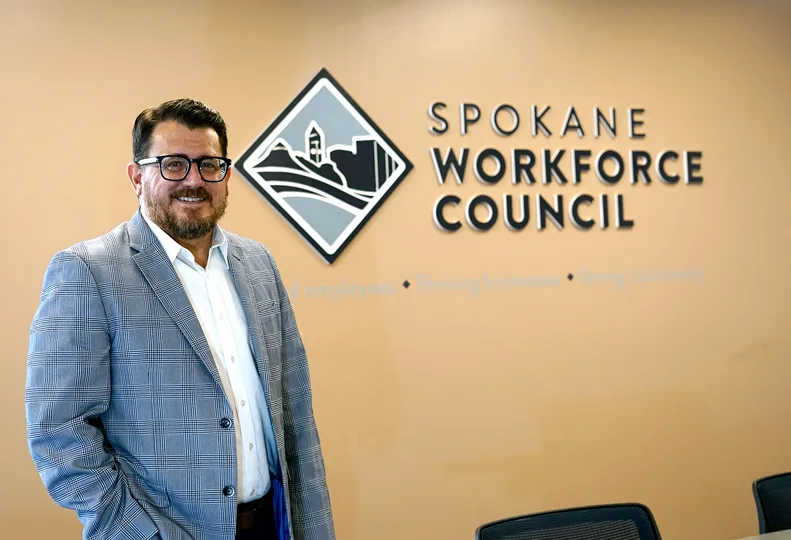
Kevin Williams took over as CEO of Spokane Workforce Council in May.
| Matt StephensKevin Williams stepped into his new role as CEO of the Spokane Workforce Council in May.
Williams joined the Spokane Workforce Council in 2022 and has been in the workforce development field for a decade. He previously spent over 23 years in the U.S. Air Force. Williams finished his military service as superintendent of the 92nd Aerospace Medicine Squadron at Fairchild Air Force Base.
What role does the Spokane Workforce Council play in Spokane County?
We have the unique role being the connector between the business community, between economic development organizations, between job seekers, and between our education and training providers.
The Spokane Workforce Council's charge and their board's charge is ultimately to make sure that we're bringing those together, so that we can continue to develop economic vitality here for Spokane County.
I think a lot of people view workforce development and maybe our organization as simply getting people into jobs, but it's far broader than that; it's trying to develop and create that ecosystem so that we understand the needs of the employers, the skills that they are looking for with job seekers, and then be able to relay that information with the jobseekers that we engage with.
How would you describe the workforce here?
I think there's lots of positives.
One of the best words I can think of for Spokane County, through multiple changes that have happened over the last 10 years that I've been in workforce development, is how resilient the Spokane economy is. It's got a lot to do with the fact that we're very diverse in our different types of industries that we have here.
But I would be remiss not to say that although we're resilient and there's lots of positives, we are obviously under some pressure in certain areas as well.
Like I said, that diversified economy is one of our strongest areas. When you're trying to attract talent, it's not just focused on one specific industry here in Spokane. There's some that stand out, but certainly you can get into multiple industries when you're in Spokane County.
We're a major healthcare hub here, as you can imagine, with a lot of big healthcare employers in the area, both very large and then smaller.
Our healthcare and social assistance footprint is really large. That is the sector that's added the most jobs over the last year; about 1,200 jobs here in Spokane County. Where everyone else may have flatlined a little bit or not seen as much of a jump, it continues to grow.
We have great educational institutions, medical schools, and the healthcare system here in Spokane in itself has been very innovative and created its own programs within their halls to continue to upskill their individuals so that they can continue to grow.
We’re also strong in manufacturing, aerospace, logistics, professional services, and then education, and life sciences have done well here as well.
Retail has struggled a little bit. We still think that retail and hospitality are definitely cornerstones, but we've seen a reduction.
Financial services has been an interesting one. In the banking industry, you could say the technology has changed a few things there as well, and so less and less opportunities within the financial service industry.
Construction is such a tough one to hear, as it is in any place that has pseudo-harsh winters, because it ebbs and flows based on that, and of course with the housing crunch when it comes from building that, and then infrastructure for office buildings has decreased as well. All of that has had an effect on the construction industry.
What are some of the greater workforce challenges facing Spokane County right now?
As we're talking to employers on a regular basis, it seems that the skills that they're looking for are sometimes not what the job seekers that are applying for the jobs have, and so, what do we have to do to mesh those together and to ensure that that skills gap is taken care of?
Totally understandable that there might be a skills gap, but it seems that gap continues to grow, and we need to work really hard on ensuring that it doesn't, and that we close it up just a little bit.
Talent attraction and attention. First of all, Spokane County has competition elsewhere. We're a border state, so we have competition from that. We have competition from the West Side. We have competition from below us.
There was a time when you could say, "Hey, we're far less expensive than other areas.” That's caught up with us just a little bit from the housing market to other things.
I still firmly believe Spokane has its attraction piece, and the type of employers that we have here are great employers, but it's something that we need to continue to work on to make sure it doesn't become a challenge that we can't overcome.
Access to opportunity is another one. I hear a lot of, “There's nobody out there; there's no talent out there.” That's an inaccurate statement.
It's not as simple as saying there's this many workers and there's this many jobs, and why can't they connect?
What is prohibiting these individuals from being able to be an employee for organizations? We need to reduce those barriers from accessibility, for example for individuals who've been justice impacted, individuals who see a job ad and may not apply for that job because it says you need six to eight years of experience. Let's be realistic about that.
What are some of your hopes and goals for the Spokane Workforce Council under your leadership?
I'm very optimistic, but I'm also a realist and understand where we're going to go isn't going to happen all by itself.
I don't want us to just be seen as an organization that has workforce development programs and manages those workforce development programs. Sure, we do that, and we do a very good job of it. But we're so much more than that.
We want to be that first organization that, if you have something that needs a solution, or you want to problem solve with someone over a workforce development or economic development challenge that's currently going on, you bring us to the table, and we can talk about the resources that we bring to bear.
And then, what we're really good at is being that connector. We already have so many great key ingredients in Spokane County to be successful with this, it's just somebody has to be that connector, and I want to see the Spokane Workforce Council be that and bring business and education, and business and economic development organizations together, so that we can have these conversations and then create solutions for the future.
One of the other things is, we have to elevate the Spokane Workforce Council and our board on being viewed not just primarily as a workforce development organization, but in the larger ecosystem of economic development. Workforce development is economic development.
This interview has been edited for length and clarity.



_web.webp?t=1790233399)