Tech IPOs spark focus on 401(k) diversification
Some financial experts warn of higher concentration risks
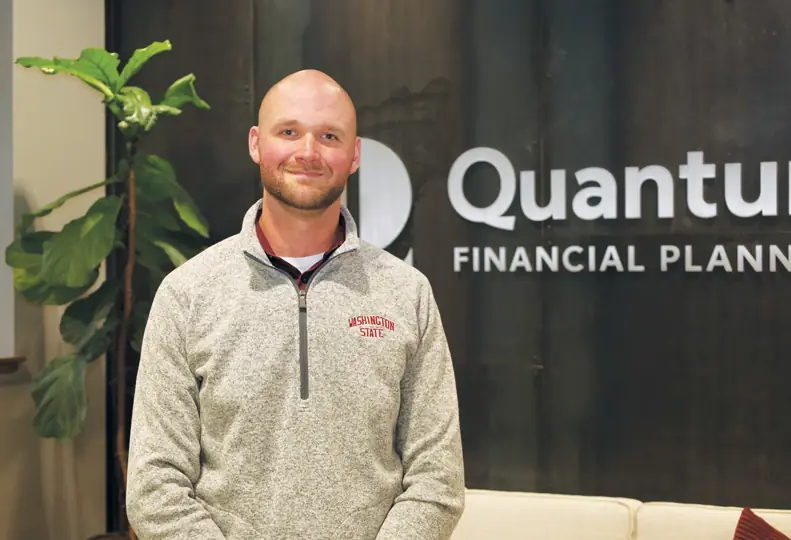
Diversified retirement investments are ideal when the stock market is depressed, says Bailey Erickson, financial planner at Quantum Financial Planning.
| Ethan PackRecent and upcoming initial public offerings for large technology companies are bringing renewed attention to concentration risk and the importance of diversifying retirement accounts and index funds, some financial experts here say.
When these mega-cap companies enter public stock markets through initial public offerings, their massive valuations cause popular index funds — and the retirement accounts holding them — to become heavily reliant on a small group of tech stocks.
High-profile IPOs for companies such as Space Exploration Technologies Corp., which does business as SpaceX, and Anthropic PBC reflect this broader trend, says Noah Schwab, financial adviser and owner at Spokane-based Stewardship Concepts Financial Services.
“Concentration risk is a very main concern for a lot of people, whether they know it or not,” says Schwab.
Index funds are investment products designed to track market benchmarks, including the Nasdaq-100, or various mid- and small-cap indexes, by holding representative shares of member companies. Inside employer-sponsored 401(k) retirement accounts, which offer special tax perks, index funds traditionally offer low risk and steady returns by spreading investment funds across many businesses.
Since popular benchmarks are market-cap weighted, larger companies often exert an outsized influence on market movement than smaller companies. This means index funds tracking benchmarks are focused more heavily on a small group of top tech firms.
“An S&P 500 index fund has outperformed a lot of other investments over the last 20 years, and so a lot of people say, 'Hey, it's beat everything, so I should just throw all my money in that and forget it,'” Schwab says. “They don't realize that it's not an equal investment in 500 names in an S&P 500 index — about 10 companies make up 30% or 35% of the whole entire fund, and so that's a lot more concentrated than what most people assume.”
The scale of recent offerings accelerates this dynamic. SpaceX recently set financial records with its IPO by raising over $75 billion in public stock sales, plus $10 billion in exercised underwriter options to purchase additional stock. Meanwhile, San Francisco-based artificial intelligence company Anthropic could raise between $80 billion and $100 billion in its upcoming IPO, says Schwab.
The recent growth of tech companies increases index risk whenever a single holding accounts for more than 5% of a person's total portfolio. He also warns that headlines surrounding the major tech IPOs can lead some retail investors to make decisions based on media hype rather than long-term retirement goals.
If a fund holds an oversized percentage of a company — more than 5% of a person's entire portfolio, as a general rule — the risk of losing money increases when a market factor impacts that company’s market negatively, he explains.
“As soon as there's a lot of headlines about the blockbuster IPO, that's when retail investors might just buy it just because it's in the headlines, not necessarily because it fits with their allocation of retirement,” he says.
To counter growing concentration risk, Tim Mitrovich, founder and CEO of Spokane-based Ten Capital Wealth Advisors, says 401(k) participants should take time to educate themselves on their current holdings and consider incorporating alternative assets, or investments outside of traditional stocks and bonds.
Diversified retirement portfolios hold investments spread across assets that may respond differently to changing market conditions. When investments don’t depend heavily on a single asset, a downturn in one sector is less likely to impact the entire portfolio, Mitrovich says.
Alternative assets include real assets, private equity, and private credit, among other investment vehicles, he says. Expanding beyond standard stock and bond indexes can reduce portfolio exposure and support more resilient long-term retirement plans.
“For us, we want to build out plans for our clients that have everything that they might need and rise to meet that educational challenge,” says Mitrovich.
Employers offering 401(k) accounts to employees can also "look under the hood" and make sure their offered plans aren’t overinvesting in areas of concentrated risk, says Bailey Erickson, a financial planner at Spokane-based Quantum Financial Planning Services Inc.
For employees choosing among several different 401(k) options, Erickson suggests looking past the expected performance metrics to evaluate diversification. An index fund may still lack meaningful diversification if all the companies are concentrated in similar sectors, rather than balanced with a variety of firms, Erickson says.
“Chasing returns, especially in a retirement account, is a very dangerous thing to do,” Erickson says. “It can feel great when times are really good, but diversification feels great when the market is down.”
Employees can also consider international indexes, which offer different companies to invest in and can remain stable when U.S.-based stocks are down, he adds.
“Take a look at the most recent calendar year, 2025. International equities did a very substantial job,” Erickson says. “It's not only just how are you diversifying locally, but also how you're diversifying within your actual stocks. There should be multiple layers to that and investors should be doing it deliberately.”

Stay Informed. It’s Free.
Subscribe to our newsletters and get the latest news and insights delivered to your inbox.
We respect your privacy.
Unsubscribe anytime.
Thank you!
You’re subscribed. Keep an eye on your inbox for the latest updates.