Railroads look to derail fines
Stuckart now says he'll ask Council to pull measure from ballot
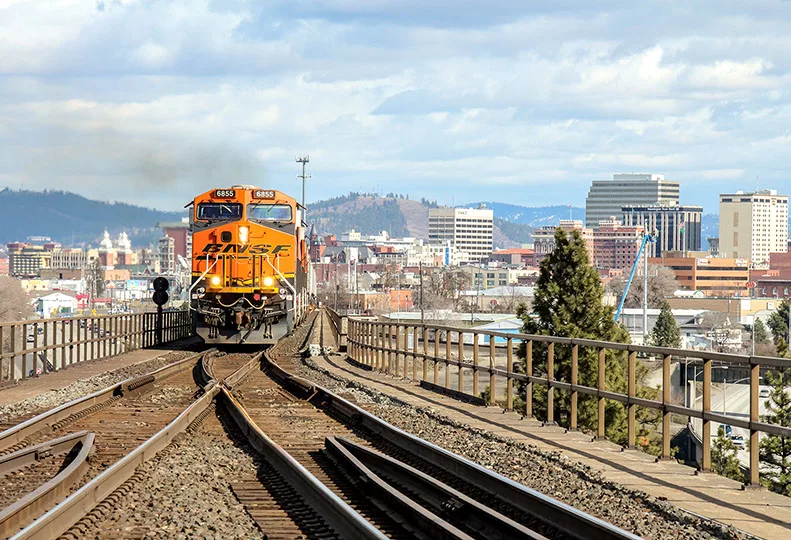
BNSF Railway Co., which has a legacy here dating back more than a century, has wasted little time in making clear that it intends to challenge—on multiple tracks—an initiative put forth by the Spokane City Council that could restrict the movement of oil and coal through Spokane by rail.
And its arguments, in tandem with those of the nation’s other largest railroad, Union Pacific Railroad Co., which also owns and operates tracks here, appear to be having the desired effect.
Council President Ben Stuckart says he’ll ask the council next Monday to approve removing from the November general election ballot a measure it approved unanimously on July 25 that would make it a Class 1 civil infraction to ship coal and some types of oil through the city. Such infractions carry a maximum penalty of $261, which potentially could be assessed per oil or coal car.
“Sometimes it’s OK to say you made a mistake. I personally think we acted a little hastily” in agreeing to put the measure on the ballot, Stuckart says.
He says he came to that conclusion after reviewing documents submitted to the council by the railroads, and others, and after meeting here face-to-face earlier this week with BNSF and UP representatives. They contend that federal law would preempt any such voter-approved city initiative and render it unenforceable. Whether Stuckart can garner the council votes to rescind the ballot measure remains to be seen.
Instead of using that tact, Stuckart says he hopes to work with the railroads on efforts to render the oil that is transported through Spokane by rail less volatile through a stabilizing process that would need to occur in North Dakota.
Of his ongoing concerns about oil trains, he says, “This is one of the things I’ve been working on for the last 4 1/2 years, and I’m not going to stop, but I just think this (fine-imposing ballot measure) solution is not the right one.”
BNSF, the more dominant freight rail provider in the Northwest, estimates it has one to three 90- to 110-car oil trains passing through Spokane daily, and one or two 100- to 125-car coal trains. Under the approved ballot measure, and if figured on a per-car basis at the maximum penalty, daily fines presumably could exceed $150,000, assuming the railroad didn’t pursue an alternate route for those trains that bypasses Spokane.
The council’s action followed on the heels of a UP train derailment on June 3 at Mosier, Ore., about 70 miles east of Portland along the Columbia River Gorge, that caused a 42,000-gallon oil spill and subsequent fire. No one was hurt, but the derailment forced evaluations and disruptions to water systems there, the Associated Press reported.
BNSF, which owns and operates tracks that pass through the urban heart of Spokane, sent a lengthy letter to the council, expressing “grave concerns” about the action it had taken. It warned that the proposed municipal code addition, even if enacted by city voters, would be “preempted by federal law and unenforceable.”
The ballot measure language emphasizes concerns about the perceived dangers that oil and coal trains pose to the Spokane area’s water supply, and to schools and medical facilities that are within one mile of a potential blast zone or evacuation area.
However, in its letter to the council, BNSF questioned why the council also wasn’t seeking to restrict the shipment of other potentially hazardous materials by rail, such as ethanol, and suggested the proposed ban was “less about safety and more about a political agenda against fossil fuels.”
It ran a full-page ad in Sunday’s Spokesman-Review and also has taken to social media to criticize the council’s action and the proposed ordinance and to direct sympathizers to a website page where they can sign a form letter that would be sent to the council. Railroad supporters also were encouraged to share the letter with their friends on Facebook and Twitter.
“Tell the Spokane City Council to Stop Wasting Tax Payer Money!” says the caption on the website page.
Courtney Wallace, Seattle-based regional director of public relations for BNSF Railway, contends the council’s action opens a Pandora’s box by attempting to single out a particular rail-transported commodity for punitive treatment.
“Where does it stop?” she asks rhetorically.
Wallace and the letter sent to the city council, signed by Andrew K. Johnsen, the railroad’s assistant vice president for community affairs, both assert that the initiative conflicts with federal laws that prohibit BNSF, as a regulated common carrier, from turning away particular commodities or from choosing with commodities it transports.
Johnsen claims in the letter that the railroad, operating under the jurisdiction of the federal Surface Transportation Board, “is under a legal obligation to provide transportation service for petroleum products, coal, and all other commodities for which a shipper has made a reasonable request for transportation.”
His letter and other internal documents supplied to the city council suggest that the ballot measure also might be preempted by other federal regulations, including the Interstate Commerce Commission Termination Act of 1995 and the Federal Railroad Safety Act of 1970, as well as possibly violating the Commerce Clause to the U.S. Constitution.
Wallace says, “It puts us in a precarious position,” having to deal with conflicting local and federal laws.
She says, “Spokane is a railroading town, and we share safety concerns,” but she adds that BNSF already puts a high emphasis on safety, including through large annual expenditures on new technologies, system maintenance, inspection, and upgrades.
Based in Fort Worth, Texas, BNSF is one of North America’s leading freight transportations companies, with a rail network of 32,500 route miles in 28 state and three Canadian providences, 44,000 employees, and total operating revenues last year of about $21.4 billion. It employs about 500 people in Eastern Washington and North Idaho.
It says it’s investing $4.2 billion across its system this year, with about $2.8 billion of that focused on maintaining the network.


_web.webp?t=1790233399)