Dignified Workday offers low-barrier jobs to unhoused
Launched in 2024, nonprofit now employs 60, with hundreds more prospects
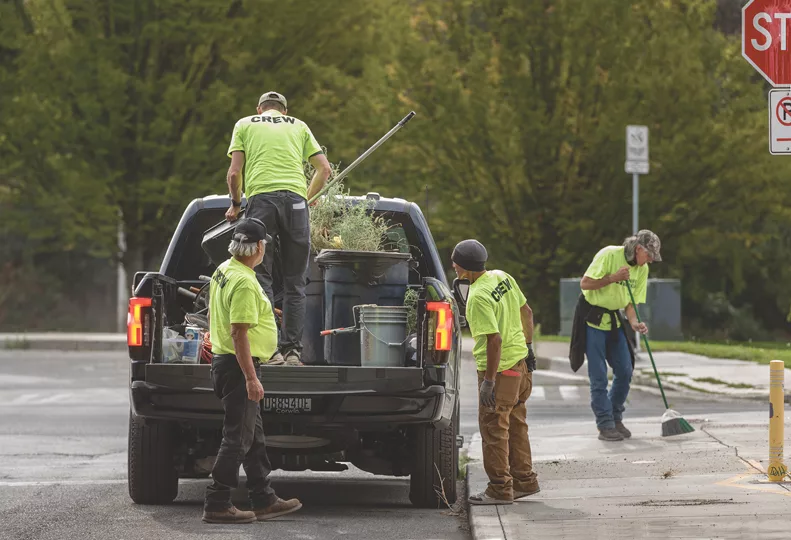
Spokane-based Dignified Workday is planning to clean up targeted sections of downtown Spokane through its new Engaged Neighbors Cleanup Project program.
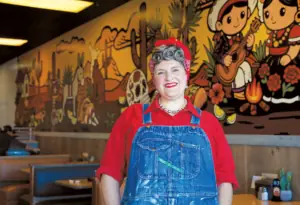
| CK AndersonWhat began as Tresa Schmautz’s gesture of goodwill and need for assistance — offering a passerby compensation to help her clean up property around Spokane’s St. Ann Catholic Church — has evolved quickly into something grander in scope.
That East Central neighborhood encounter in the spring of 2023 led to the creation of Dignified Workday, a nonprofit organization here that provides low-barrier jobs to people who are homeless or in transitional housing.
Based in office and shop space at 1711 E. Trent, just west of the Habitat for Humanity-Spokane thrift store, Dignified Workday now has about 60 participants on payroll and a waiting list of more than 300 prospective team members. The services it provides, with the support of 12 vehicles, range from demolition, cleaning, hauling, and painting, to landscaping maintenance, snow removal, and helping elderly people move.
Although still looking to stabilize operationally and not yet financially self-sufficient, the grant- and donor-supported nonprofit has aspirations of some day replicating its services in other areas locally and possibly around the Inland Northwest.
“One of the things we love about these guys is they often do a better job than other vendors,” Schmautz says, describing the program participants as grateful and happy to be employed.
Schmautz, a retired social worker, and her husband, Steve Schmautz, owner of Spokane-based real estate company SDS Commercial, officially launched Dignified Workday in January 2024 in partnership with Career Path Services.
Andy Dwonch, chief operating officer at Career Path Services, is a fellow parishioner at St. Ann’s and his organization had the resources and experience to expand on Tresa’s concept and provide administrative support.
SDS also provides financial and operational support, and Spokane-based utility company Avista Corp. has chipped in significant funding, Tresa says. St. Ann’s, located at 2120 E. First, provided the organization its “first real job,” which was refinishing the church’s pews, she says.
Since then, Dignified Workday has developed relationships with a diverse range of clients, such as Catholic Charities Eastern Washington, Spokane Neighborhood Action Partners, Habitat for Humanity, the cities of Spokane and Spokane Valley, The Lands Council, and the Washington State Department of Transportation, with hopes of further expanding on that list.
The organization received a management boost when Dwonch enticed Harold Vanderpool to apply to become its director of operations. He started in that position last August. Vanderpool lives in the East Central neighborhood and has been involved with the neighborhood council there.
Although he has a physics degree, did research in artificial intelligence, and worked in software engineering and development for 25 years here, including in management roles, Vanderpool also has outdoor leadership experience and says he’s “always been a carpenter.” He says he knew Dwonch through the Boy Scouts organization, overseeing a high adventure trip in which Dwonch assisted.
Of what stirred his interest in the position with Dignified Workday, he says, “It sounded super interesting. I think what we’re doing here is cool. I think it’s a great approach to solving a problem.”
Also, he says, “I’ve had a diverse background, and this job incorporates a wide variety of those skills and experiences. I particularly enjoy the leadership aspect of it. We take our participants and identify the ones who have natural leadership skills, then mentor them, and promote them” to job-leading positions.
“Some sophisticated ‘job leads’ can run a whole crew with equipment safely all day by themselves; others need more mentoring,” Vanderpool says.
The organization’s goal is to pay all workers who meet its basic expectations — such as to be hard working, respectful, and have a positive attitude — a wage of $20 an hour, he says.
Dignified Workday’s website says people who are unhoused often want to work but may not meet basic job requirements without an address and phone number, photo identification, the ability to work every day, clean work clothes, special training or job skills, and reliable transportation.The nonprofit strives to remove those barriers.
“We provide the opportunity to do real work, earn an income, build stability, and even qualify for housing,” its website says.
Partly because it’s so young, the nonprofit is still trying to find its own stability.
“It’s a crazy startup. It runs like a startup — constantly changing, constantly evolving, multiple organizational elements,” Vanderpool says, adding, “That’s frustrating and exciting at the same time because you’re normally changing for a good reason, but it also requires a fair amount of work.”
“We’re growing like crazy and we don’t know what we need until we need it. It requires constant adaptation. I enjoy that kind of problem solving for sure,” he says.
One of the biggest challenges Vanderpool says he faces is “matching resources with available work.” He says, "The work ebbs and flows quite a bit, and the kinds of work vary as well. Some folks are totally reliable all of the time and some are less reliable.”
He oversees a schedule that generally includes 11 to 14 jobs a day, with each job typically requiring two to six people, “so it demands a steady flow of work,” he says, and maintaining that flow can be tough, particularly during winter months.
Less reliable workers don’t get kicked out of the program, and if they come back, Dignified Workday will continue to work with those individuals to try to help them develop more dependability.
“We would like people to use this as a stepping stone so they move on to full-time work at some point for different employers,” Vanderpool says.
He adds, “One of the fun things about working here that I didn’t expect is just how committed the participants are. They want to do something to make their lives better. They want to work hard. They don’t want a handout. They’re committed to making this thing successful. They recognize what an unusual cool thing it is we’re doing.”
Tresa, who continues to volunteer, says another nice aspect of employing the unhoused is that “when people have fallen down and they’ve had to get back up, you’re not having to deal with a lot of ego.”
One of the new projects Vanderpool says the nonprofit is working to establish, dubbed Engaged Neighbors Cleanup Project, would involve taking a more comprehensive approach to cleaning up targeted sections of downtown Spokane and getting businesses in each section to participate. Tasks would include things such as cleaning streets, power-washing sidewalks, collecting trash, and removing graffiti.
Looking ahead, rather than trying to grow continuously at the nonprofit’s current location, where Vanderpool says it now is getting close to its optimum size for the space it occupies there, he envisions possibly replicating the model and establishing similar work centers elsewhere.
“We’re never going to have 350 people working out of this office, but you can imagine 65- to 70-person groups (each working from a different base location),” he says.
Reflecting on the potential for added growth, separate from new locations, Vanderpool says,“I think there’s a ton of untapped stuff we haven’t gotten to yet. There’s just so many things this group can do. I think we’re just scratching the surface.”

Stay Informed. It’s Free.
Subscribe to our newsletters and get the latest news and insights delivered to your inbox.
We respect your privacy.
Unsubscribe anytime.
Thank you!
You’re subscribed. Keep an eye on your inbox for the latest updates.