Aerospace, green energy drive manufacturing activity
Capital investments to boost production, projects out of holding pattern next year

The manufacturing sector is expected to grow at a steady pace in 2026.
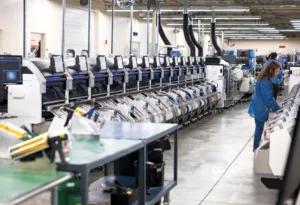
| Jubilant HollisterStierAfter a year marked by stalled projects and softening job numbers, Spokane’s manufacturing sector is poised to enter 2026 on firm footing. Industry experts describe a stabilizing manufacturing landscape that is quietly expanding, even as automation, global market pressures, and federal funding cuts impact the way companies grow.
Joey Gunning, director of economic development for Greater Spokane Incorporated, says that while the manufacturing sector lost jobs in 2025, data from Lightcast, which provides labor market analytics, indicates the industry is expected to grow 6% over the next five years.
Additionally, a significant number of capital investments by regional manufacturers are expected to buoy further growth, he adds.
As reported by the Journal, regional manufacturing companies including Kaiser Aluminum Corp., Jubilant HollisterStier LLC, and Solstice Advanced Materials Inc., among others, have invested at least $577 million in facility upgrades, developments, and expansions that have been planned, are underway, or have wrapped up since July.
“My projection would be, given the investments we’ve seen this year, it would be a safe bet to see a trend line of growth over the next few years,” Gunning says.
The manufacturing industry here is wide-ranging and intersects different fields from aerospace parts and materials, to medical products, to agricultural manufacturing, Gunning says.
According to the Washington state Employment Security Department, there were 17,400 manufacturing jobs in Spokane County as of August, down 300 from the year before.
Mark Norton, executive director of Northwest I-90 Manufacturing Alliance, says several manufacturing sectors are showing strong activity, including aerospace, space and satellites, and green energy.
“I think when you look at our region, there are some really positive things happening here,” he says.
Norton points to Collins Aerospace on the West Plains, which is has a $200 million, 70,000-square-foot expansion of its carbon brake facility underway. That project is expected to be completed in 2028.
The space and satellite sector is rapidly growing with many regional manufacturers supplying parts to major companies with Seattle-area operations like Blue Origin and SpaceX, he adds.
Green energy companies such as Spokane Valley-based CarbonQuest Inc. are also leading growth in the industry. Spokane-based Johnston Engineering PLLC, for example, has delved heavily into the green sector, winning dozens of U.S. Department of Energy grants and helping build green energy systems for private companies.
Looking ahead to 2026, Norton says he is hopeful. Growth is expected in these sectors as clarity around economic conditions, tariffs, and federal funding cuts helps to restart some stalled projects, he says.
“From a macro level, what I would hear from manufacturers was that there was just a lot of projects on hold because of just the general economic activity,” Norton says. “In the last 90 days, that seems to be changing. I’m hearing a lot of folks saying that those things have kind of come out of the holding pattern and they’re seeing activity really pick up again.”
Other sectors showing strong activity include agricultural manufacturing and biotech-related manufacturing, Norton adds. But perhaps the most dynamic growth is occurring in Washington’s space and satellite industry, of which many Spokane-area manufacturers have been supplying parts and products to for years.
Washington state’s space companies spent 2025 validating new technologies, and 2026 will mark a pivot toward commercial contracts, orbital launches, and expanded production, says Stan Shull, a Seattle-based space industry consultant.
“2026 will be about turning breakthroughs into bookings,” Shull says. “Space used to be mostly experimental and exploratory. Now it’s also really becoming industrial, and Washington state space companies are setting the pace in that regard.”
One company that reached a significant milestone this year is Kent, Washington-based Stoke Space Technologies Inc., which has a facility in Moses Lake, Washington. In September, the company announced it had raised $510 million in funding, bringing the total funds raised to just under $1 billion since 2019. The company completed successful engine tests this year and is currently building out its Florida launch pad, Shull says.
“In 2026, we should expect to see the first orbital test launch of their Nova Rocket,” Shull says. “Which is intended to be a fully and rapidly reusable rocket with real game-changer technology. And then they’ll be scaling up their manufacturing.”
Starfish Space Inc., of Tukwila, Washington, which provides satellite servicing in space, will launch its first commercial satellite servicing mission in 2026. The company’s satellite servicing vehicle is projected to provide fuel, maintenance, or upgrades to satellites belonging to a major global satellite operation, the U.S. Space Force, and NASA, Shull says.
The space and satellite industry is an important field with work inherently poised to help Earth and its inhabitants, Shull says. Space technologies support climate monitoring, pollution detection, human trafficking and smuggling detection, emergency response logistics, high-yield agriculture, transportation safety, and national security.
Another company that has turned a far-flung idea into reality is Redmond, Washington-based Starcloud Inc., which, driven by the explosive demands from artificial intelligence on Earth, is seeking to launch data centers in space. Space-based data centers offer “unlimited” solar power and reduce land-based environmental strain, Shull says. In 2026, the company will launch its first set of small orbital data centers, he adds.
“Building data centers in space probably seemed like a crazy notion,” Shull says. “But it’s increasingly gaining support from a growing chorus of tech leaders, including Elon Musk, Jeff Bezos, the former CEO of Google, and OpenAI. With the data centers expected to reach unsustainable levels on Earth, space offers access to unlimited solar energy and the ability to preserve Earth in the process.”