2026 legislative outlook: Regional priorities face tough session ahead
Potential for an 'all-cuts budget' limits options for city of Spokane, GSI
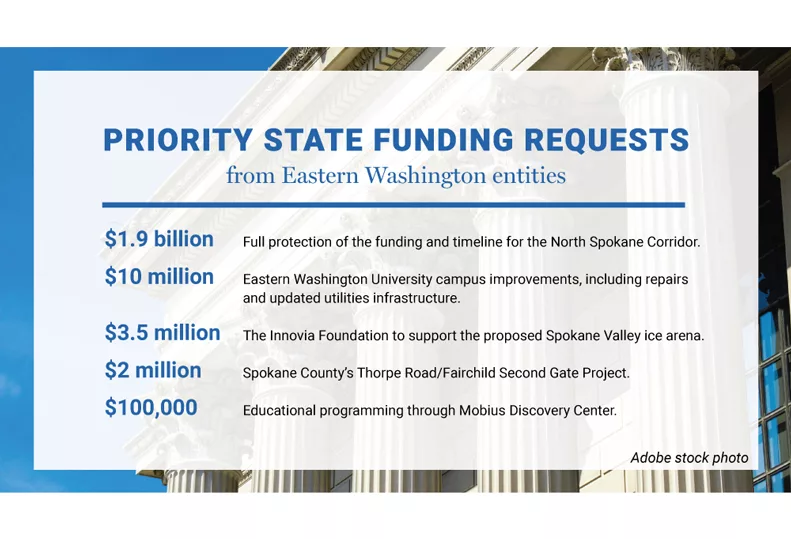
Washington state legislative agendas for the city of Spokane and Greater Spokane Incorporated indicate that their priorities for the 2026 legislative session will focus on clarifying taxes, reducing costs for residents, and improving infrastructure and housing affordability, but lobbying efforts from the two entities face an added challenge due to a tight state budget.
“The message we're getting from lawmakers is it’s going to be a tough legislative session,” Spokane City Council Member Zack Zappone says. “There's been pessimistic economic outlooks from the state on their budget, and we know the governor's proposing an all-cuts budget, so it's going to be a tough budget.”
Gov. Bob Ferguson is expected to release his supplemental budget proposal this month, before the next legislative session begins on Jan. 12, 2026. The session will last through mid-March; during which time the Legislature may modify the budget, then pass it. The governor then is expected to sign the finalized budget in April or May, according to the Washington State Office of Financial Management.
Both the city of Spokane and GSI employ lobbyists and meet with legislators throughout the year.
Higher priority requests, such as requested changes to the Climate Commitment Act which affects the city of Spokane’s Waste-to-Energy Facility, have been in the works for years.
“Last year, our tactic was to get an exemption for (the Waste-to-Energy Facility) from the Climate Commitment Act’s penalties. That bill didn't move out of committee,” Zappone says. “Feedback that we got from lawmakers is that (the bill is) not going to keep moving forward, so we're changing our strategy this year and looking for a longer transition over several years, rather than a transition that would impact us in 2027.”
Both the city and GSI are pushing for changes to the Climate Commitment Act, which limits the amount of greenhouse gases an entity can emit before penalties are enacted, as part of their 2026 legislative priorities.
The city is seeking more time and state support to implement technologies that reduce greenhouse gas emissions at the Waste-to-Energy Facility, and GSI is asking the Legislature to reduce costs, in part, by enforcing agricultural fuel exemptions and increasing credit availability, the organizations’ respective agendas state.
“This absolutely impacts more than just people around our region, and that's why we see other organizations that are concerned about this too, because increased utility rates could adversely impact our local economy,” Zappone says. “If people don't have as much money that they can spend, … that has a ripple effect throughout our entire economy.”
Another priority issue for the city of Spokane includes expanding the state’s sales tax deferral program for converting surface parking lots to affordable housing. Passed in 2022 as Senate Bill 5755, the measure enables the city’s Parking 2 People incentive program. Spokane also is seeking the authority for cities to exempt buildings and improvements from local property taxes to encourage the development of vacant properties.
While the city’s priorities are focused on increased funding for public services and funding adjustments, GSI’s legislative priorities are gathered from businesses and are focused on regional business needs, says Mary Miller, director of public policy at GSI. The organization sponsors an annual Olympia Fly-In event, where business leaders in the greater Spokane area travel to Olympia during the yearly legislative session to lobby for the region’s business priorities.
“We're going to have a wide range of industries represented — from our health care partners, our construction partners, to small businesses in the athletic space and the nonprofit space,” Miller says.
GSI has five broader priorities — empowering business growth, infrastructure, workforce, sales tax on services, and health care access — each with specific bills, taxes, or proposals that the organization supports or opposes.
“You’ll see throughout all five (priorities) and throughout our positions, this theme of affordability; of do no harm, and reduce the harm done to businesses,” she says.
Washington’s high taxes compared to Idaho are a concern for GSI and businesses here, Miller says. Clarifying the language in tax bills, such as Senate Bill 5814, which expands sales taxes to more services, in addition to requesting exemptions for certain small businesses and nonprofit service providers, is requested by the organization to reduce unnecessary burdens on employers, she explains.
“There's a whole range of services that are now subject to a sales tax, and it just is sort of one more burden on our businesses when they're already struggling to keep the lights on,” Miller says.
GSI also is supporting efforts to reduce regulatory burdens for businesses, to secure full protection for the North Spokane Corridor’s funding and timeline, to expand investments in apprenticeships and career and technical programs, and to protect the 340B Drug Pricing Program in state law, among other things, according to the organization.
The 340B Drug Pricing Program, a federal program created in 1992, requires pharmaceutical manufacturers to provide outpatient medications to eligible health care organizations and covered entities at significantly reduced prices, according to the Washington State Health Care Authority.
Both the city of Spokane and GSI are also pushing for increased access to affordable and reliable child care, with the city of Spokane requesting more state-subsidized child care slots, workforce development, and construction of new facilities. At the same time, GSI is calling for regulatory reform to remove barriers that prevent private market solutions.
“This past legislative session and this upcoming one are really difficult in terms of the budget. … Legislators are saying, ‘don't ask us for money,’” Miller says. “We’re using that as the context and looking for what wins we can still get. Sometimes it’s big wins and sometimes it’s little wins, and both of those matter.”

Stay Informed. It’s Free.
Subscribe to our newsletters and get the latest news and insights delivered to your inbox.
We respect your privacy.
Unsubscribe anytime.
Thank you!
You’re subscribed. Keep an eye on your inbox for the latest updates.