New transfer agreement targets workforce gap
Spokane Colleges, U of I create a path for students in natural resource fields
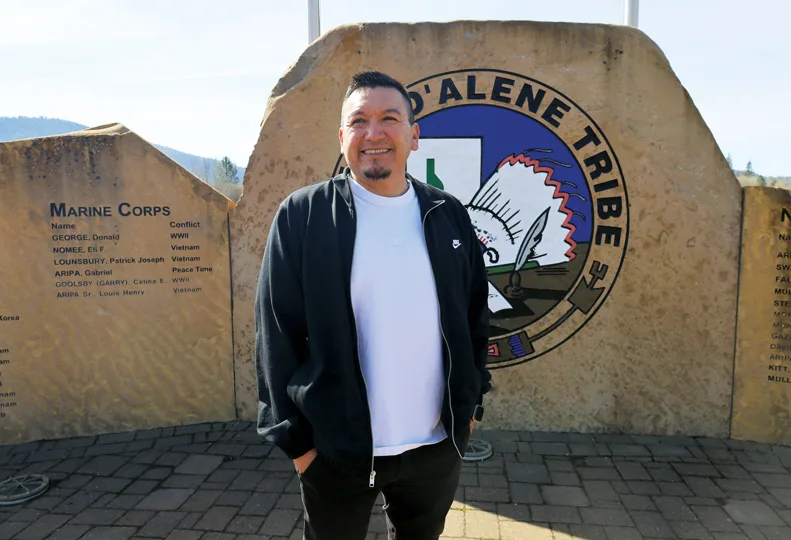
Ralph Allan Jr., of the Coeur d'Alene Tribe, says a new student transfer agreement helps strengthen the region's natural resource workforce pipeline.
| Karina EliasSpokane Colleges has established a new transfer agreement with the University of Idaho that aims to create a pathway to help students advance their education and prepare them to work in natural resource fields across the Inland Northwest.
The agreement between the two higher education institutions allows students to receive hands-on technical knowledge through Spokane Community College's Natural Resource Studies program before transferring to the University of Idaho for advanced coursework in fisheries, forestry, wildlife biology, and related fields through the Moscow, Idaho-based institution’s Wildlife – Human/Wildlife Interactions Bachelor of Science program.
The partnership is orchestrated by Spokane College’s Tribal Relations Director Naomi Bender and the University of Idaho’s Executive Director of Tribal Relations Yolanda Bisbee to create a more sustainable talent pipeline for departments that rely on both scientific expertise and deep cultural knowledge tied to stewardship and sovereignty.
In a press release from Spokane Colleges, Warren Seyler, of the Spokane Tribe of Indians, who played a key role in bringing the agreement to fruition, calls the pathway a “milestone.”
“What was once an education hurdle is now an advanced career pathway,” he says. “The Pacific Northwest’s tribes, states, and environmental organizations will all see benefits.”
Ralph Allan Jr., deputy director of natural resources for the Coeur d’Alene Tribe and a graduate of the Spokane Community College program, praises the school's curriculum for preparing students with the technical skills required to work in natural resources, such as field sampling, data collection, and habitat work. Coupled with a degree from U of I, students gain a higher level of scientific knowledge and leadership growth, he says.
“Going to SCC — and if that is all you got was that two-year degree — you could run a crew, you could collect data, you could do just about anything out in the field, technical-oriented,” Allan says. “Being able to transfer to U of I will really boost that and touch more on those high-level details that you don’t get from SCC.”
The transfer agreement also addresses workforce shortages identified by tribal leaders and other natural resource professionals at last year’s 2025 Government-to-Government Natural Resource Summit. The summit, held at the Spokane Tribe & Casino last June, is an annual conference of Washington tribes and leaders in higher education to strengthen workforce development and create stronger educational and career pathways between tribal communities and the state's technical and community colleges.
Allan, 48, first noticed the need to create a workforce pipeline in 2015, shortly after taking the helm as the Coeur d'Alene Tribe’s fish and wildlife program manager. There, he says he realized that within the next five to eight years, the department would face a wave of retirees.
He calculated that about 15 people represented more than 300 years of combined experience, including tribal ecological knowledge, scientific expertise, operational knowledge, and land stewardship practices. At the same time, there was a lack of interest from younger generations entering into natural resource work, creating a substantial loss if that institutional knowledge could not be passed down.
The Coeur d’Alene Tribe’s Natural Resources department employs over 100 people and represents the tribe's largest and fastest-growing department, he asserts. It's responsible for protecting, preserving, and enhancing all natural resources within the reservation’s boundaries, which encompasses 345,000 acres in North Idaho, including portions of Lake Coeur d’Alene, forested areas, and farmland.
“The way I look at it, without our natural resources, there wouldn’t be a Coeur d’Alene Tribe,” Allan says. “Tribes are where they are because of their natural resources, the ability to take care of those, and trying to look out for the next seven generations.”
Allan explains that his love of the outdoors was passed down from his father through camping trips, hiking, fishing, and hunting. However, after contacting the Idaho Department of Education, he learned that there weren't many tribal students entering the field, as it’s not a lucrative career choice. In an effort to improve the longevity of the department, Allan says he took it upon himself to create an internship program with the Coeur d'Alene Tribe's Natural Resources department to interest students in the work they do.
This summer, the department expects to welcome 14 interns from universities in Washington, Idaho, and other states. The transfer agreement between Spokane Colleges and the University of Idaho further strengthens the workforce pipeline needed within tribal governments, he says.
“You don’t really go to school for this to become rich,” he says. “It’s a deeper love and a deeper understanding of the natural world.”
Spokane Community College also has added a one-year Forest and Wildlife Sampling certificate and a Freshwater Fisheries Associate of Applied Science degree to expand its Natural Resources program offerings.
The Coeur d’Alene Tribe’s work is rooted in its core values of stewardship, membership, guardianship, scholarship, and spirituality, Allan says. Those values are embedded into the department’s operations, including hiring, project planning, land management, and natural resources restoration.
“A lot of our staff who are retiring, they have grabbed on to these core values and have run with them,” he says. “Those values are really the heart of the culture and how we bring all that together and how we implement all of our projects and just act out in the general public.”