Barton English School leader evolves program
Becky Rempe is building community with language
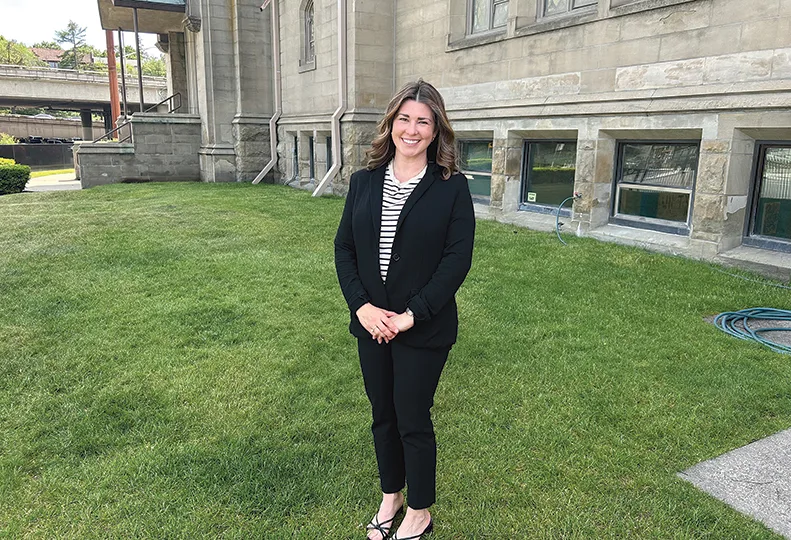
Becky Rempe, director of the Barton School of English, is transforming the decades-old, one-on-one tutoring program into a lively community hub.
| Karina EliasWhen Becky Rempe arrived at the Barton English School at First Presbyterian Church of Spokane, the decades-old program consisted largely of one-on-one tutoring sessions. Today, the school is abuzz with conversations in multiple languages as immigrants, refugees, volunteers, and residents gather to learn and engage with each other and the community.
The school, located inside the Gothic Revival-style church at 318 S. Cedar, provides English learning groups, medical language workshops, cultural events, and child care.
Rempe, who joined as director in 2019, has spent the last several years transforming the longtime tutoring program into a community-centered learning hub that serves about 80 students a month, all free of charge. Her work has earned her recognition from YWCA Spokane's Women of Achievement Awards and The Spokesman-Review’s Inland Northwest Women of the Year awards.
Rempe attributes the school's growth to her ability to listen and respond to the needs of her students.
“You have to be flexible to see what is happening in the moment and respond to what’s in front of you," Rempe says of her role at the organization.
Guided by this philosophy, Rempe has redeveloped courses and programs by observing challenges faced by immigrants, understanding gaps in available resources, and student questions, she says.
Along with English language learning, the Barton English School offers free child care for children ages 5 and under, a Mommy and Me program for mothers with infants, and bilingual online lessons for individuals unable to leave their homes. Medical English workshops provide physician- and health care professional-led discussions to answer questions about understanding medical systems, navigating health care options, and emergency care procedures, Rempe says.
Additionally, citizenship study groups are available to assist participants in preparing for the Naturalization Interview and Test, including test requirements and explaining the overall testing process.
In 2025, the Barton English School was awarded the Community Innovation Award from the Partners in Campus & Community Engagement in recognition of its commitment to meeting community needs. The award reflects the school's broader efforts to develop projects aimed at improving the Spokane community.
Much of the school’s growth has been funded through an endowment-like reserve established through decades of donations to the school, Rempe says. The funding has given Rempe flexibility to experiment with new programs without the restrictions often attached to grant funding, she explains.
"I was given the open-book opportunity to start (the programs) and see where it would go," Rempe says. "It’s everybody’s dream, every entrepreneur or businessperson, 'If somebody would just give me some money, look what I could do.'"
Rempe’s path to the Barton English School began two decades ago and half a world away. After graduating from college, Rempe accepted a job teaching English in Vietnam, a two-year experience that continues to shape her approach to education, she says. Rempe returned to the U.S. with the intention of receiving a master’s degree and then promptly returning to Vietnam to continue teaching. However, while pursuing her master's, she met her husband and instead stayed in the U.S. and began teaching at Ohio State University.
Following a move to Spokane in 2009, Rempe taught at Whitworth University, Spokane Colleges, and Eastern Washington University. At those institutions, Rempe says she enjoyed working with international students in higher education, but a few factors influenced her to pursue a different learning environment.
For instance, teaching at the university level allowed her to meet with people from around the world; however, they offered transient settings, and she was beginning to seek a more permanent community to create deeper connections with immigrant and refugee groups resettling in Spokane, she explains. While at EWU, during President Trump’s first term in office, a decline in international students further fueled her desire to build community. Additionally, her daughter, Beah, had just started school, and Rempe says she wanted to surround her daughter with multilingual and multicultural people.
“I wanted to be close by, and I wanted her to have as much of an intercultural, international experience here in Spokane,” Rempe says. “I wanted to transition into this because I was transitioning into a different phase of my life.”
Upon joining the Barton English School, Rempe's first initiative was to introduce learning groups, rather than traditional classroom instruction. She says she avoids using the word “classrooms” because it is often associated with grades, tests, and homework. Instead, her philosophy is centered on creating an open learning environment where everybody participates, asks questions, and forms connections and a sense of belonging, she says.
“I really like learning collectively,” Rempe says. “It facilitates this fostering of friendships and groups and connection here.”
When Rempe was hired, donations to the school had been building for a long time. That capital, she explains, has been used over the last six years to fund her salary along with the salaries of two child care employees, a Slavic community coordinator, and a Latino community coordinator, all of whom work part-time.
First Presbyterian hosts the school on its campus free of charge, and 45 volunteers help teach workshops and classes. The school’s monthly budget varies between $5,000 and less than $10,000, she says.
Currently, the school is entering a transition phase, where previously it relied on reserves, it will shift to generating its own revenue and creating long-term sustainability, she says. A fundraising team is being assembled to help support future growth while preserving the school’s commitment to free programming.
Although the Barton English School is evolving organizationally, Rempe says its broader mission remains unchanged. She sees multilingualism not simply as a practical skill, but as a way to reduce isolation, foster empathy, and strengthen Spokane’s increasingly diverse community.
In the past year, the school began collaborating with Spokane-based nonprofit Manzanita House to launch community language clubs focused on conversation, culture, and cuisine. The clubs currently offer Arabic and Spanish language learning through shared meals, cooking nights, and cultural exchange led by native speakers.
Rempe says she believes language can become a bridge between communities at a time when immigrants and refugees are often treated as outsiders. Her hope, she says, is for Spokane residents to recognize multilingualism and cultural exchange as opportunities for connection.
“If they know a few words in Arabic, if they know the culture, if they have friends who speak Arabic, and they hear Arabic in the grocery store, they’re going to engage,” Rempe says. “It makes sense that this would be a portal or a way that we can combat racism and that othering, or even ignorance.”