Refinancing activity holds steady pace
Inflation, high oil prices impact rates, consumer uncertainty, expert says

Refinancing activity in the Spokane market is expected to remain low but steady, as ongoing market uncertainty and global events keep interest rates elevated, according to some industry experts here.
Driven by lower interest rates early in the year, Spokane's refinancing volume hit 163 in April. Anthony Carollo, CEO of Vista Title & Escrow LLC, says this surge follows a period of stagnation of 73 in April 2023 and 71 in April 2024.
The monthly refinancing volume as of April 2026 in Spokane has dropped 85% from April 2020, which had 1,100 closed refinances.
“The homeowner that's refinancing now is refinancing a loan that's three years old, versus 15 years ago when a homeowner was refinancing a loan that was maybe five years old or eight years old,” Carollo says. “Very few people are refinancing a 2% loan or a 3% loan. They're keeping it."
While Spokane-based Vista Title & Escrow manages the logistical side of transactions — including title insurance, escrow services, and contract servicing — the volume of those closings is heavily dictated by shifting mortgage rates. The number of closed refinances generally correlates with these rates: when rates drop, the company's activity picks up.
Mortgage rates are on the decline since reaching a high of 18.5% in the early 1980’s, according to data from the Federal Reserve Bank of St. Louis. Rates fell to single digits in 2020 and 2021 during the COVID-19 pandemic, before climbing to a nearly 25-year high of about 8% in 2023. Since then, rates dropped to 6% at the beginning of the year, before increasing slightly to about 6.5% currently, federal data shows.
Carollo attributes the rise of interest rates, mortgage rates, and consumer uncertainty to geopolitical and economic pressures, compounded by rising 10-year U.S. Treasury bond yields, and the Federal Reserve’s influence on the market.
“When the consumer is not certain about the future and not certain about where things are headed, they're going to hang on and wait and see how things play out before they (refinance),” he says.
The incentive to refinance depends on when a homeowner entered the market, he notes. Buyers who purchased in 2023 may find current rates attractive. However, those who secured the lower 2% to 3% rates during the pandemic are unlikely to refinance, as many are unwilling to trade in low interest for a more expensive loan.
“It's a good time to buy, and under the right circumstances for the right borrower, it's a good time to refinance, though not for everybody,” he contends.
Carollo estimates 90% of homeowners here currently have an interest rate under 7%. 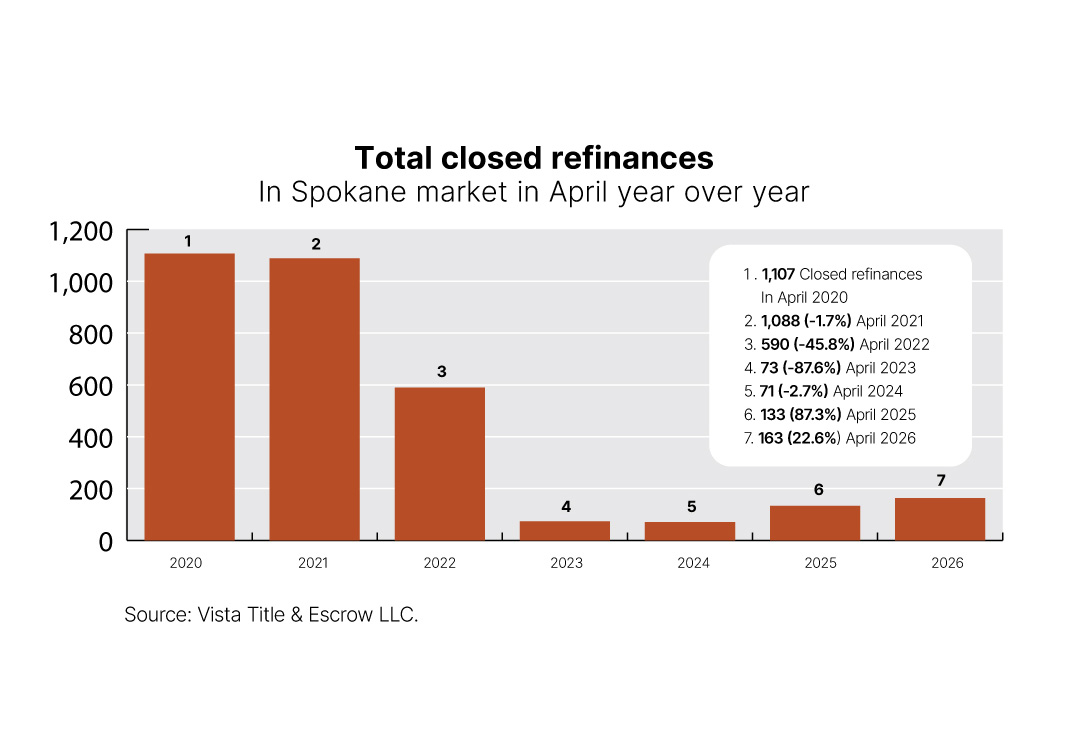
Chad Johns, a Spokane-based mortgage adviser at BECU, says he expects to see more refinance activity when the Iran war ends and consumers start to feel more certain about the market's stability.
“Once that ends, those rates will come back down, and we'll see another mini refinance boom,” Johns says. “Because we have so many people who are buying right now at 6.5%, as soon as that gets below 6%, the phone's going to start to ring.”
Currently, Johns says 27% of the loans he handles at Boeing Employees’ Credit Union are refinances, compared to 14% of loans in 2025 and 20% of loans handled in 2024. He attributes current market conditions to homeowners who are taking advantage of slightly lower rates seen at the beginning of the year.
Other factors, including life circumstances and legal incentives, can drive borrowers to refinance, even when rates are unfavorable, he notes.
“In today's market, (refinancing) has slowed down because the rates have gone up, so there was not a net tangible benefit for those people to refinance,” he says. “Now, our opportunities are more selective because it's usually going to be due to a divorce situation, a death, or driven by debt consolidation.”
Spokane Valley-based Numerica Credit Union experienced a similar trend in refinances at the beginning of the year, says Chad Burchard, chief lending officer at Numerica. The credit union reports a 30% increase in inquiries, with up to a 15% increase in closed refinances as interest rates dropped below 6%.
Activity has retracted since earlier in the year, due to a 6.5% rate, which is prohibitive for many homeowners, he adds. Home Equity Lines of Credit — HELOCs, or second lines of credit — tend to be more popular in high rate environments.
Some national financial experts have previously predicted three Federal Reserve rate cuts in 2026, but some reports are expecting rates to increase, which would further slow down refinance activity.
“I would define the market as stable. It's not cold, it's not hot. If rates go up 50 basis points, it could really cool down the market,” Burchard says. “There's some fear about inflation, and fear about when gas prices will come down. Consumers drive the economy, so when consumers cut back their spending, it starts hurting the economy.”