
Long-term care sector faces increasing pressure
Providers prepare for wave of major population growth among oldest demographic
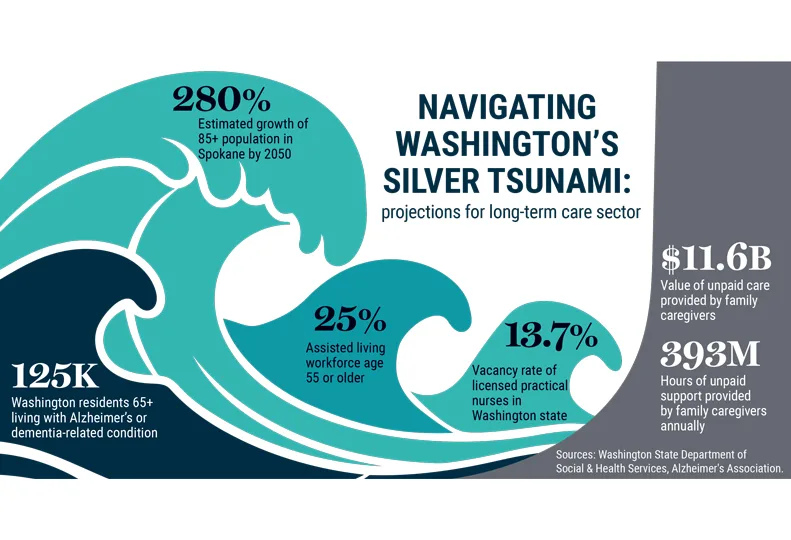
The population of adults age 85 and older in the Spokane area is projected to nearly quadruple, rising from 10,700 in 2025 to 40,400 by 2050 — a significantly higher growth rate than any other age group over the next 25 years, according to information from the Washington State Department of Social and Health Services. As the demographic grows older, the long-term care sector is expected to face higher demand for assisted living, skilled nursing, memory care, and adult family homes, creating new opportunities — and challenges — for providers across the region.
The region’s oldest population is growing at a faster rate than the state and national average. According to DSHS projections, the number of Washington state residents 85 and older will grow by 260% through 2050, a rate five times faster than the 75 to 84 age group. Spokane’s demographic shift will be even more intense; the county's oldest population is set to increase by nearly 280%, outstripping the state average and nearly doubling the 147% growth rate projected for the rest of the nation.
"This isn't simply about an aging population; it's about preparing an entire healthcare system for a dramatic increase in demand," says Lauri St. Ours, executive vice president for communications and government relations for the Washington Health Care Association, a nonprofit trade association.
The long-term care sector already has a substantial economic impact in the Spokane area. The region is a major employment hub for the sector, with about 10,500 direct care workers as of 2023, representing a concentration of about 19 workers for every 1,000 people in Spokane County. As the population ages, the ratio of working-age adults to those 85 and older is expected to decrease from 30-to-1 to a ratio of 9-to-1 by the year 2050, DSHS data shows.
"While I trust the hard work of our caregivers every day, I know that we're not ready to provide for the needs of that many more people," St. Ours says. "The work we do now will determine how well we're prepared for the future."
Part of that preparation involves a shift toward smaller residential settings, which is already reshaping the sector here.
More than 6,000 licensed adult family homes operate statewide, compared with fewer than 600 assisted-living communities, creating one of the nation's largest networks of small residential care providers, says Kenyon Durr, co-founder of Silver Age Senior Living Advisors, a trade name for SilverAge LLC, an Issaquah, Washington-based senior living placement service.
Adult family homes are seeing particularly strong growth in cities such as Spokane and Vancouver, as rising construction costs and lengthy development timelines are making large assisted-living projects more difficult to build, Durr says.
"Assisted-living communities require significant capital investment and years to develop," Durr says. "Adult family homes help fill an important gap by expanding care capacity in smaller residential settings."
Statewide, Washington is home to over 550 licensed assisted-living facilities serving nearly 40,000 residents and employing about 32,000 workers.These facilities generate an estimated $3.74 billion in economic activity and about $418 million in annual tax revenue, according to data from the Washington Health Care Association. Washington also has about 200 licensed skilled nursing facilities caring for 13,000 residents while employing more than 18,000 workers.
While this infrastructure provides an economic foundation for the state, in areas such as Spokane, facilities are adapting their operations to support a population that's not only growing, but also is becoming more medically fragile.
Many residents currently entering these communities also are arriving later in life and with greater medical needs, the association reports. More than half of assisted-living residents are at least 85 years old, and over half have a diagnosed Alzheimer's or dementia-related condition, according to the association. Residents frequently require assistance with medication management, mobility, personal care, and other daily activities.
An estimated 125,000 Washington residents 65 and older are living with Alzheimer's disease, but many aren't receiving care at a specialized facility. An estimated 257,000 family caregivers are providing nearly 393 million hours of unpaid care each year; services valued at $11.6 billion, according to the Alzheimer's Association.
Recognizing the increasing need for specialized care, Washington has adopted new statewide certification standards for memory care communities beginning this year, creating more consistent training and operational standards for facilities serving residents with dementia-related conditions.
Many providers also are turning to technology to improve resident safety while helping caregivers respond more quickly.
Elena Madrid, executive vice president for education and regulatory affairs for the Washington Health Care Association, explains that as technology advances, it's not intended to replace caregivers, but may help improve outcomes.
Additionally, DSHS has consistently maintained that electronic monitoring cannot substitute appropriate staffing and direct resident supervision.
Maintaining a human presence is complicated by a workforce that is both maturing and increasingly stretched thin by vacancies across the state.
The median age of Washington's assisted-living workforce is 43, while more than 25% of employees are already 55 or older, according to Washington Health Care Association data. At the same time, registered nurse vacancy rates average 10.5% statewide in skilled nursing facilities, while licensed practical nurse vacancies average 13.7%.
Those shortages come as many providers are competing with hospitals and other healthcare organizations, some of which often offer higher wages and signing incentives, the association contends.
"Caregivers are the foundation of everything we do," St. Ours says. "Without enough trained staff, we simply cannot meet the needs of Washington's growing senior population."
Financial pressures among long-term care providers are adding to workforce challenges.
Currently, Medicaid only covers about 82% of the actual cost of caring for an assisted-living resident, according to association data. Skilled nursing providers are facing an annual $60 million Medicaid funding shortfall, while also absorbing $115 million in unreimbursed contracted agency staffing costs created by workforce shortages, according to information from the Washington Health Care Association.
Reducing staffing or services to offset those costs isn't a viable financial solution, as state and federal regulations have established minimum care standards. Reimbursement shortfalls often translate into higher costs for private-pay residents while limiting resources available for future expansion, according to association reports.
The financial instability of the sector does more than just strain individual facilities; it threatens Washington’s broader medical infrastructure, as many long-term care facilities act as a buffer for the state's medical network.
"As part of the broader healthcare system, nursing homes act like a relief valve for stressed hospitals and receive transfers of roughly 40,000 patients each year," says St. Ours. "As the number of Washington residents over the age of 65 continues its rapid climb, the number of beds in long-term care communities available will not meet the need."