
Strategic focus grows Numerica Charitable Fund
Credit union's emphasis on telling stories leads to more support from its donors
Consistent donation growth is pushing the Numerica Charitable Fund to new levels as the program has distributed 40% more in grants year over year, totaling a record $532,000 distributed to 23 nonprofits during the 12 months ending in May, Numerica Credit Union data shows.
The Numerica Charitable Fund is an annual grant program by Numerica Credit Union that invests in regional nonprofits, supporting vulnerable youth and families to address the causes and effects of poverty. Since its launch in 2018, the fund has given over $3 million to local community organizations.
The fund's year-over-year growth is attributed to the credit union's marketing strategies for its charitable giving campaigns, which are focused on a primary mission instead of attempting to support all causes equally, says Amanda Swan, vice president of community impact and communications for the Spokane Valley-based credit union.
"We've been intentional about our focus," Swan says. "When people know what you're trying to accomplish, it's easier for them to become part of that mission."
That concentrated approach has expanded alongside Numerica's charitable investments. The credit union has previously awarded $315,000 through its charitable fund in 2023; $372,000 was awarded in 2024; followed by $380,000 awarded in 2025.
Grant recipients include Second Harvest Inland Northwest, Family Promise of Spokane, Volunteers of America of Eastern Washington and Northern Idaho, Vanessa Behan, Communities in Schools of Northeast Washington, Boys & Girls Club of Spokane County, Safe Passage, and several other regional nonprofits.
 Numerica voluneers sort and pack food donations at Second Harvest Inland Northwest. -Numerica
 Organizations that successfully connect donors with a cause — rather than simply asking for financial support — are often those that help people see themselves in a mission, Swan explains.
"People don't necessarily give because they were asked. They give because they understand why it matters," she says.
That philosophy has helped guide Numerica's charitable efforts through its Numerica CARES for Kids initiative and the Numerica Charitable Fund, which focuses on reducing youth poverty and supporting vulnerable children and families throughout Eastern Washington, North Idaho, the Tri-Cities, and the Wenatchee Valley, she says.
The Numerica Charitable Fund combines contributions from the credit union, its members, and its employees before distributing grants to nonprofit organizations that align with priorities including educational success, financial stability, income and earning potential, and crisis intervention and family stabilization.
Rather than spreading donations across dozens of initiatives, the fund establishes clear allocation priorities that help donors understand exactly where their contributions will be used, Swan contends.
Successful strategies
Successful charitable marketing begins with community awareness before fundraising efforts begin, she says. Organizations first need to educate the public about the problem they are trying to solve because donors are more likely to contribute when they understand both the need and the measurable difference their gifts can make.
That awareness often comes through storytelling.
Instead of leading with statistics alone, organizations should share authentic stories that demonstrate how lives have changed because of community support. Swan says those stories help transform abstract social issues into relatable human experiences.
"When people can picture someone in their own community, maybe even someone who could be their neighbor, the issue becomes real," Swan says.
Emotional storytelling remains one of the strongest drivers of charitable engagement, particularly when paired with transparency and measurable outcomes, Swan says. Donors increasingly expect organizations to demonstrate where money goes, explain how programs operate, and provide evidence of community impact rather than relying solely on emotional appeals, she adds.
Organizations also should think beyond traditional fundraising by helping people understand how financial contributions translate into meaningful outcomes rather than simply emphasizing dollars raised. Blending quantified data with connective storytelling gets the best results, she says.
Campaigns should demonstrate what those dollars accomplish, whether that means providing meals, preventing homelessness, supporting educational achievement, or helping families recover from crises, Swan says.
"It's really about helping people understand the impact behind the investment," Swan says.
Numerica's charitable marketing strategies reflect that philosophy by emphasizing stories from nonprofit partners alongside measurable community outcomes.
Since launching Numerica CARES for Kids in 2023, the initiative has supported more than 250,000 children and families through food assistance, housing support, school supplies, mentoring, and crisis intervention while investing more than $15 million in communities over the past decade, according data from Numerica. The philanthropic initiative supports over 150 regional nonprofits, sponsors over 150 community events annually, logs over 16,000 yearly volunteer hours, and reports over $1 million in annual giving, Swan says.
Maintaining consistent communication throughout the year instead of only during fundraising campaigns also helps build donor confidence and long-term relationships.
Keeping the public lens pointed at the beneficiary rather than your company is another key strategy, she says.
Messages focused heavily on institutional accomplishments or operational needs often generate less engagement than campaigns highlighting individual stories and community outcomes, and likewise, organizations that overwhelm audiences with statistics or guilt-based messaging can unintentionally discourage participation, Swan explains.
Instead, she recommends presenting a clear problem, illustrating a realistic solution, and showing how every donor can contribute to meaningful change regardless of gift size. She also encourages nonprofits to thank donors, report measurable results, and continue sharing stories after campaigns conclude to reinforce trust and encourage long-term support.
Effective charitable campaigns ultimately succeed because they build new and lasting relationships rather than simple transactions, Swan says.
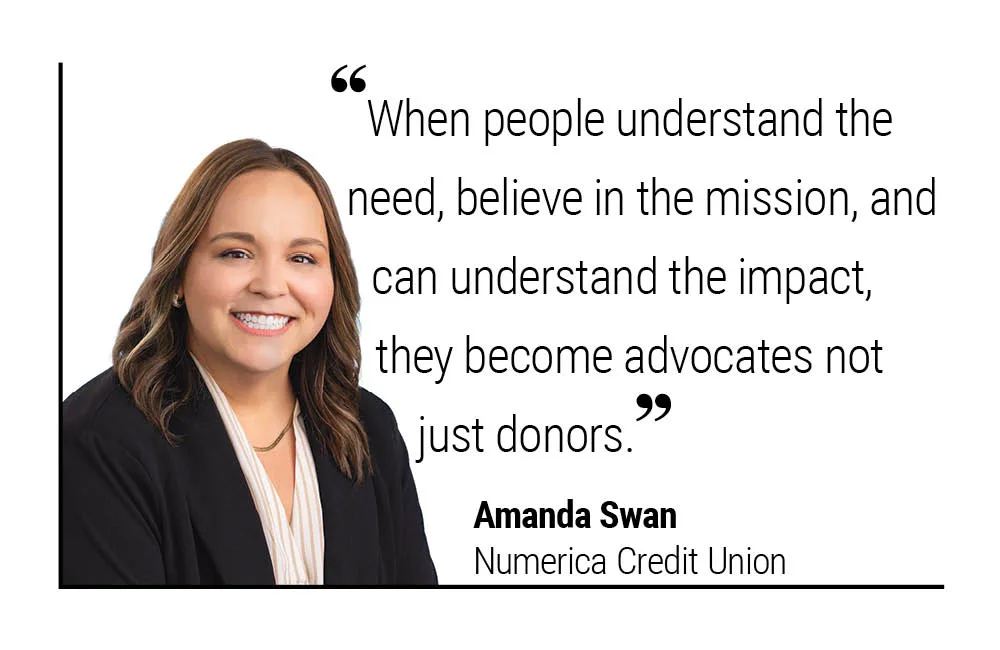
"When people understand the need, believe in the mission, and can see the impact, they become advocates, not just donors," Swan says.