Guest Column
Chad Mitchell: Measures of a successful life
Founding member of folk group formed in Spokane reflects on career, values, relationships
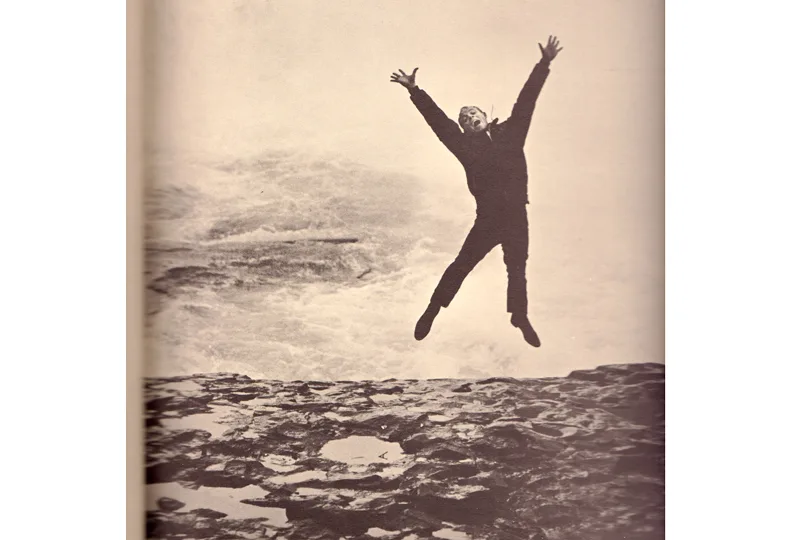
Chad Mitchell next to the Spokane River in a 1960s publicity photo for the Chad Mitchell Trio.
| Courtesy of Christine Mitchell“I’ve kind of wandered through life,” wasn’t the answer I expected from a founding member of one of America’s most formative folk groups. Most people assume Chad Mitchell spent decades chasing success. He insists the opposite is true.
At 89, from his home in Spokane, Mitchell speaks less like a celebrity reminiscing on a star-studded career and more like an engineer looking back on a lifetime of completed designs. Each chapter of his life — from the Trio to riverboats, real estate sales to community activism, and today as a local pickleball organizer — has been a sequence of worthwhile undertakings.
“I love the idea of a project,” he says. “Once complete, it’s put away, and I move on.”
His perspective is highly unusual coming from an era obsessed with career achievements, five-year plans, and corporate ladders.
“I was never career-oriented,” Mitchell says. "Goal-setting has never been a part of my philosophy.”
That doesn't mean he lacked ambition. It means he was driven by curiosity and the challenge of a new opportunity, rather than by the pursuit of a predetermined outcome.
That curiosity encouraged Mitchell, Mike Kobluk, and Mike Pugh to form the Chad Mitchell Trio while attending Gonzaga University in 1958. None of them started as trained musicians. In fact, Mitchell readily admits they knew very little about folk music. But with the guidance of Harry Belafonte’s assistant conductor, Milt Okun, the Chad Mitchell Trio grew from a college act into a defining group in the American folk revival.
The more Mitchell talks, the more apparent it becomes that music is only one thread running through his life. Though he was good at it, his deepest satisfaction wasn't performing.
"I enjoyed working on the arrangements," he says. "That was really fun ... bouncing musical ideas off each other and finally coming up with a really good arrangement. I enjoyed that much more than performing."
The Chad Mitchell Trio was known for sophisticated vocal harmonies, social commentary, and a razor-sharp wit. Mitchell lights up as he recalls that students at one of America's premier music conservatories studied the Trio's arrangements. That recognition mattered because it validated craftsmanship over celebrity.
Mitchell would like future generations to remember not simply that the Trio entertained audiences, but that they were musicians who cared deeply.
"We were really good singers," he says quietly. "We had a social conscience, and we were good stage performers."
Reflecting on his youth, Mitchell shared that one of his closest friends was a Black classmate named Hiram Clark. They participated in the same sports and regularly helped each other with their paper routes.
One afternoon, Mitchell's mother gently suggested they probably shouldn’t be seen together downtown. That comment stunned him. His mother was a kind and compassionate woman. Yet, like many people of her generation, she had absorbed attitudes about race from the world around her. Mitchell suddenly realized that prejudice wasn’t always loud and overt. Sometimes it was quiet and insidious.
Looking back, it's difficult not to see how experiences like that may have shaped the Trio's growing social conscience.
Years later, the Trio’s music increasingly reflected questions of social justice, civil rights, and war — not because the three young musicians had entered the music business as activists, but because they were becoming more aware of the world around them.
Long before audiences heard of Chad Mitchell, classmates knew something else about him. Whether in high school, college, or elsewhere, people consistently chose him for leadership positions. Twice, he was voted as the friendliest boy in high school — a distinction that still puzzles him today.
"I never understood why people gravitated toward me," he says. "I didn't think I did anything special."
When asked what values remained constant throughout his life, Mitchell answered with a chuckle, "Be friendly." Then went on, "Be fair. Be just. Be kind."
Those lessons eventually became the values by which he still measures a successful life.
"I don't think a life well-lived necessarily means accomplishments," he says. "It means making the most out of the gifts you have, giving to society and the people around you, ... being reliable and helping others.”
Those words explain much about what happened after the spotlight dimmed. While many performers spend retirement trying to recreate yesterday's applause, Mitchell simply moved on. He worked for Delta Queen Steamboat Co. in New Orleans. Later, he sold real estate, helped preserve a neighborhood dog park, and these days, organizes pickleball schedules. And, while none of these pursuits generated headlines, each became another opportunity to improve something.
When the conversation turned to John Denver, who replaced him in the Trio before becoming an international star, Mitchell didn't dwell on comparisons. Instead, he shared his admiration for how Denver used his fame to advance causes larger than himself.
"If I were a big star like John Denver was," he says, "I would hope I would use my stardom the way he did."
It's another revealing characteristic. Mitchell consistently redirects attention away from celebrity and toward giving to others. That perspective also shapes how he views his greatest regret. The strain of success didn’t end the Chad Mitchell Trio.
Relationships did.
He speaks candidly about the growing tension within the group and the anger that eventually convinced him to leave. Being part of a trio meant there were always two against one. Situations became so intense, he realized he no longer wanted to stand beside his partners at the microphone, which, in his words, “truly was crazy. So, I said, 'I've got to go.'"
Today, there’s no bitterness in his voice. Only honesty. Age seems to have replaced regret with understanding.
By every measure, fame left remarkably little trace on Mitchell's personality. Toward the end of our conversation, I asked what advice he would give his 25-year-old self. Professionally, he wishes he had studied acting and musical theater more seriously. Personally, his answer was much simpler. He repeated, “Be friendly, be just, and be kind."
For a man who spent years singing in perfect harmony, perhaps it isn't surprising that Mitchell believes the greatest measure of a life has nothing to do with applause. It has everything to do with how we treat the people standing beside us.
Kevin Spafford, CFP, is a partner adviser with Allworth Financial in Spokane. He is available at the office: (509) 624-5929; by cell: (530) 966-5560; or by email: [email protected].
Stay Informed. It’s Free.
Subscribe to our newsletters and get the latest news and insights delivered to your inbox.
We respect your privacy.
Unsubscribe anytime.
Thank you!
You’re subscribed. Keep an eye on your inbox for the latest updates.