A heavy load for carriers
Spokane’s trucking workforce shifts into gear despite hurdles
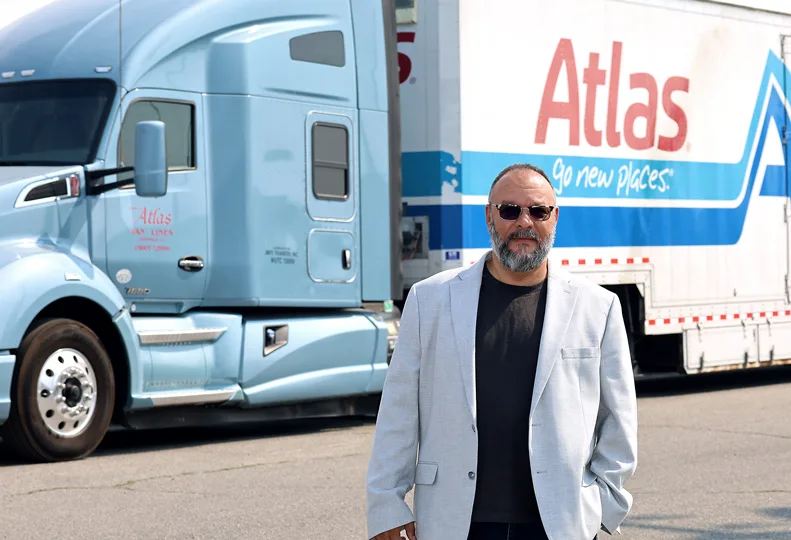
Matt Cortez, president at DeVries Moving Packing Storage, says higher fuel, vehicle, and maintenance prices are making it difficult to hire new drivers.
| Ethan PackSome Spokane-area trucking carriers are struggling to fill seats as an aging workforce and the elimination of some state apprenticeship programs hollow out the labor pool. While the industry experienced a brief post-pandemic rebound, job numbers in the county have since declined to 1,591 in 2025 — a 10-year low.
Before this decline, the number of general freight trucking jobs available in Spokane County had remained stable at an estimated 1,900 jobs for several years, according to U.S. Census Bureau data provided by Mike McBride, regional labor economist for the Washington state Employment Security Department.
The struggle to recruit drivers is being driven largely by a demographic shift, with the national average age of a truck driver at 60 years old, says Matt Cortez, president of Spokane-based Jim's Transfer Inc., which does business as DeVries Moving Packing Storage.
DeVries assists in commercial and residential moves primarily in the lower 48 states.
Additionally, Cortez says that many new recruits are facing hurdles in obtaining their commercial driver's license and joining the industry's workforce. Industry barriers include high costs of training, regulatory limits, and the end of some state apprenticeship programs.
CDL schools can cost more than $5,000 for a 160-hour training period and individuals interested in driving commercial trucks for a living must wait until age 21 to transport freight across state lines, which is generally more profitable than in-state trucking, Cortez explains. Additionally, Washington halted some trucking apprenticeship programs more than seven years ago, which made it more difficult for laborers interested in driving a truck at DeVries to train for a CDL, he contends.
The 10-year workforce low of 1,591 jobs in 2025 followed a temporary 2022 rebound to 1,817 jobs — which was fueled by government stimulus funding — after the market had initially declined to 1,750 jobs during the 2020 and 2021 pandemic years, according to data from McBride.
Government spending in 2022 sparked a wave of consumer demand and real estate activity, which benefited carriers such as DeVries, says Cortez. Stimulus funds authorized after the pandemic helped the trucking job market rebound, as the additional funds prompted spending, leading to additional contracts with trucking companies and more jobs to meet the demand, he explains. However, as stimulus funds ended and more remote workers returned to offices, shipping contracts became scarcer, leading to a contraction in the job market.
“We really haven’t had to hire locally, because we haven’t had a need to,” Cortez says.
DeVries handles both commercial and residential moves primarily in the Lower 48 states. Currently, out of the company's 43 full-time employees, four hold CDLs and drive within the Spokane region, Cortez says, adding that the company contracts with an estimated 15 drivers for long-haul interstate moving jobs.
Beyond hiring, many carriers here are battling rising fuel, maintenance, and equipment costs. Rising fuel prices attributed to the Israel-Iran war, and higher maintenance and vehicle costs due to inflation, also are impacting DeVries' bottom line, making it difficult to hire new drivers, Cortez says.
"A lot of people in the trucking industry are owner-operators, meaning they own their own truck,” he says. “After a job, the driver is left with only so much extra money, and a lot of it goes to fuel maintenance, mechanic prices, and those prices are extremely high right now.”
The trucking industry also is facing "chameleon carriers" — described as unregulated companies that avoid insurance and safety costs through deceptive practices, says Jeff Bosma, owner and president of Spokane-based Fast Way Inc., which does business as Fast Way Freight System Inc.
These operators are driving down freight rates, making it difficult for legitimate companies to grow or hire. Between 2023 and 2025, for example, Fast Way saw its hiring stall due to these lower market rates, says Bosma.
One method these carriers use includes renaming the company and changing the company’s U.S. Department of Transportation registration number following an accident or after a driver gets caught operating with a noncompliant vehicle or CDL, Bosma says. These carriers operate with little oversight and can afford to transport goods at a less expensive rate because they don’t comply with driver or vehicle regulations, Bosma contends.
Information from the Federal Motor Carrier Safety Administration shows that the number of new annual DOT registrations spiked between 2000 and 2025, an indication that chameleon carriers may have been registering as new companies with new DOT identification numbers to avoid complying with federal regulations, rather than an increase attributed to new trucking companies in operation, Bosma says.
New DOT registrations reached 61,000 in 2025, outpacing annual historical averages of 10,000 between 2010 and 2019 and 4,400 between 2000 and 2009, federal data shows.
To curb this trend of carriers skirting safety standards through re-registration, the legal landscape is shifting to place more responsibility on the companies that hire them. A unanimous U.S. Supreme Court ruling in May, Montgomery v. Caribe Transport II LLC, will require freight brokers that contract with trucking companies to more thoroughly vet carriers they hire. These companies can now be found liable if a driver gets into an accident and doesn’t have a valid CDL, if the vehicle is out of compliance, or if the carrier doesn’t have valid insurance, Bosma says.
The federal government also has made an effort to enforce other regulations since the start of the year, such as cracking down on illegal cabotage. Foreign commercial drivers and carriers are legally prohibited from hauling point-to-point domestic freight within the U.S., which is considered illegal cabotage under federal law, he explains. A carrier from another country can make a delivery or pickup to or from the U.S., but isn't allowed to transport to a location within the U.S., he adds.
Bosma attributes federal enforcement efforts for demand at Fast Way increasing after a period of falling revenue from 2023 to 2025. Fast Way is seeing business pick back up this year, says Bosma, who declined to disclose the company's 2025 earnings.
Fast Way hauls freight in Eastern Washington and North Idaho, with an average trip length of 175 miles for company drivers, he says. Following the recent increase in work, the company has grown its workforce to 72 total employees, including 55 drivers now on staff after several new hires were made this year.
Overall, Bosma says he expects the next few years to be better for the trucking industry and that more companies likely will begin hiring drivers in the Inland Northwest as business improves.
“I think we'll all be hiring more drivers,” Bosma says. “I could put five drivers to work today if we found the right ones, because now freight rates are coming back to where they should be.”