New Markets pipeline grows in Spokane
Organizations position themselves for a share of a $5B federal program
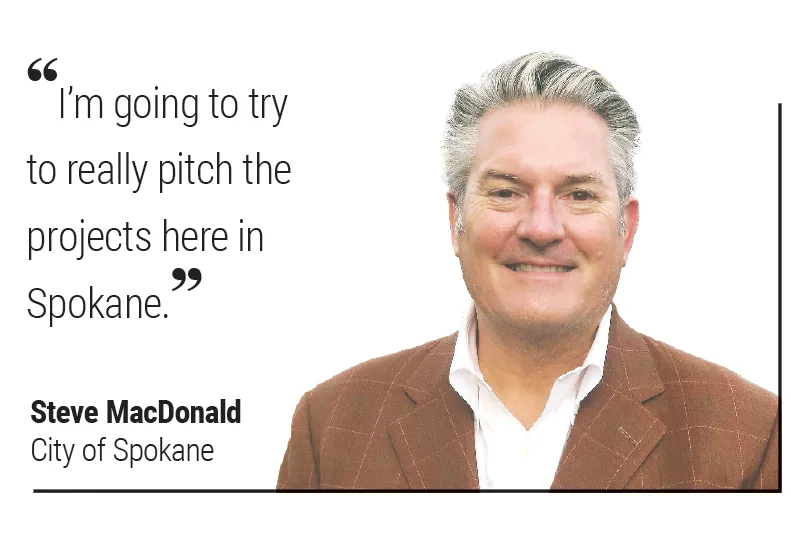
Organizations behind a growing pipeline of projects across Spokane — including a behavioral health center, a mixed-use childcare development, and an expanding transitional pediatric health facility — are actively positioning themselves for a federal tax-credit program to help their projects move forward, says Steve MacDonald, director of community and economic development for the city of Spokane.
The activity comes as the U.S. Treasury opens applications for a new $5 billion round of New Markets Tax Credits through its Community Development Financial Institutions Fund. The New Markets Tax Credit financing program is designed to spur private investment in economically distressed communities by providing tax credits to investors who finance qualifying development projects. New Markets Tax Credit projects typically require a minimum total project cost of $10 million to be economically viable.
Applications from Community Development Entities are due Nov. 10. New Markets Consultants — advocates hired by organizations who evaluate projects and gauge their New Markets Tax Credit eligibility — are working to get Spokane-area projects into those organizations’ pipelines, MacDonald says.
“The New Markets Consultants that have been connected to some of those projects are all trying to make sure the timing is right, that their project is in the pipeline within the Community Development Entity’s application,” he says.
Three Spokane organizations have hired consultants to help them attract and secure an investment from a Community Development Entity.
Spokane-based Maddie’s Place, a neonatal transitional facility, is a strong fit for the program, MacDonald contends. The organization, located at 1004 E. Eighth, is planning a $15 million campus expansion aimed at increasing clinical capacity, strengthening family support services, and enhancing long-term program sustainability.
“That’s a later 2027 project, but nonetheless, we’re asking that it be put in some (Community Development Entity) applications and making sure people are aware of this project because it’s a high-impact project,” MacDonald says. “They’re a perfect case for New Markets. There are groups out there that focus on that kind of issue; they’re really going to like that project.”
Frontier Behavioral Health, in partnership with Community Health Association of Spokane, has also hired a consultant and is seeking an allocation for its new building at 130 E. Sprague. The 10,000-square-foot clinic will connect patients of Frontier Behavioral Health to primary care providers and connect CHAS patients to mental health treatment. The project drew attention from several Community Development Entities, banks, and tax-credit investors in May at CohnReznick’s 25th Annual New Markets Tax Credit Summit, MacDonald explains.
“We’re hopeful on that one,” he says.
Another project that drew interest at the conference is the Northeast Public Development Authority’s plan to build a $12.5 million workforce housing project in Spokane’s Hillyard neighborhood.
As reported by the Journal, the project, centered on a half-acre of property at 3011 E. Wellesley, is envisioned as a three-story structure with 30 residential units on the second and third floors and a childcare center on the ground floor.
Other organizations are also showing interest in pursuing New Markets Tax Credits, a sign of growing momentum in a program that the region failed to leverage for over a decade, MacDonald says.
While he can’t disclose those organizations yet, he says he is looking forward to an industrial project on the West Plains that will bring 60 jobs to the area.
The New Markets Tax Credit program was authorized by Congress in 2000. Since its inaugural round in 2002 through the end of 2025, the program has awarded $91 billion to Community Development Entities. Those entities subsequently invested those tax credits into economically distressed communities, creating and/or retaining 950,000 jobs, supporting the construction of 106.2 million square feet of manufacturing space and 111.3 million square feet of office space, building nearly 15,000 affordable housing units, and generating $8 of private investment for every $1 of federal funding, according to the U.S. Treasury.
When MacDonald stepped into his role at the city a few years ago, he noticed that Spokane County had not closed any New Markets Tax Credit deals since 2011. He estimates that the lack of participation in the program conservatively cost the region between $50 million and $100 million in direct federal subsidy, and several times that amount in total project investment. Over the last couple of years, he has made it his mission to educate the business community about the program.
Those efforts have paid off. In September, Portland, Oregon-based Craft3, a nonprofit community lender and designated Community Development Entity that helps finance projects in underserved communities, finalized two tax-credit investments in Eastern Washington valued at $35.5 million.
"Having Craft3 get another award is going to help Spokane," MacDonald says.
Unlike a traditional grant program, businesses and nonprofits don't apply directly to the federal government for funding, MacDonald says. Instead, the tax credits attract private sector investment by incentivizing banks to invest in qualified projects through Community Development Entities, which are specialized lenders that have been awarded the tax credits by the U.S. Treasury. Banks receive a 39% tax credit over seven years in exchange for their investment in distressed areas, he says.
The value of an allocation also differs from the amount of money a project ultimately receives. A $10 million New Markets Tax Credit allocation, for example, can result in roughly $2 million in net financing benefit to a project that doesn’t have to be repaid.
MacDonald says he hopes the growing pipeline of projects marks a shift. He's planing to attend the next national New Markets Tax Credit conference in October, where he and consultants representing Spokane projects will meet with Community Development Entities and tax-credit investors and pitch projects in the city.
"I'm going to try to really pitch the projects here in Spokane," he says. "We'll really have the opportunity to tell the Spokane story and tell the story about all these projects."