Developers put commercial conversion program to work
Adaptive reuse takes shape with five projects in Spokane
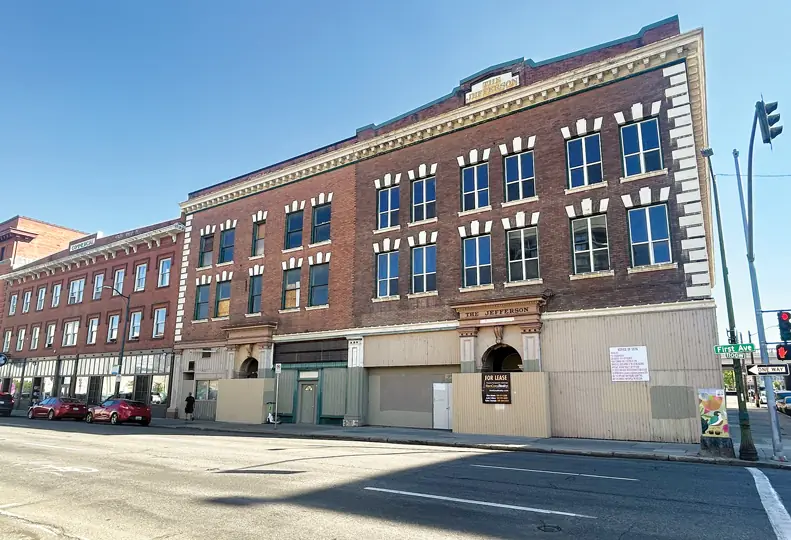
Construction of the Norman-Jefferson Apartments, located at 115 S. Jefferson, is expected to start this fall.
| Karina EliasOld offices, warehouses, and other underused commercial buildings in the city of Spokane are slowly finding new life as apartments, retail areas, and mixed-use spaces through the city’s 2-year-old commercial conversion incentive program designed to make difficult conversion projects more feasible.
The commercial conversion incentive program — passed in the 2024 Washington State Legislature and adopted in the city of Spokane in the same year — is designed to encourage developers and property owners to convert underused commercial properties into multifamily housing by allowing qualifying projects to defer sales and use taxes on construction.
To date, five commercial building conversion conditional applications are at various stages of development, says Spokane Planning Director Spencer Gardner. The five developments represent nearly 400 residential units and about $78 million in construction value.
Through the adoption of the conversion program, the city saw an opportunity to take the surplus of underused and vacant commercial buildings and incentivize their use as an additional tool to address the region’s housing shortage, he says. While only five projects are taking advantage of the program, the total is in line with what city leaders expected to see, Gardner says. As the city is an early adopter of the program, other models aren't yet available to compare progress, he adds.
“We have a lot of underused commercial space, and we have a housing crisis,” Gardner says.
The historic Wharton Building, at 411 W. First in Spokane, is the first project completed in the city through the incentive program, contends Chris Batten, developer and principal of Spokane-based real estate company RenCorpRealty LLC.
“I think it’s the first one, but it certainly won’t be the last,” Batten says.
Named the Wharton Lofts, the three-story structure has gone through a $3.5 million renovation featuring new commercial spaces on the ground floor, and 17 one-bedroom and studio loft-style units on the second and third floors. A certificate of occupancy was issued in June and several units already are occupied, Batten says.
Commercial tenants include Jupiter’s Eye Book Cafe and Korean Barbecue restaurant Gangnam Style, both of which opened in 2025, he says.
Through the Commercial Conversion Incentive Program, Batten and his partners will save 9% on the applicable taxed goods and services for the renovation of the residential portion of the project. To qualify for the program, at least 10% of the units must be set aside for affordable housing, he explains. The partners also applied for the city of Spokane’s Multifamily Property Tax Exception Program, which exempts the residential component of the project from property taxes for 12 years. The building also is on the Spokane and national historic building registers, offering tax savings for the commercial side of the project.
Batten is anticipating for construction to start this fall on a second project involved in the conversion program: the Norman-Jefferson Apartments, at 115 S. Jefferson. The three-story former single-room-occupancy hotel property has been vacant for about two decades and is a blight on downtown’s west end, Batten says.
“If not for the sales tax deferral, it would not get done anytime soon,” Batten says.
Built in 1909, redevelopment of the historic property calls for construction of 40 residential units on the second and third floors comprised of studios, one-, and two-bedroom apartments, he says. The ground floor will include retail spaces facing Jefferson Street and First Avenue, as previously reported.
The largest and most ambitious of Batten’s commercial conversion projects is the NODO Normandie multifamily development, located on two city blocks at 115 and 127 W. Mission. The $37 million mix-use project will create 237 residential units, and commercial spaces on the ground floor.
“NODO is kind of going to take a life of its own,” Batten says. “We’re trying to get some final touches to get that going.”
Two more projects taking advantage of the incentive program currently are under development by Jordan Tampien, co-owner of 4 Degrees Real Estate.
At 441 W. Sharp, in Spokane’s North Bank neighborhood, Tampien is redeveloping a 59-year-old Northwest Microfilm warehouse building into five live-work suites. Through the commercial conversion incentive program, Tampien says he will save about $80,000 in deferred taxes on the $1.25 million project. Each 1,600-square-foot unit is planned with two bedrooms plus a loft, he says. Tampien is anticipating the Sharp Lofts redevelopment to wrap up in 2027.
At 10 N. Post in downtown, Tampien is spearheading the $32 million redevelopment of the historic Peyton Building, a seven-story office property that's being converted into a 96-unit mixed-use apartment complex. Through the commercial conversion incentive program, Tampien estimates saving about $1.8 million in deferred sales and use taxes.
“The program’s amazing,” Tampien says. “If we didn’t have it, we wouldn’t have been able to get the Peyton project done.”
The office-to-housing renovation project has been paused since earlier this year following an unanticipated delay tied to asbestos removal, he says. Construction activity is expected to resume in the next few weeks, and completion of the Peyton Building renovation is expected in the third quarter of 2027, he says.
Despite the progress on the five buildings in the program, developers and city officials say broader economic conditions continue to make conversions difficult to pencil. Gardner says high material and labor costs, coupled with rents that don’t always support the cost of construction, remain large barriers to redevelopment.
“The rents just don’t justify building a lot of projects,” Gardner says.
While the commercial conversion incentive program can help reduce those costs, Gardner says the program alone isn’t enough to make every potential redevelopment financially feasible.
Batten points to rising interest rates and construction costs as additional barriers. However, the program’s affordable housing requirements aren't preventing greater participation, he notes.
“It’s a great program,” Batten says. “I just think development is difficult right now.”
Gardner says downtown Spokane offers some of the region’s greatest potential for commercial-to-residential conversion because commercial occupancy remains below historic averages and many older buildings downtown are physically better suited for adaptive reuse.
Potential changes to the commercial conversion program have also been floated among city officials and downtown stakeholders, including adjustments to income and other eligibility requirements, Gardner says.
For now, however, the city is focused on working within the existing program as its first group of projects moves forward, he says.

Stay Informed. It’s Free.
Subscribe to our newsletters and get the latest news and insights delivered to your inbox.
We respect your privacy.
Unsubscribe anytime.
Thank you!
You’re subscribed. Keep an eye on your inbox for the latest updates.