Agriculture labor crunch drives H-2A growth
Washington growers squeezed by increasingly narrow margins
Caught between shifting federal administrative rulemaking and ongoing litigation, some Washington state agricultural employers are struggling to navigate changing wage requirements and H-2A guest-worker regulations.
While Washington employers had about 36,000 H-2A positions certified in 2024, compared with fewer than 4,000 requested two decades ago, according to the most recent data from the Washington State Employment Security Department, growers report that administrative compliance and regulatory complexity carry steep financial burdens. For low-margin operations, any added administrative mandate directly jeopardizes long-term sustainability.
As it stands, Washington farmers are increasingly relying on foreign guest workers to fill jobs once handled by a larger domestic agricultural workforce, adding another layer of cost and complexity to an industry already struggling with narrow margins, says Jon DeVaney, president of the Washington State Tree Fruit Association.
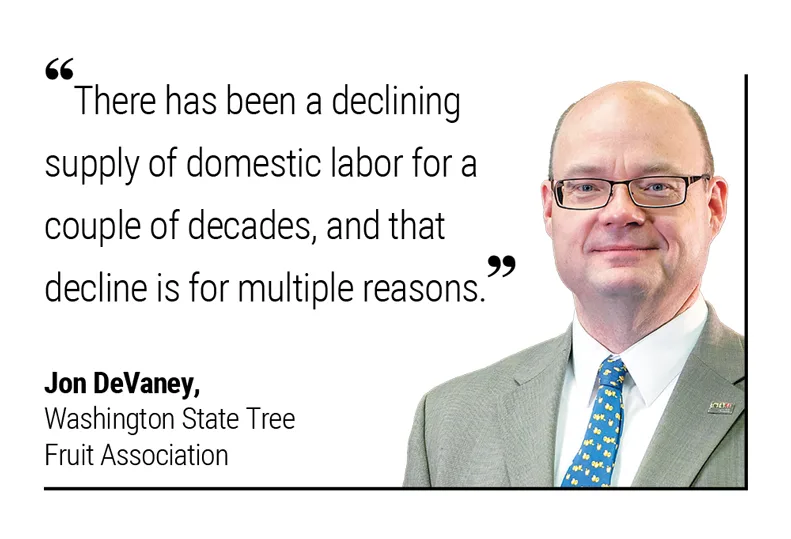
“There has been a declining supply of domestic labor for a couple of decades,” says DeVaney, "and that decline is for multiple reasons."
Washington has consistently ranked high nationally — fourth in 2024 — for H-2A use as growers contend with a declining domestic workforce and fewer people entering the industry. Adams and Franklin counties totaled over 5,000 Eastern Washington H-2A workers in 2024, while Spokane County brought in a handful.
The federal H-2A Temporary Agricultural Program allows agricultural employers who anticipate a shortage of domestic workers to bring nonimmigrant foreign workers to the U.S. to perform agricultural labor or services of a temporary or seasonal nature, according to the U.S. Department of Labor.
A proposal to reform the program, dubbed the Securing Agriculture's Workforce Act of 2026, was introduced to Congress in June. The act would expand access to employ nonimmigrant foreign workers for other sectors of agriculture, including dairy farming and livestock ranching. If adopted, the act would also prevent any sudden spikes in pay rates paid by producers year-over-year.
Labor pressure became part of a broader financial picture surrounding Brewster, Washington-based Brewster Heights Packing & Orchards LP, which does business as Gebbers Farms, when the company entered Chapter 11 bankruptcy protection in June.
Labor alone accounted for about 99% of the Washington apple producer's average return per bin in 2023, according to financial information cited in Gebbers' bankruptcy proceedings. DeVaney notes that industry research found the situation worsened with the 2024 apple crop, when labor costs reached about 110% of growers' returns.
“So you spent 10% more than every dollar you took in for your product just to pay your labor costs,” DeVaney says. "That's not sustainable."
Washington farmers have experienced several consecutive years of rising costs coupled with flat or declining returns, draining the financial reserves producers traditionally use to weather the agriculture sector's cyclical downturns, DeVaney explains.
Washington Agriculture at a Crossroads, an agricultural viability report from the Washington State Department of Agriculture, identifies rising input costs, workforce concerns, lost markets, land costs, infrastructure, and other factors as threats to the state's agricultural industry.
“They’re really getting pinched between rising costs and declining returns,” DeVaney says.
The H-2A program offers growers a more predictable workforce, but participating employers also assume costs beyond hourly wages.
Generally, employers must provide transportation and free housing, cover certain visa and processing expenses, guarantee a portion of contracted hours, and pay the highest applicable required wage, says Bertha Clayton, director of the Employment Security Department's Office of Agricultural and Seasonal Workforce Services. Washington also eliminated the overtime exemption for the agriculture sector, bringing the overtime threshold to 40 hours in 2024. This means employers now must compensate workers for overtime.
“The H-2A program is extremely expensive,” Clayton says.
While the agency remains neutral on domestic labor shortages and the overall merits of the guest-worker program, Clayton notes that employers rely on H-2A to secure a dependable workforce during peak seasonal demand. Increased immigration enforcement, however, could affect migration patterns among domestic agricultural workers who traditionally travel between regions as crops come into season, she explains.
Federal immigration detentions in Washington state spiked sharply this summer, reaching 699 in June and 688 in July. That marks a significant increase from the monthly average of 342 arrests over the preceding four months, and a steep jump from the 24 detentions recorded statewide during the same two-month period in 2024. While federal records obtained by the Deportation Data Project highlight the enforcement surge, the data doesn't specify how many detainees were farm laborers, leaving the direct impact on agricultural workforce trends unclear.
The Deportation Data Project is a centralized online repository that uses the Freedom of Information Act to obtain, publish, and analyze anonymized U.S. government immigration enforcement data. The project aims to provide transparent data to journalists, researchers, lawyers, and policymakers.
The labor shortage also has increased the importance of contractors that connect growers with workers, DeVaney says.
Recent cases involving Moxee, Washington-based Superbee Contracting LLC and Harvest Plus LLC, of Kennewick, illustrate the legal and financial risks farms can encounter when labor contractors don't follow state and federal requirements.
Investigators accused both businesses of violations involving workers who were recruited through the H-2A program, including allegations of fraudulent visa applications and misrepresentations concerning jobs and working conditions. Federal prosecutors also have alleged workers were subjected to exploitative conditions after being recruited from Mexico. Those allegations remain subject to court proceedings, according to the Washington State Department of Labor and Industries.
“These are bad actors in the industry,” Clayton says.
The Employment Security Department's Office of Agricultural and Seasonal Workforce Services assisted in the cases, and the allegations potentially rise to the level of human trafficking or forced labor, Clayton contends. However, such cases aren't representative of most Washington agricultural employers, many of whom actively seek assistance understanding H-2A's complicated requirements, she explains.
Farmers can protect themselves by verifying that farm labor contractors are properly licensed and by reviewing state records for complaints, debarments, or revoked licenses, DeVaney says.
“It is important to really ask difficult questions when you’re working with a contractor,” he says.
Washington's Agricultural and Seasonal Workforce Services Advisory Committee annually brings together agricultural employers and worker advocates to recommend improvements to the state's administration of H-2A, says Clayton.
Federal policy remains another source of uncertainty, and Clayton explains H-2A regulations and wage requirements have changed repeatedly through administrative rule making and litigation.
Greater long-term certainty would allow farmers to plan for labor expenses without reorganizing operations every time federal rules change, DeVaney says.
For growers, those discussions come as the industry attempts to balance worker protections, reliable access to labor, and the economics of farm production in Washington.
“You can’t just wave away the cost increases of new regulations and assume that it can be passed on,” DeVaney says.