Bridging the NIL gap
Gonzaga students launch mobile app connecting small businesses, college athletes
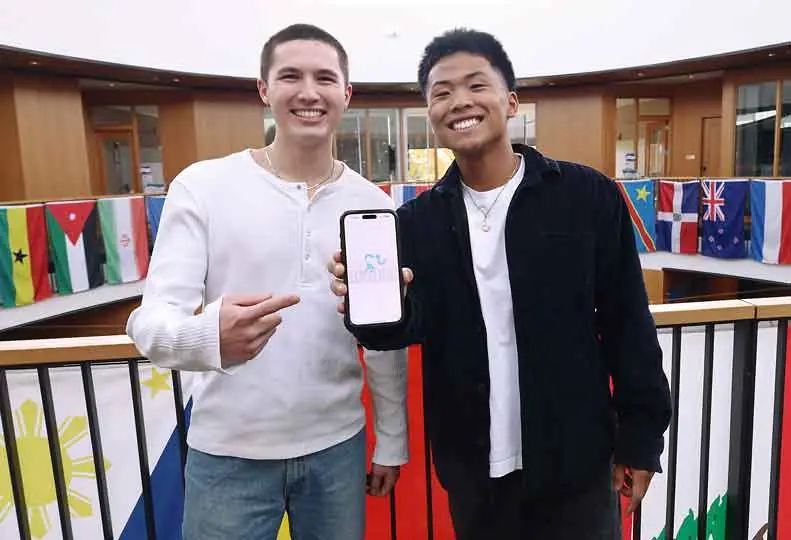
Jesse Riodil, right, and Jake Mosby launched Bridge NIL, a mobile application that connects student-athletes with small businesses.
| Karina EliasWhen college athletes gained the ability to profit from their name, image, and likeness in 2021, Gonzaga University student Jesse Riodil saw an opportunity that never materialized for him during his four years playing on the men’s soccer team.
Now a graduate, Riodil, together with Gonzaga University senior Jake Mosby, is trying to change access to those opportunities through Bridge NIL, a mobile application designed to connect college athletes in less publicized sports such as tennis, baseball, soccer, and track with businesses seeking NIL partnerships.
For Riodil, owner and founder, the app is intended to bridge the gap — hence the name — and allow all athletes to make NIL deals while small businesses gain access to a market previously dominated by big brands.
How Bridge NIL works
Launched Sept. 14 on the Apple Store, Bridge NIL LLC is designed similarly to a dating app, Riodil says. Using a swipe-based matching feature, businesses and athletes can swipe to discover one another and connect. When matches are made, businesses can use the platform to arrange promotional collaborations. Since launching, five deals have closed on the app, Riodil says.
Sponsorship pricing is based on an athlete’s social media following, using a rate of about 10 cents per follower, which gives businesses flexibility to find athletes whose sponsorship costs fit their marketing budgets, says Mosby, chief operating officer and partner. For example, the sponsorship cost of an athlete with 4,000 followers is equal to $400 for a one-time deal. Bridge NIL receives 10% of each completed deal arranged through the app.
A Gonzaga basketball player might have a large national following, but a lesser-known athlete whose audience is concentrated in Spokane could be more valuable to a business here, Mosby contends. While a recognizable player might have a national audience, a follower in Florida, for instance, is unlikely to visit a Spokane cafe simply because a Gonzaga basketball player promotes it, he explains.
“Most of these local businesses can’t afford to pay a Gonzaga basketball player tens of thousands of dollars,” Mosby says. “Smaller athletes do have more pull for these smaller businesses. It’s a win-win for both the athlete and the business.”
High-profile athletes in major athletic programs have dominated the first five years of NIL, explains Ryan Turcott, associate professor of kinesiology and sports management at Gonzaga. Companies like Bridge NIL can expand the market by connecting businesses with smaller marketing budgets with athletes who previously might not have been considered for sponsorship.
“There’s a lot of opportunity for other organizations who maybe thought that the men’s basketball or women’s basketball team was too expensive,” Turcott says.
Spokane is well-positioned for NIL partnerships, Turcott notes. Gonzaga athletes are among the region’s most recognizable sports figures and, unlike larger markets where businesses have numerous professional athletes to choose from, businesses here have relatively fewer professional sports teams competing for endorsement deals.
A changing regulatory landscape
The app arrives as the NIL landscape undergoes a transformation following the NCAA’s introduction of revenue sharing between universities and student-athletes in 2025. Previously, NIL agreements were often used to attract and retain high-profile athletes, but with universities now able to compensate athletes directly, traditional sponsorships could increasingly serve as supplemental income for athletes across a wider range of sports, Turcott says. As previously reported by the Journal, the NCAA revenue sharing program caps revenue sharing between Division I schools and student athletes. For the 2026-2027 school year, the cap is $21.3 million, up from $20.5 million in its inaugural year.
However, the new revenue-sharing program has also introduced restrictions on third-party NIL agreements, complicating operations for organizations that have helped facilitate athlete compensation since NIL rules first changed in 2021. Tim Brandle, treasurer of the Cougar Collective, a nonprofit corporation that raises funds for Washington State University student-athletes, cites the launch of revenue sharing as the biggest development in NIL.
The first few years of navigating the NIL gave way to a “wild west” in which suddenly, players were moving between schools, chasing high-priced NIL offers. The landmark House v. NCAA settlement, signed in June 2025, established new oversight of third-party NIL agreements in an effort to prevent schools and affiliated organizations from circumventing revenue-sharing limits, Brandle says.
The settlement also established the College Sports Commission to oversee and enforce rules related to third-party NIL deals, explains Brandle. Now, NIL deals must be approved by the Commission’s official online reporting and disclosure platform, NIL Go. According to the College Sports Commission, all third-party NIL agreements worth $600 in value or more must be reported to NIL Go.
London-based Deloitte Consulting, a global professional services firm, built, administers, and runs NIL Go. The company reviews submitted deals and assesses whether the compensation reflects legitimate commercial activity and fair market value, Brandle says. Factors such as an athlete’s social media following, their sport, and profile can influence how a deal is evaluated, he says.
For NIL collectives such as the Cougar Collective, the new oversight system has complicated how they compensate student-athletes, Brandle says. Under the previous system, collectives could negotiate agreements directly with athletes in exchange for promotional services. Now, certain third-party agreements are subject to review and collectives affiliated with universities face heightened scrutiny to prevent schools from circumventing the revenue-sharing cap.
For the Cougar Collective, the new framework has caused delays and rejected contracts. Brandle says the organization submitted between 20 and 30 agreements for review following the settlement, some of which went unanswered for months. By the time the collective received rejection notices, some athletes had already fulfilled their contract negotiations and graduated.
“It’s just truly insane,” Brandle says.
The collective has since adjusted how it operates while continuing to honor its commitments to athletes, he says. Despite the challenges, it continues to work alongside WSU to support student-athletes.
Brandle, an attorney, also questions whether the restrictions on agreements between athletes and third-party organizations can withstand potential legal challenges. He contends that preventing private parties from entering into otherwise lawful contracts raises constitutional concerns.
“My lawyer hat says these are a violation of the Commerce Clause of the U.S. Constitution; this restraint on trade is illegal,” Brandle says.
Brandle expects collectives to evolve as universities take on a greater role in compensating athletes directly. For the Cougar Collective, that could mean a greater emphasis on fundraising, donor engagement, and supporting athletic programs rather than negotiating individual NIL agreements.
Looking ahead
While the regulatory landscape remains unsettled, opportunities for traditional NIL sponsorships continue to emerge.
For Bridge NIL, Riodil and Mosby are focused on turning those opportunities into a sustainable business. Although athletes have shown interest in the platform, educating businesses about NIL partnerships and converting matches into completed deals remains their biggest hurdle, they say.
Riodil and Mosby are working to establish Bridge NIL in Spokane before expanding to serve athletes and other businesses at other universities, including Eastern Washington University and Whitworth University.


Stay Informed. It’s Free.
Subscribe to our newsletters and get the latest news and insights delivered to your inbox.
We respect your privacy.
Unsubscribe anytime.
Thank you!
You’re subscribed. Keep an eye on your inbox for the latest updates.