North Idaho combats physician shortage
Problem shown to be more pronounced in rural counties
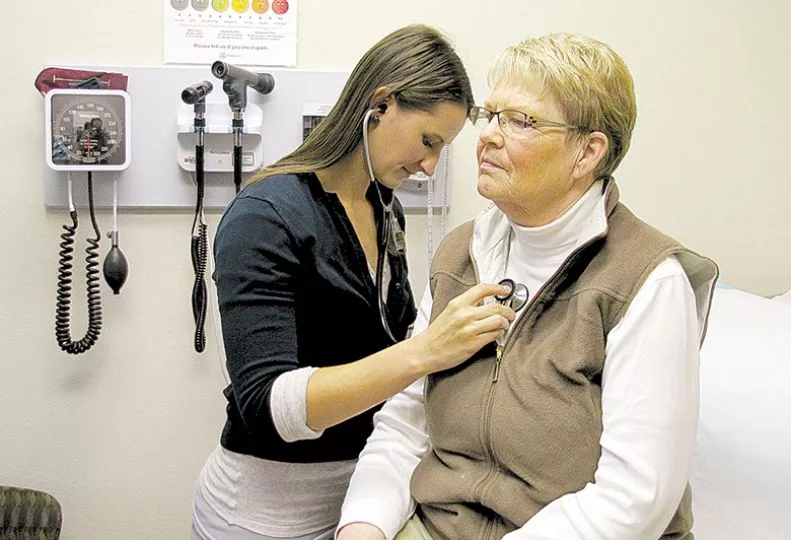
Though it hasn’t reached a critical point, a shortage of doctors in Idaho is plaguing the state, which ranks 49th nationwide in physicians per capita.
Those numbers aren’t getting any better, some North Idaho medical professionals say.
According to the American Medical Association, 1.6 doctors work in Idaho per 1,000 residents in 2016, down from 1.9 physicians per 1,000 in 2013. That’s well below the nationwide ratio, which was 2.6 per 1,000 people last year.
By contrast, neighboring Washington had 2.6 per 1,000 and Montana had 2.2 per 1,000. Only Mississippi had fewer per capita physicians than Idaho, with 1.4 per 1,000.
The shortages are most severe in the state’s most rural, underserved areas. And unless there’s a shift in what’s trending in the medical community, the outlook isn’t good for the Gem State, officials say.
Brian Jerome, director of physician recruitment and retention at Kootenai Health, in Coeur d’Alene, says it boils down to economics and education.
“There are not a lot of physicians (in Idaho) because the days of practicing medicine in rural areas are just no longer an option, and let’s face it … we live in a rural state. You just can’t have a clinic in a rural community and stay afloat,” Jerome says. “The cost of doing business as a physician—it’s just too expensive; it’s astronomical.”
In North Idaho, a lower population mostly means a lower number of doctors.
According to 2016 U.S. Census Bureau population estimates and American Medical Association ratios from the same year North Idaho counties have the following ratios: Kootenai County, population 150,346, 2.1 physicians per 1,000 people; Bonner, population 41,859, 1.8 physicians per 1,000; Benewah County: population 9,052, 1.3 physicians; Boundary County, population 11,318, 0.7; and Shoshone County, population 12,432, 0.6.
The absence of an accredited medical school in Idaho contributes to the doctor shortage, Jerome says.
“We don’t have the pipeline of medical students in this state that we’d sure like to,” he says. And while Idaho does have three medical residency programs, most graduates tend to pursue their careers in other states. Political intervention may be the answer, he says.
“I would certainly love for the powers that be in the governmental arena to focus on, ‘how do we improve access to the local medical schools for graduating high school kids,’ and really try to encourage young potential doctors to consider the field of medicine and stay in Idaho,” Jerome says.
Catching up with the need, Idaho’s first medical school, the Idaho School of Osteopathic Medicine, is being built in Meridian. The first classes are expected to start in August of 2018 in the 94,000-square-foot structure that’s under construction.
While that’s great for the Gem State, Jerome says, it may not do much to help the physician shortage in North Idaho.
“It will certainly be of value; however, the vast majority of new physicians tend to stay and practice upon completion close to their residency … programs,” Jerome says.
According to the Journal of Medical Economics, an academic journal that covers medical trends, most medical graduates practice near where they trained, which explains the primary care shortage in rural areas.
More than half of all family medicine residents practice near where they trained, a series of individual decisions that have far-reaching implications for the U.S. primary care shortage.
“What we’re struggling with is trying to get people from out of state to come to Idaho … but I think it’s always going to be a challenge until the governmental arena really starts to focus on how do we promote access to medical schools in our state,” Jerome says.
Melanie Collett, public information officer for the Panhandle Health District, concurs. She says the agency, which serves Idaho’s five northernmost counties, is focused on providing quality medical care throughout the region and supports the recruitment of more doctors in all facets of the medical community—particularly in the area of mental health—which she says currently has the largest need for more health care professionals.
“We’re working closely with our partners, including Kootenai Health, to make medical care access a top priority,” Collett says.
Jerome says much of the issue boils down to economics.
“The challenge becomes they (med school graduates) already have $200,000-plus in debt and now they have to go and buy into a practice.” It’s just not attractive, he adds, to lure doctors to rural areas, “because there’s not a lot of employment opportunities.”
“There’s a new focus on quality of life for med students … they want to be put in a position where they can focus on medicine. They didn’t go to school to learn how to operate a business,” Jerome says.
The trend for today’s doctors is to seek out careers with an established hospital or clinic. And with the proliferation of urgent care facilities and specialty hospitals that offer the promise of a steady income with no overhead, many new doctors are choosing to be employees of a health care network rather than starting or acquiring a practice.
“The trend in the past five years is the idea of employment where physicians are being employed by multispecialty groups,” he says.
With the state’s physician demographic getting older—the U.S. Census Bureau reports that the average Idaho doctor is 52 years old—the need to recruit and retain younger doctors has never been more important.
Another factor to the growing need for physicians is that today’s emerging doctors—while dedicated and highly trained—are not as apt to work the long hours of the doctors of yesteryear.
“Where the docs of old would set up a practice and work 90 hours a week, that’s not the case today,” Jerome says. “This generation is all about a balanced lifestyle and working closer to a 40-hour work week. That means it’s going to take 1.5 docs to replace one doctor from the previous generation”.