
Research probes sleep cycle, cancer treatment link
Timing drugs to patient's internal clock could increase efficiency
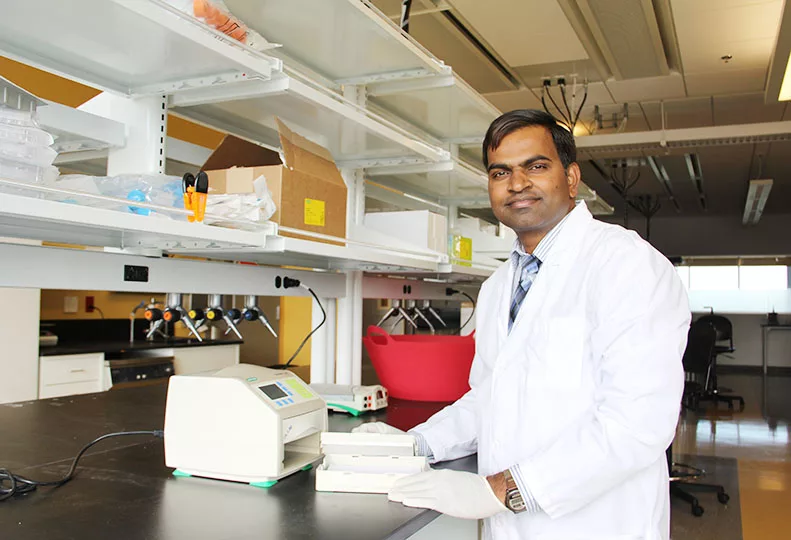
A researcher at Washington State University Spokane is studying the way the body’s biological regulatory system, called the circadian clock, influences skin cancer and the treatments used for it.
Dr. Shobhan Gaddameedhi, an associate professor at WSU Spokane’s College of Pharmacy who moved here from the biochemistry and biophysics department at the University of North Carolina Chapel Hill just over a month ago, contends that the time of day that people undergo cancer treatments can be important.
Every cell in the body has what’s known as the circadian clock, Gaddameedhi says, which is what regulates all its cell processes. Also, the expression of as many as 10 percent of all genes is regulated by the clock, he says.
“There’s a lot of research on the effects of the circadian clock on organs like the liver and heart, but not so much on the skin,” Gaddameedhi says.
The most severe form of skin cancer, melanoma, develops from the abnormal growth of the cells in skin that cause pigmentation, known as melanocytes. Exposure to the sun and its ultraviolet rays is a major risk factor for melanoma, as it causes mutations in the cells, and causes changes in the immune system when it responds to sunburn.
Modern society has somewhat disrupted the circadian clock, Gaddameedhi says; before the invention of the light bulb, people mainly went to bed when it was dark and woke up with the sun.
“Today, cities are full of lights,” he says.
The circadian clock can also be disrupted when a person has to work a late or overnight shift, Gaddameedhi says.
Disruption of the circadian clock can have a negative effect, he says, noting that it’s implicated in a number of chronic conditions, such as diabetes, heart disease, and cancer.
Gaddameedhi’s research is being funded by an almost $900,000 grant from the federal National Institutes of Health. The grant runs from September 2013 to August 2018.
The research focuses on a specific process known as nucleotide excision repair, or NER, which repairs ultraviolet and other damage done to DNA.
Through research on mice, Gaddameedhi has found that a skin cell’s capacity for repair oscillates with the circadian clock, as does the replication of cells in the skin. The repair and replication cycles are “anti-phase,” or opposite, of each other.
One of Gaddameedhi’s research goals is to investigate a practice called chronotherapy. Chronotherapy is administering treatments timed to a patient’s circadian clock. By understanding the circadian rhythms and NER cycles of both the healthy and cancer cells, doctors can time treatments to be the most effective, Gaddameedhi asserts.
“If you can inject the drug when cell repair is high, it will be less toxic and have fewer side effects,” he says.
Gaddameedhi says that a 2012 study done on mice at the University of Southern California in Los Angeles showed that mice that were given radiation therapy in the evening, when their repair was high, had dramatically less hair loss than mice that received radiation in the morning.
“In that study, the patients who had their radiation in the morning—when the cells are very sensitive—had 85 percent hair breakage,” he says. “In the evening, those patients had about 20 percent breakage.”
Gaddameedhi says it’s important to note that mice are nocturnal, while humans are diurnal, so their circadian clock is the opposite of humans. Based on this, people would probably be more sensitive to radiation exposure in the evening. However, experiments on people need to be conducted before that premise can be confirmed, Gaddameedhi says.
If drugs can be given at a time when the healthy cells are in the repair process, and when tumor cells are less defensive, the treatments could be more effective, he says.
The concept of chronotherapy isn’t standard practice for oncologists now, Gaddameedhi says, because it’s still in the experimental stages.
“When I was in Chapel Hill, I spoke to an oncologist about it, and he was surprised,” he says.
Doing the research at WSU’s School of Pharmacology is an advantage, Gaddameedhi says.
“We can collaborate with people who know how the drugs work in the body,” he says.
Another of Gaddameedhi’s research goals is to try to understand how the circadian clock might affect the body’s immune response to UV exposure and sunburn, he says. He also wants to collect samples from people who work late or overnight shifts, and those who work regular hours, to study the differences in their genes and hopefully identify which genes are being affected by the disrupted circadian clock.
Gaddameedhi also has an interest in mentoring high school and college students who may be interested in research or pharmacology, he says.
“Basically, I believe that the young generation is already very smart and talented,” he says. “They need to understand what they want to do with their careers, and if research is the right fit for them. I want to give an opportunity to any of the younger generation who want to explore research.”
Gaddameedhi earned his bachelor’s degree in biology and chemistry from Osmania University, and a master’s degree in plant sciences from the University of Hyderabad, both in India. He also has a Ph.D. in pharmaceutical sciences from North Dakota State University, in Fargo, N.D.

Stay Informed. It’s Free.
Subscribe to our newsletters and get the latest news and insights delivered to your inbox.
We respect your privacy.
Unsubscribe anytime.
Thank you!
You’re subscribed. Keep an eye on your inbox for the latest updates.