Influencer brand endorsements carry complexities
Federal agency regulates misleading advertisements
The notion of performers, professional athletes, and other famous people partnering with a brand to bolster sales or exposure of a product or business is hardly a new concept.
Now, however, just about anybody can become—or attempt to become—famous on social media, and it’s important to know what federal laws need to be followed by all parties in influencer contracts and how not to fall prey to false promises, says George Brunt, a partner at Spokane law firm Lee & Hayes PC.
"There's nothing new here, but I think there were the Wild, Wild West days where people were just all over the place and not taking any care to prevent false advertising and were being deceptive," Brunt says. "I think we're going to see more enforcement and regulation around this to try to protect the consumer. That's the foundation of trademark law itself."
Brunt chairs the firm's corporate practice group, which focuses on growing startups and handles media and intellectual property. He has seen an uptick in deals involving influencers and businesses, which have become a growing part of his practice.
For local businesses, the most important thing that Brunt recommends to his clients is to create a contract with an influencer that requires the influencer to abide by the rules set forth by the Federal Trade Commission and which, if not followed could be terminated or grounds for not paying, he says.
The Federal Trade Commission enforces laws that prevent unfair, deceptive, and fraudulent business practices. It regulates influencers to ensure they are transparent about their brand endorsements and don’t promote false or misleading advertisements to the public.
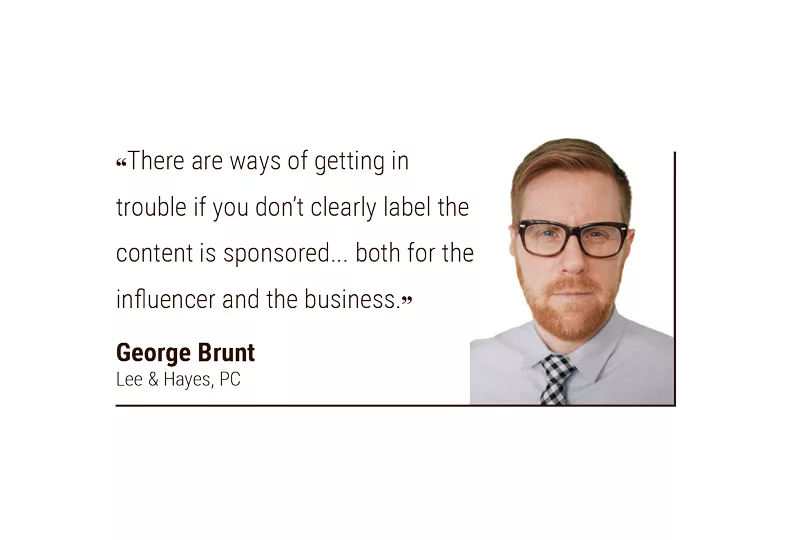
“There are ways of getting in trouble if you don’t clearly label the content is sponsored ... both for the influencer and the business,” he says.
According to the FTC’s endorsement guides, the key rule to follow is that the person endorsing a product through social media should make their relationship or “material connection” to the brand obvious, including if the connection is a personal, family, employment, or financial relationship. Economic relationships aren't limited to money but include free or discounted products or other perks. Even if that person has disclosed their relationship in the past, every new endorsement should be clearly marked so as not to mislead audiences just discovering the promotion.
Where the disclosure is placed is also important. The disclosure cannot be mixed within phrases; if the endorsement is on a picture on social media for example, it needs to be superimposed over the image. In a video endorsement, the disclosure should be said in the video and not in the written description of the video. An influencer can't promote a product they haven't tried, and they must be honest about their reviews and endorsements.
The contracts that Brunt has handled for businesses partnering with influencers cover a range of stipulations, including an agreement to follow the guidelines of the FTC, abiding by a morality clause, length of time of the partnership, and who owns the content. Most contracts he’s seen range from $5,000 to $10,000 a year—and occasionally more.
“I’ve never done a single-post transaction. It’s more of a relationship where for a year they’ll post once or twice a month,” Brunt says. “I’ve done them where the brand needs the approval of every post before it goes out, and I’ve done other ones where it’s a little looser.”
However, partnering with an influencer is not a magic wand, Brunt says. He’s had clients get excited about collaborating with an influencer with a half-million followers and expecting a large sales bump after that influencer makes a social media post only to be disappointed.
“There is a bit of fatigue out there on the part of consumers," he says. "They get a lot of sponsored content pushing products.”
Perhaps the model that works best when working with influencers is affiliated marketing, says Brunt. In this model, the affiliate promotes a product or service and makes a commission when a purchase is executed on the affiliate link.
“There needs to be clear disclosure that if you buy from this link, then that influencer gets a commission,” Brunt says. “But that tends to align interest a little better where it’s not just a pay-to-post situation. It’s: Here’s a unique link, if you direct web traffic to this link and consumers buy from your link, then we keep track of it, and the influencer gets a commission from it.”
Some of the repercussions of not abiding by these laws include civil penalties, action from the FTC, and loss of business contracts. Perhaps the most important one to some is the loss of the public trust, he says.
According to Morning Consult, a business intelligence company, 57% of people in Gen Z, born between 1997 and 2012, say they would be an influencer if the opportunity presented itself.
Because the appeal to become an influencer is so widespread, many aspirational influencers will try to grow their audience by presenting a misleading or unrealized connection with a brand, Brunt says. In these cases, a business could file a civil action, called a 43(a) claim, under the federal Lanham Act, which addresses false advertising.
“It is akin to trademark infringement where the influencer would be infringing on the brand,” he says.
Spokane-based influencer Erin Peterson, publisher of Trending Northwest, says she keeps abreast of the FTC’s guidelines with each endorsement and only collaborates with advertisers whose product and business she can give an honest review.
“We form a really close relationship with (advertisers),” Peterson says. “We really value trust with our audience, so they know that if we share something, even if it’s an advertisement, we stand behind them and their products."
In the Inland Northwest, however, a lot of influencers promoting brands generally don’t disclose their promotions. Peterson knows that because Trending Northwest sometimes has been given the same offer for the same promotion.
“They don’t want people to know, because, sometimes, if it’s denoted as sponsored content, people will engage with it less,” she says.
Peterson says that deciding to collaborate with an influencer is more than simply going by that person’s followers on social media. An influencer might have gained thousands of followers from one viral post, but may not have been able to create that same engagement over time and is “buried by the algorithm,” which filters irrelevant or low-quality content.
Brunt says it’s important to evaluate an influencer diligently before collaborating with them instead of simply scanning their number of total followers.
“Total followers is not the same as current engagement,” Brunt says. “You want to see how many likes, how many reposts, and how many views they are getting on their recent content to make sure that follower count is not inflated or artificial somehow.”