2025 Rising Stars: Joey Gunning
Greater Spokane Incorporated exec supports economy, rural areas, arts

When Joey Gunning left Eastern Washington University with a business administration degree in 2016, he didn’t have an answer for the classic question of what to do next.
He moved to Spokane that same year seeking an ideal employment opportunity. A role he describes as the “right fit,” that would blend strategy with community connection and allow him to spend as much time meeting people as staring at spreadsheets.
It was by accident that Gunning found an open position at Greater Spokane Incorporated, the Spokane region’s combined chamber of commerce and economic development council.
“I didn’t really know what economic development was or what GSI was,” Gunning says. “I just found it on a blind Indeed job search."
GSI's job posting promised time in the office and in the field, and importantly, offered direct contact with the region’s businesses. Gunning joined the organization as business growth coordinator in 2019.
Gunning grew up in Davenport, Washington, and went to school in Cheney, where wheat crops pass through small-city corridors, that feed into Spokane’s urban core. Those roots inform how he carries out his work.
“GSI serves Spokane County as a whole and not just the city of Spokane,” he says. “Partnering with rural businesses helps foster lasting relationships.”
In his view, a strong regional economy requires participation and focus on farm towns and bedroom communities as well Spokane's downtown core and industrial districts.
Within six months of joining GSI, Gunning says he was tested with the arrival of COVID-19, and with it a wave of uncertainty that threatened to shutter businesses and erase livelihoods. Gunning’s initiation to the role required a crash course in urgency.
“We were the organization that got to distribute a lot of emergency grants to local small businesses,” he says. “Money from the state, and federal money as well, passed through the hands of GSI and on to small businesses.”
Business owners used the grant funding to keep their employees on payroll and keep the lights on, he says.
“We literally helped businesses keep their doors open,” adds Gunning.
For Gunning, the experience cemented the importance of economic development in a community: to help employers problem-solve, connect to resources, and advocate for economic conditions in which businesses can grow. Since that time, he has leaned into long-term planning, where decisions set a course for the next decade.
Gunning says he's especially proud of GSI’s role in launching Thrive Spokane, a comprehensive and collaborative economic strategy designed to align the region’s public and private partners for long-term growth.
“Spokane County had not had a strategy like this in over 20 years,” Gunning says, adding that the initiative was developed over 16 months to “bring all partners to the table and create a collective vision about where the economy could be in five years.”
As economic developer, Gunning's role involves listening to business owners discuss challenges, then figuring out how GSI can help.
Programs aimed at specific needs resonate with him, such as the Spokane Inclusive Business Catalyst, a business accelerator designed to serve historically underserved entrepreneurs. The model pairs workshops and mentorship opportunities with community-based organizations. Businesses that complete the catalyst program receive $5,000 in grant funding from GSI.
“We saw a lot of improvements through this model including businesses getting substantial revenue growth or employee retainment,” he says, adding that the point of the accelorator program is to help small businesses with cash flow, compliance, branding, and hiring support.
Gunning also wants to expand who qualifies for support from GSI. One of his goals is to push for more assistance tailored to creatives and artists — those who add value to the regional economy but who often don’t qualify for traditional small-business tools and resources.
“Art-driven businesses can’t always access the same type of assistance that sales- or product-driven businesses do,” he says. “More help needs to be readily available for the creatives in our communities.”
Practically, that could involve revisiting eligibility criteria for grants or technical assistance, building mentorship networks that include creative professionals, and ensuring that cultural enterprises participate in broader strategy conversations.
Gunning frames his motivation in terms of faith and service.
“I serve Jesus by helping shape an economy where families can thrive and everybody has the opportunity to contribute,” Gunning says.
Gunning's job requires switching from a spreadsheet to a site visit to a council briefing, often in a single morning while keeping an eye on trends in housing, workforce development, and infrastructure.
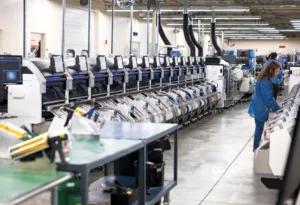
In the office, Gunning spends time diving into data and policy. Field days are spent touring manufacturers or checking in with retailers. Each interaction, he says, adds another tile to the mosaic of a regional economy.
He credits the region itself and its capacity to scale that make his work possible. Spokane is large enough to support industry clusters, higher education, and a growing tech presence, and also is small enough that people often know the person who can help.
After six years, Gunning is clear-eyed about the challenges ahead — ensuring that growth doesn’t outstrip infrastructure, expanding access to child care, and training workers for evolving industries — and he's equally clear about the opportunities available.
He sees momentum in the partnerships forged through Thrive Spokane, and applauds programs that meet owners where they are, and that recognizes rural towns and creative enterprises as essential to the region’s economic fabric.
What began as a blind click on a job listing has become a vocation that fits. The role lets him toggle between planning and people. He can alternate focus on five-year horizons and a business owner who just needs someone to return a call.
“This opportunity has been awesome and has opened a lot of doors during my time with GSI,” he says.
If there’s a through-line to Gunning’s career outlook, it's the belief that economics is a means to an end, he explains.
“For me, economic development really boils down to quality of life,” says Gunning. “That’s why we do what we do, it’s to improve the quality of life for our businesses and residents."

Stay Informed. It’s Free.
Subscribe to our newsletters and get the latest news and insights delivered to your inbox.
We respect your privacy.
Unsubscribe anytime.
Thank you!
You’re subscribed. Keep an eye on your inbox for the latest updates.