
Catching up with: Brian Jon Garvey, founder of Vata7 startup
Frogman turned entrepreneur finds next invention
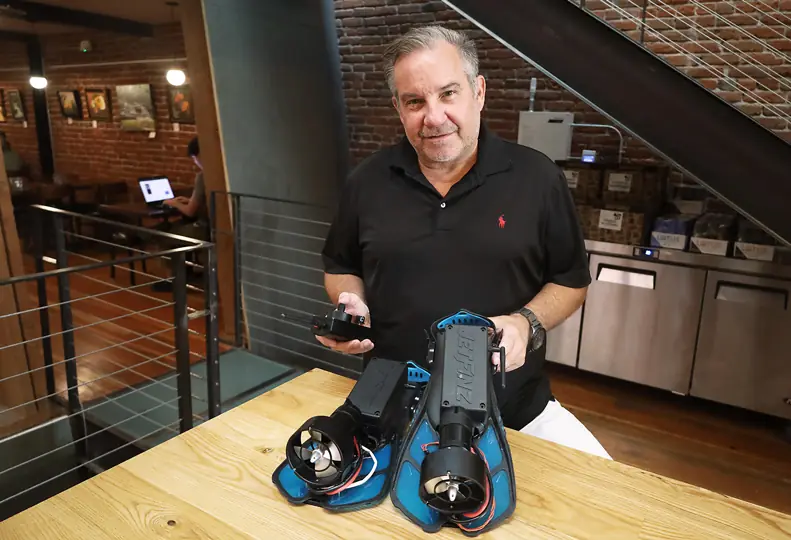
Brian Jon Garvey says his patent-pending JetFinz invention can propel rescue divers to speeds above 15 mph.
| Karina EliasEntrepreneur Brian Jon Garvey has always had a mind full of inventions.
When the Journal last caught up with Garvey, the 59-year-old former Navy frogman had founded Vata7 Inc., a Spokane-based startup that creates motorcycle gear and clothing featuring lighting technology meant to increase rider visibility and safety. Since then, that company has grown and reached a stable churn that has allowed Garvey time to come up with his next invention: a dual-propulsion fin system that could power Navy SEALs through the ocean at 15 mph.
Dubbed JetFinz, the patent-pending invention merges military-grade performance with sleek commercial potential, Garvey says. While the early stage is focused on the professional and military uses, such as Navy SEALs, rescue swimmers, and oil rig divers, Garvey envisions JetFinz could eventually be marketed for commercial use by recreational divers. He plans to create two versions, a “black ops” model for elite military and rescue use, and a lighter commercial model.
“We’ve already got our meeting with the Department of Defense, the military,” says Garvey, emphasizing the importance of prioritizing service members.
He’s already trademarked and branded the product. In the coming months, Garvey plans to finalize a working prototype, launch a highlight reel and website, and begin a $5 million funding round to complete engineering, mobile app integration, and additional patents.
Garvey came up with the idea for JetFinz while taking a swim at the Airway Heights Recreation Center. As a former military diver, Garvey still swims every day, he explains. Earlier this summer, after he had completed swimming laps, he noticed two special forces men exiting the pool carrying Rocket Fins — high-performance swimming fins that Garvey himself used when he served as a rescue swimmer in the Navy some 40 years ago.
“I thought, man, that’s 40 years ago and the technology has not caught up?” he says. “That’s when the idea came to me and I jumped out of the pool, went home, and basically just researched everything and came up with the whole concept.”
While Rocket Fins can propel divers to reach a swimming speed between 1 and 1.5 mph, JetFinz has been designed to reach over 15 mph, he contends. For the commercial model, Garvey has also commissioned an accompanying app, that allows for the customization of speed and depth and can enable reverse thrust for maneuvering near coral, he says.
Garvey says he already has interested buyers, and how things move forward will depend on his meeting with the Department of Defense. Even so, Garvey says he’s more interested in generating ideas and putting together the groundwork to bring the product to a stage in which someone will want to buy the product and manufacture it on their own. That way, he can just move on to the next idea on his list.
“I’ve got a whole book of ideas and now that I’ve got Vata7 pretty much on cruise control — we’ve got patents and manufacturing all over the world — I’ve found the magic that I like to do, and that is to come up with an idea, … build it up, and then sell it,” he says.
To that end, Garvey founded Brain-Gravey LLC last year, a company that will help him and others bring their inventions to fruition. Brain-Gravey, a play on his first and last names, will act as an umbrella company for all of Garvey's active and developing inventions, he says. As an inventor, he’s built the infrastructure and network needed to help him get his ideas from concept to prototype, patent, and potential investment stage. Under Brain-Gravey, he hopes to help other innovators get their ideas off the ground and to the Shark Tank stage, he says.
"If you have a great idea that can help humanity, we want to help you get that idea to the world," he says.
Other ideas he’s trademarked and branded include a “robot bullet,” dubbed SynKill, which is designed to disable synthetic and robot targets; and a firefighter helmet redesign that is equipped with an oxygen supply, air conditioning, and heads-up displays.
Garvey’s inventive spirit began when he was a teenager at Mead High School and conceived a waterproof “e-book” device for reading in the bathtub. The concept involved interchangeable clips that could be attached to the back of the device. A friend’s dad conducted a patent search that showed nobody else had a patent for it. Garvey took his idea to different manufacturing and engineering companies but was turned down each time, he says.
He dropped the idea and carried on with his life, got married, and had kids. When the Amazon Nook was launched, he felt the pang of losing his idea to naysayers who told him he was “too ahead of his time,” he says.
“At that moment, I said, 'you know what? Never again,'” Garvey recalls. “Never again am I going let an idea go where somebody’s just telling me no.”
The same thing happened when he came up with the idea for Vata7, he says. Garvey wanted to wirelessly sync the lighting system from a motorcycle to a backpack, that would allow the rider to be more readily seen in the dark. However, every person he brought the idea to told him it couldn't be done. But this time, he wasn’t taking no for an answer. He learned how to jerry-rig a four-channel garage opener to sync the motorcycle and backpack. He then took the concept back to electronics partners that shrunk the technology for use in helmets, jackets, and boots, among other ideas.
“That was the moment where I was like, you just can’t keep accepting nos and basically give up on it,” Garvey says.
Now, Vata7 is an international company with 15 patents worldwide. The company is headquartered in Spokane, at 1908 N. Old Trails Road, and operates additional offices in Switzerland and Hong Kong in addition to an Italian factory team that builds helmets. Seven of the company’s 21 staff are based in Spokane. Garvey plans to expand Vata7’s presence next in Europe and Asia, and aims to manufacture 7,000 helmets per month.
With Vata7 on a steady footing and JetFinz preparing for its first test runs, Garvey says he is far from finished. Brain-Gravey, he says, will give him room to keep launching two or three products a year. For an inventor who thrives on moving quickly from one idea to the next, the work is less about slowing down and more about seeing how far his imagination can go.


Stay Informed. It’s Free.
Subscribe to our newsletters and get the latest news and insights delivered to your inbox.
We respect your privacy.
Unsubscribe anytime.
Thank you!
You’re subscribed. Keep an eye on your inbox for the latest updates.