Surge responders
Avista, McKinstry, CarbonQuest confront challenges posed by generative AI data centers

On the hottest or coldest days of the year, Avista Corp.’s entire customer base uses just under 2,000 megawatts of electricity, says Jason Thackston, senior vice president of energy policy and chief strategy officer. Yet, the Spokane-based utility company is fielding calls for more than 3,000 megawatts of demand — all from technology companies hoping to build massive data centers to fuel the rise of artificial intelligence.
The requests, Thackston says, represent a tidal shift that could triple regional energy needs and test how the Inland Northwest balances growth with sustainability.
The surge of interest is forcing energy players across the Inland Northwest to prepare for a future that is being reshaped by the demand for artificial intelligence. For Avista, the challenge lies in balancing reliability, customer costs, and clean-energy commitments as it considers how to serve an unprecedented wave of load growth. For energy efficiency system designer and contractor McKinstry Co., it means scaling up new factories that manufacture modular cooling systems to keep next-generation servers from overheating. For carbon capture company CarbonQuest Inc., it’s a chance to prove that natural-gas-powered generation can be made low-carbon, fueling the data center boom without derailing climate goals. Together, all three companies demonstrate how the Inland Northwest is becoming a proving ground for the energy demands of generative AI.
Thackston is quick to point out that data centers have been around for a long time. For decades, businesses have operated relatively small server rooms or storage hubs to process their own information. Avista has a few in its territory.
What’s different now is the arrival of generative AI and the sprawling facilities and energy they require. A figure that is constantly used to describe the energy demand by generative AI compares the energy used by a traditional Google search to ChatGPT.
“A traditional Google search compared to that of a ChatGPT process request is about 10 times as much consumption,” he says. “That’s creating this need for much larger, more energy-intensive data centers across the U.S. Other parts of the country have seen that growth already starting to happen.”
That multiplier effect is changing the industry’s growth curve, he adds. For the past 15 years, the U.S. electricity demand barely budged, increasing by 0.1% a year. With AI-driven data centers, annual growth could climb closer to 3% annually, a pace 30 times higher than what utilities have become accustomed to.
Faced with an increased request from tech companies, Avista has set two guardrails: protect reliability and make sure new entrants pay their way, says Thackston. The utility is developing contract structures that would require data center operators to cover the full cost of new generation and infrastructure, rather than shifting expenses on to households, he says. Done right, those agreements could even bring a modest benefit, he claims.
“We think there’s an opportunity to structure the contract in a way that provides a little bit of relief on all our customers’ bills,” Thackston says. “That’s really how we are trying to approach this, we’re thinking about affordability, making sure the system is reliable so we don’t put our reliability at risk, and also be mindful of our clean energy goals that we have.”
Layered throughout all of this is the company’s climate commitment, Thackston says. Avista will retire coal from its portfolio this year, leaving a mix of hydro, wind, solar, natural gas, and biomass to power its customers.
Roughly half of its electricity comes from hydropower, among the cleanest generation mixes in the country, he says. Any new data center deals would need to align with those clean energy goals, a balance that Thackston says could distinguish the Inland Northwest from other regions where fossil-heavy portfolios dominate.
“We are being mindful of having these conversations with technology companies,” Thackston says. “Hopefully, if we do that well … from an environmental perspective, we’re being more responsible than other utilities might be, just because of their generation mix.”
Beyond power bills, data centers bring tradeoffs that communities will need to weigh, he says. Once built, data centers don’t bring a lot of jobs, but they can deliver significant property tax revenue. Any agreement Avista reaches will undergo scrutiny from state regulators in Washington and Idaho to ensure rates remain fair and reliability is uncompromised.
For McKinstry, its role is figuring out how data centers will manage the heat generated from such large-scale facilities.
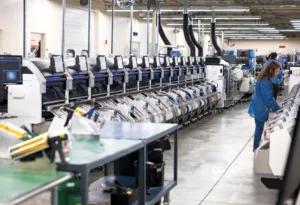
The company recently opened a 150,000-square-foot offsite manufacturing facility on Spokane’s West Plains dedicated to building modular cooling plants and liquid cooling systems for large-scale data center clients, says Thomas Tellefson, senior vice president of Data Center Innovations at McKinstry. From there, McKinstry ships prefabricated components nationwide, allowing contractors to assemble new facilities more quickly and with consistent quality, an advantage as most data centers are built in remote areas with limited skilled labor, he notes.
“The number one challenge, besides power, that these customers are having is labor availability,” Tellefson says. “That’s why the data center market has been the first to really supercharge and lean in towards ... everything they do. Think of it as an IKEA box, everything connects seamlessly, so you can build faster and more reliably.”
Cooling itself has become more complex as generative AI accelerates demand. Servers running on new NVIDIA chips generate about 50% more computing power than those installed just a few years ago, Tellefson explains. This also means a lot more heat. Traditional air-cooling systems can’t keep up, so data centers are rapidly adopting liquid cooling, in which chilled water circulates directly to server chips through closed-loop systems that minimize waste.
The expansion, Tellefson claims, cements the city as a hub for the infrastructure behind the AI boom.
While McKinstry is working to keep data centers cool, CarbonQuest is working to keep them clean. The Spokane Valley-based company is pitching its distributed carbon capture technology as a way to make natural-gas-powered generation compatible with the region’s climate goals.
The company first gained attention by capturing emissions from apartment buildings in New York City, but Shane Johnson, CarbonQuest CEO, says it has since grown into a broader mission: targeting industrial-scale emitters and energy infrastructure.
“Our core technology, distributed carbon capture, works in so many diverse applications, and one of the areas we’ve been working on for a long time is low-carbon power,” says Johnson. “By coupling natural gas generation with carbon capture, we can make electricity that is actually lower in carbon intensity than most electrons you get from the grid.”
The model is straightforward: a generator produces electricity while a capture system alongside it traps the carbon dioxide. The company then helps customers monetize that CO2, turning emissions into an asset that can lower overall energy costs. Johnson argues this approach lets data centers tap into reliable baseload power without abandoning sustainability.
“There’s so much focus now on cost effectiveness and just getting the power that they’ve almost forgotten about sustainability,” Johnson says. “We say, look, you don’t have to choose, you can use fossil fuels and make them sustainable by coupling them with carbon capture.”
CarbonQuest is also trying to remove barriers to adoption. Through a new “carbon capture as a service” model, the company works with financing partners to cover the upfront capital costs, allowing customers to add the technology without a major investment.
For Johnson, the rise of AI data centers has created a sense of urgency.
“We owe it to our future generations to figure this out now,” Johnson says via email. “I’m really trying to educate the community that this is doable and, in my opinion, must be done today.”