Golden opportunity
Record high gold values prompt a rush for resale in Spokane market
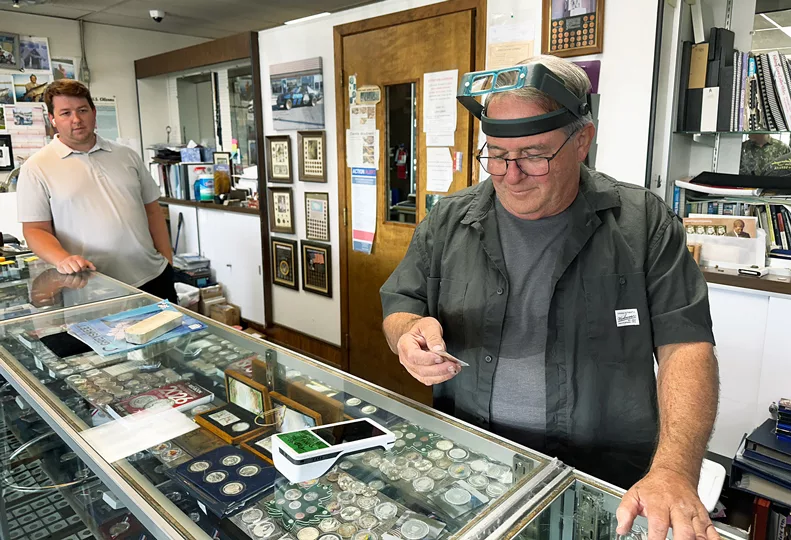
Recently, customers have been lining up at Coin Corner, where co-owners Nick Crocker and his son Eric Crocker buy a variety of items, including coins, jewelry, gold, silver, and scrap.
| Tina Sulzle
As gold prices soar to record highs, Spokane shops are seeing a rush of eager sellers.
Gold futures reached $3,757.60 per ounce on Sept. 22, up about 80% from Jan. 1, 2024, and up over 40% so far this year.
Spokane businesses that buy and sell gold are seeing a surge of customers and weighing in on the variety of factors behind the recent fluctuations.
Ye Olde Hock Shoppe
Deron Nicholson, co-owner of Spokane Valley pawn shop Ye Olde Hock Shoppe, a trade name for Dermich LLC and commonly known to customers as the Hock Shop, says the surge in gold prices is bringing in a flood of customers eager to turn old, broken, or forgotten jewelry into cash.
“Gold’s sitting around $3,600 an ounce right now,” Nicholson explains. “That’s a big number, and when people hear that, they start digging through their jewelry boxes.”
Unlike some traditional jewelers in the resale market, Nicholson says, pawn shops offer immediate cash. He says the quick access to cash has made the Hock Shop, and other pawn shops, a prime destination for people holding onto broken items, single earnings, or outdated jewelry.
“We had a lady in here yesterday that just had little stuff like a broken bracelet and a broken necklace, and one earring,” Nicholson says. “Long story short, she left with $700 cash.”
While scrap material is in steady supply, some sellers are more hesitant to part with their gold bullion and coins, he says.
“A lot of people are bringing in more gold bullion and coins of gold that they’ve squirreled away and waited for it to do what it’s doing now. But a lot of people are still kind of holding back because it’s climbing so rapidly,” he says. “They’re asking, ‘how high is it going to go?’”
Nicholson compares the gold market to the stock market, saying it's sensitive to global events.
“A lot of things out there in the world ... kind of control and dictate what the market does,” he says.
Nicholson believes there’s still room for prices to climb.
“When we opened (in 2018), gold was under $2,000 an ounce,” he explains. “Now, it’s almost doubled.”
The Hock Shop, located at 9315 E. Trent, deals in everything from firearms to guitars to wedding rings, he says.
“People break up, they get divorced,” Nicholson says. “With broken goods, we take it to a smelter, melt it down, and turn it into new jewelry.”
At current prices, Nicholson says investing in gold is hard, but silver is more accessible.
“It’s a lot more affordable and easier to obtain,” he says.
As of Sept. 22, the price of silver was $43.10 per ounce, a fraction of the price of gold.
“I was buying ounces of gold for $1,700 when I opened,” he says. “It’s higher than it’s been in our lifetime.”
People are holding on to gold because of uncertainty, he says.
“It always happens. As soon as you are selling, it goes back up,” Nicholson says. “And you’re like, 'Dang, I wish I would have sat on it.’ The market is a daily ticker — you don’t know what it’s going to do.”
Coin Corner
Nick Crocker, who co-owns Spokane Valley-based Coin Corner with his son Eric Crocker, says he’s no stranger to market volatility, but this is the highest he’s seen gold prices since the store opened in 1980.
“Up until about a year ago, we had 10 buyers for every two sellers,” Nick Crocker says. “And now gold has almost doubled in price in the last six months. We now probably have 10 sellers for every two to three buyers.”
Coin Corner, located at 9215 E. Trent, buys a variety of items, including coins, jewelry, gold, silver, and scrap. In recent weeks, Crocker says, customers have been lining up at the door.
“We buy anything that’s jewelry that’s for scrap,” he says. “We buy larger diamonds, … we buy tokens, we buy anything that’s paper money. With the price of gold and silver going up, we're seeing more silver dollars and U.S. coins coming in too.”
Despite the high gold prices, Crocker notes there’s less gold jewelry coming in compared to previous market spikes.
Currently, Crocker says many items sold are coins.
“It’s gold, silver, and bullion coins … 90% coins,” he says. “There’s not near as much (traditional jewelry) out there. Everybody and their brother is in the game this time. These guys are making so much money.”
The market reversal, he says, is putting pressure on small coin and bullion dealers. With demand slowing and supply increasing, profitability becomes a balancing act.
“Lately, there’s been more supply than demand,” he says. “But a year ago, there was more demand than supply.”
Crocker says that sometimes means he has to turn products quickly — even at a loss.
“It doesn’t matter if you make money or lose money in the gold and silver business, you still have to turn that product,” he explains. “There’s such a thin market. Just yesterday, silver would have cost you almost $1 an ounce more than it would cost you today. So every ounce of silver that I owned yesterday to today, I lost the dollar. Now, it just goes away. It just disappears. And vice versa. It’s a commodity. But I keep buying and selling.”
Despite the uncertainty, Coin Corner continues its day-to-day business of buying, selling, and making modest spreads, Crocker says.
“If you sell me a silver dollar for $32, you can buy the same one back for $35,” he says.
Tracy Jewelers
When Tracy Jewelers Inc. first opened 75 years ago in Spokane Valley, third-generation owner Sean Tracy says gold was priced very differently.
“When my grandfather opened the store, gold was $25,” Tracy recalls. “And when I started getting into the business, it was around $350. Now, it is well over $3,600.”
The store, located at 106 N. Evergreen Road, sees 30 to 50 customers a day — its usual average.
"It’s a great time to sell, obviously," says Tracy. "People have stuff a lot of their kids do not want. Maybe it’s dated and maybe it’s their grandparents’ stuff. What are they going to do with it? Why not sell it and make some money? So we’ve seen a ton of business that way.”
What many people don’t realize, Tracy adds, is that old gold can offset the cost of new jewelry.
“(People) are welcome to use the gold they have toward the new purchase,” he says. “That’s helped tremendously to alleviate the cost. If gold is up 30% from last year, so is the cost of a ring, obviously. So your gold scrap goes a tremendous way toward something new. Not a lot of people know that.”
Higher gold prices, he says, aren’t deterring buyers either.
“Obviously, with the pricing of gold rising, you have to raise your prices,” Tracy says. “I think people know it is what it is, like with the cost of eggs, it is what it is. And gas, it is what it is. People still get married, which is great.”
In the end, it’s about love at Tracy Jewelers, he says.
“When people come in and see the price is $3,000, they still say, ‘I still want to get that for her,'” Tracy says.
As for why gold prices have climbed, Tracy doesn’t pretend to have all the answers.
“I’m certainly not an economist, but what I hear is with the uncertainty of the economy and the market, gold has always been a stable place to put your money to invest in,” he says. “People don’t know what is going to happen with certain things in the stock market and other things, so they invest in gold, and that just drives the price. It’s all supply and demand.”