
Economic uncertainty and a tightening labor market make planning difficult
Spokane labor market has seen only tiny job gains, while civilian labor force here continues to decline
Economic and labor market data are telling multiple stories right now:
The labor force is tightening and it’s becoming more difficult to find a job, but the unemployment rate is remaining low. Economic uncertainty is on the rise, but the stock market continues to hit new highs. Prices continue to increase, but consumer spending is up as well.
The current state of the economy has become bifurcated – those who are well-off are doing better than ever, and those who are struggling are finding it more difficult than ever to navigate this economy. According to Moody’s Analytics, in Q2 of 2025 the top 10% of households by income ($250,000 or more) accounted for nearly half of all consumer spending. This dynamic has driven the direction of the economy and where jobs and growth can be found. International trade disruptions have also impacted specific industries more than others, and in many ways has created an uncertain situation where future business planning is increasingly difficult.
According to the August 2025 monthly employment report released by the Washington Employment Security Department, over the past year, total employment has decreased state-wide by 5,400 jobs while over the same time, the Spokane-Spokane Valley MSA total employment is up slightly by 200 jobs. In the Spokane area, goods-producing sectors like manufacturing and construction have declined by 400 jobs, while service-providing sectors have increased by 600 jobs.
The service-providing sector job gain was driven almost entirely by the healthcare and transportation and warehousing sectors, while other service-providing sectors have seen losses. This hyper focused sectoral job growth has been observed nationally as well.
The civilian labor force in Spokane County has been declining over the last year and appears to have crested, as retirements continue to impact the total number of available workers in the economy. While Spokane County’s population grew at a higher rate (1.2%) than Washington State (0.9%) and the US (1.0%) last year, the silver tsunami of the Baby Boom generation exiting the labor force outpaced new labor market entrants and will continue to do so for years ahead. This demographic reality has been known and will continue to tighten the labor market and the available labor for businesses to draw from.
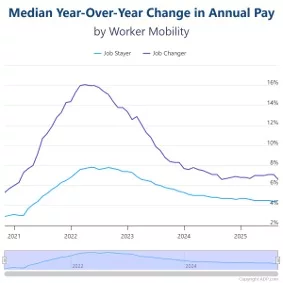
During the pandemic, job hopping and remote work was on the rise. The wage premium of taking a new job peaked around 16% in 2022 according to ADP, doubling the annual wage change that job stayers saw at this same time. This caused an enormous amount of shifting and churn in the labor force, which has since slowed down significantly. As of September 2025, the annual wage change differential between job stayers (4.5%) and job changers (6.6%) is now only 2.1%.
The wage benefit of taking a career risk and actively changing jobs has been greatly diminished, and reports of job hugging, where workers are now more afraid of losing their current job has increased.
A strong amount of churn and worker mobility is healthy for an economy, as workers can upgrade their careers and businesses can more easily fill open positions with qualified candidates. The current tightening of the labor market, driven both on the demand side with businesses facing increased economic uncertainty, and on the supply side with workers changing jobs less and the total labor force declining, will have a slowing effect on the overall economy. The year-over-year total job decline in Washington State may be an indicator of this slowing.
This current economic situation has been referred to as a No Hire, No Fire economy, where businesses haven’t been laying off workers in large numbers, outside of a few specific sectors, but also aren’t creating new jobs and in many cases aren’t back filling jobs made open through retirements. While macroeconomic factors and uncertainty is mostly outside of local control, addressing a declining labor force participation rate does have more local options.
The most effective strategy in addressing the tightening labor force is to better engage and alleviate barriers to employment for underrepresented demographics who have lower labor force participation rates. This includes numerous racial demographics, the disability community, mothers with young children, etc. (various labor force participation and unemployment rates by demographic can be found on the Spokane County profile on the Employment Security Department website).
Childcare costs and availability, transportation, and workplace flexibility are routinely cited as barriers to employment for potential workers who are on the sidelines, and oftentimes these barriers can be multiple and compounding.
Businesses who authentically review and adjust their hiring practices to better accommodate the existing workforce set themselves apart. Little shifts can include transparent wage expectations in job postings, introducing targeted behavioral interviewing techniques to the hiring process, and accommodating real life circumstances with some flexibility in the workplace. Any small change can open opportunity to capture and keep talent who otherwise would not be available. Many worker engagement strategies are low or no cost but rather require a shift in mindset. Economic uncertainty is up, and the tightening workforce demographics are known, so adjusting approach to engage workers locally is the best way to keep Spokane’s economy growing and better build a thriving community.
Mike McBride is the Regional Labor Economist here for the Washington State Employment Security Department.
Stay Informed. It’s Free.
Subscribe to our newsletters and get the latest news and insights delivered to your inbox.
We respect your privacy.
Unsubscribe anytime.
Thank you!
You’re subscribed. Keep an eye on your inbox for the latest updates.