
Gonzaga, Providence invest in nurse anesthesia program
Program to expand, move to meet a growing demand
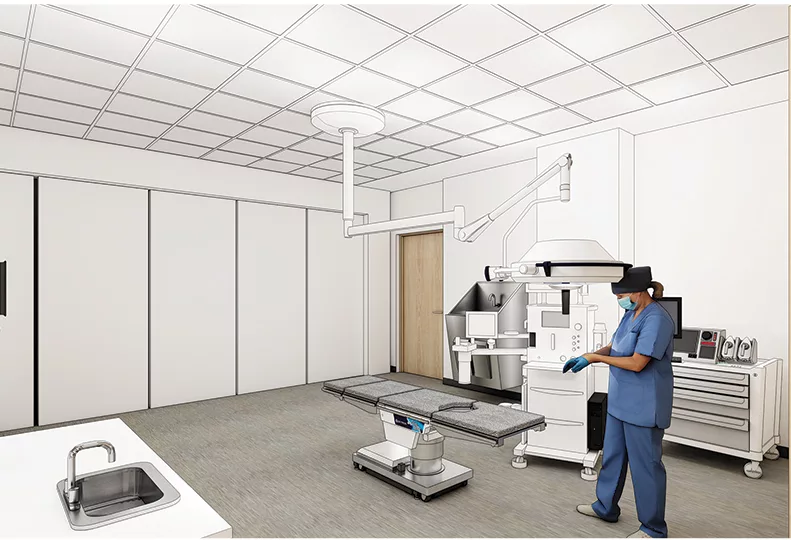
The expansion of the Doctor of Nurse Anesthesia Practice program will include advanced simulation education facilities intended to prepare students for real-world clinical experiences.
| Gonzaga UniversityIn response to rising demand for Certified Registered Nurse Anesthetists and a national shortage of anesthesia providers, Gonzaga University and Providence Sacred Heart Medical Center are embarking on a major expansion of the jointly owned and operated Doctor of Nurse Anesthesia Practice program.
The expanded Doctor of Nurse Anesthesia Practice program will be relocated to an 8,700-square-foot undeveloped education and simulation space on the fourth floor of the Gonzaga University and University of Washington School of Medicine Health Partnership building, located at 840 E. Spokane Falls Blvd., says Scot Pettey, program director and department chair for the program.
This marks the first time in more than 100 years that the program will be relocated from its longtime home at Providence Sacred Heart Medical Center, he adds.
“There’s a large demand and a shortage of anesthesia providers,” says Pettey. “We’ve really expanded our clinical partnerships … and we’re now at the point for future growth and that’s the impetus to come to this building and get this space built up.”
Following the onset of the COVID-19 pandemic, the health care industry has been facing a wave of retirements and provider burnout, including among anesthesia providers, while at the same time, the country’s aging population continues to drive demand for surgical procedures, Pettey says.
“The baby boomers started to really age into needing more surgeries, more care,” Pettey says. “So you have a demand building there, as well.”
The program currently enrolls 72 students across three cohorts and will expand to 120 students over the next few years, he says. This year, the Doctor of Nurse Anesthesia Practice program received 475 applications for just 28 first-year cohort spots — a 50% increase from the previous year. The program's acceptance rate is only 5%, he adds.
The nurse anesthesia program was founded in 1917 at Sacred Heart. In 1977, the hospital partnered with Gonzaga to offer a master’s degree in response to national standards for advanced practice nurses that were emerging at the time, Pettey says.
“For CRNAs at the time, they were saying that you needed to have a bachelor’s degree and eventually need a master’s degree,” he explains. “(Providence and Gonzaga) joined together and offered a master’s degree. That degree was retired in 2015 when we converted over to the doctoral degree, the doctor of nurse anesthesia program.”
There are 156 programs in the country. However, Washington state still has only one Doctor of Nurse Anesthesia Practice program, Pettey notes.
“There are more CRNA programs on the eastern half of the United States than there are the western half,” Pettey says. “But the West is starting to expand."
Gonzaga is funding the expansion through an $8 million investment over 14 years and through a collaborative lease agreement with energy-efficiency system designer and contracting company McKinstry Co., which owns the building and will serve as general contractor, Pettey says. Seattle-based architectural firm CollinsWoerman is the project architect.
The Doctor of Nurse Anesthesia Practice program will share space on the building’s fourth floor with Eastern Washington University’s Regional Initiatives in Dental Education program, a collaboration between EWU and the University of Washington schools of medicine and dentistry.
Julie Wolter, dean of Gonzaga’s School of Health Sciences, says the project reflects the university’s broader mission to deliver community-centered health education.
“Part of the goal for this, and the strategic plan of Gonzaga, is to expand our health education in the region and even the world,” Wolter says. “Our mission is to serve the underserved, and part of my role as dean is to look at where the gaps in education, or the needs of the community, are and see how Gonzaga can be part of the solution. And how can we partner in new and engaging ways across the community and health to be serving these critical shortages and regional needs?”
The new location, she adds, will support greater interdisciplinary training and collaboration.
“One of the opportunities of being in the Health Partnership Building is that it provides increased opportunities for our students to engage in cross disciplinary research,” she says. “We’re able to share simulation spaces with other health programs, such as our med school, as well as the new dental school that has gone in with the (Regional Initiatives in Dental Education) program.”
The expansion includes advanced simulation education facilities, including an operating room and preoperative environments, high-fidelity mannequins for simulation education, virtual reality systems, and standardized patients — all designed to prepare students for real-world clinical experiences, Wolter says.
Although the Doctor of Nurse Anesthesia Practice program draws applicants from across the country, Pettey says a significant portion of graduates remain in the Spokane area.
“Right around 70% of our applicants are going to stay at one of the sites they trained at, in Spokane,” he says. “Sometimes a full cohort stays in Spokane to as little three people out of a cohort. But generally, half of the cohorts are staying in Spokane.”