Spokane builder pushes for smarter, longer-lasting homes
Cameron Rippy advocates for early collaboration across industries
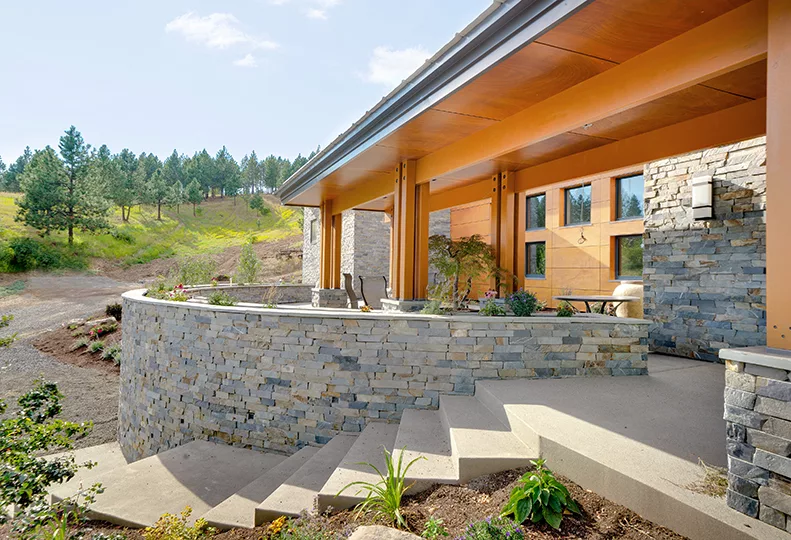
Cameron Rippy says building homes with European-made windows is more suitable for homes in the Inland Northwest.
| Rippy Homes LLCSpokane builder Cameron Rippy says he believes good homes are built to last, not just through better materials but through better communication and collaboration across the industries tasked with their creation.
That is the message he hopes to get across at a sustainability forum hosted by Spokane-based architecture firm Uptic Studios Inc., scheduled today, Nov. 20th, at Uptic’s offices located at 402 E. Sprague.
“If we can work together, the point of collaboration is to help make better builders, help make better architects, better tradespeople, and better suppliers,” Rippy says. “We’re very interested in helping elevate building in our area.”
As founder of Rippy Homes LLC, a trade name for CG Rippy & Associates LLC, Rippy, 46, says he’s spent two decades trying to bridge the gaps between architects, suppliers, and tradespeople to build high-performing homes — an alternative industry term for energy-efficient homes — that perform well and hold up over time.
As a certified passive house builder, Rippy focuses on building ultra-energy-efficient homes that produce reduced operating costs through specialized building techniques, including structural insulated panels, insulated concrete forms, and geothermal systems.
Rippy says he likes to experiment with methods and materials, such as European windows and high-performance insulation, but says innovation only works when the people building the homes understand how to use those products. He focuses on finding solutions that fit the Inland Northwest homebuilding climate and its workforce.
His company operates remotely, with 12 employees who work on about 10 projects a year. Rippy Homes offers services in custom home building, custom commercial buildings, remodels, historical home remodeling, and passive house building. Rippy declined to disclose the company’s projected annual revenue but says 2025 is set to be his best year.
“There is a demand from clients to have homes that are higher performing homes,” Rippy says. “When they know there is a better way to build a house and frame a house, they want that.”
To build better homes, Rippy has drawn inspiration from places with similar climates to the Inland Northwest — Germany and Poland in particular — where construction materials and methods are designed for durability and efficiency, he says. Specifically, he focuses on what is known as improving the envelope of homes, which includes the foundation, walls, windows, and roof that improve the home's energy efficiency.
“A home that is well-insulated, well air sealed, and the ventilation is mechanically regulated is a comfortable home and changes the way you experience life,” Rippy contends.
Previously, he’s imported high-performance windows from Europe, which he says have tight seals and are made for longevity. Window companies often manufacture windows in one factory for several different climates, but the Inland Northwest has a very specific climate to contend with, he explains. For the last 10 projects he has worked on here, he’s imported windows from Poland.
“We share a climate with Poland and Germany in many ways,” he says. “They also have a different mentality in terms of longevity of housing. They stay in these homes for a long time, and likely their family will be in the homes after them.”
However, bringing those innovations across continents isn’t always straightforward. Tariffs and shipping costs have made importing European materials more expensive, and crews here are not always familiar with how to install them, he says.
“Most builders, if I brought them European windows, wouldn’t know how to put them in,” he says. “This is a metaphor for everything that falls in line. The way to bridge that is trying to use things that the local labor, resources, and suppliers of our area have access to, and that way we can add value within the confines of what we know.”
Rippy acknowledges that it's possible for builders to achieve a similar high performance with products and materials available closer to the Inland Northwest market, such as foam insulation from Westwood Insulation LLC, of Rathdrum, for example, or by employing construction methods that use standard materials in more efficient ways. Similarly, he advocates for innovative window manufacturing suited for the region's climate and to work with architects who are equally devoted to ensuring a home has the best possible resources.
For Rippy, his pursuit isn't just about energy efficiency, but also resiliency, he says. Better insulated, tighter homes are quieter, cleaner, and more affordable to heat and cool, which are qualities that make them more comfortable as Spokane faces hotter summers, colder winters, and prolonged wildfire seasons.
“We’re passed the question about why efficiency matters,” he adds. “The real question is how do we make it affordable and accessible?”
Rippy says the future of better homebuilding in the Inland Northwest depends as much on communication as on technology. Washington state’s updated energy codes have pushed the industry toward more efficient building practices, but he believes regulation alone won’t close the gap between design ambition and the realities of construction. If the architect, builder, and trades workers are not collaborating with each other early on, the details can fall apart, he says.
“For the most part, some of this is a little bit siloed,” he says. “The architect designs and passes it to the builder, and the builder does his thing and passes it to the tradesperson.”
That lack of coordination, he adds, can undercut the environmental and financial benefits of better design. Through Rippy Homes, he’s tried to model a different approach that brings architects, suppliers, and tradespeople into the conversation from the start. He often collaborates with firms like Uptic Studios, whose designs emphasize modern aesthetics and sustainability.
Rippy says he also thinks of homebuilding in terms of longevity. His company’s mission statement is, “We build monuments that are a representation of us and the people we build them for.”
He points to century-old homes on Spokane's South Hill and in the Browne's Addition neighborhood, which are still identified by the names of their original owners or architects.
“At the end of the day, that is our goal,” Rippy says. “We’re building these things that are going to last for a long time, and a hundred years from now somebody’s going to be walking through them and asking questions about the people this was built for and how they lived and what was important to them.”