Designing businesses that outlive founders
Succession planning paves the way to high-value exits
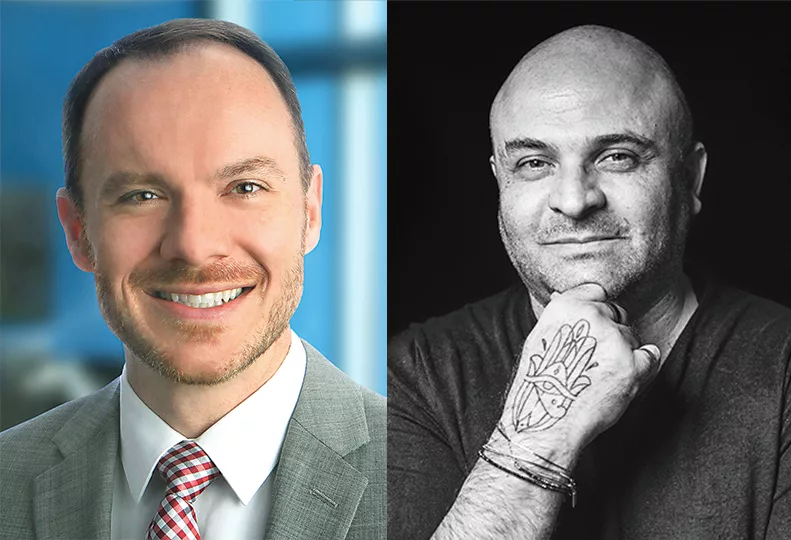
Lars Gilberts (left) is vice president of market development at Numerica Credit Union. He can be reached at [email protected] or 509.688.6863. Alex Barrouk is the founding director of Spokane-based Aim & Build Consulting & Development/Listen Louder. He can be reached at [email protected] or 310.980.0989.
For most business owners in the Pacific Northwest, succession planning lives somewhere between "eventually" and "when the time comes." It sits on a list alongside other distant concerns, comfortably deferred while the immediate demands of running the business take priority.
Often, by the time business owners are ready to step away, many are faced with some hard realities. For instance, the business isn't worth what they thought, no one wants to buy it as is, or the company is structurally inseparable from the owner personally. If the valuation they assumed would be there has evaporated, chances are it's not because the business failed, but because ownership didn’t gradually shift operations to function without them, which would justify a higher valuation. What looked like a thriving enterprise on paper reveals itself to be a high-performing job; one that ends when the owner leaves.
Maximizing the value of your business as a transferable asset utilizes its own set of strategies similar to the way starting or expanding a company requires distinct approaches. Succession architecture drives valuation through a deliberate, multiyear design process that decouples business value from the founder's daily involvement. This isn't a legal event or a financial transaction scheduled for some undefined future date. It's a governance phase that ideally begins at least five years before a planned exit to maximize value, expand options, and ensure that what you've built can actually be transferred.
Build transferable value
The highest valuations often go to companies where the owner is optional. Businesses that can’t function without their owners are worth less — often much less — than those that can stand on their own. When the founder is the main relationship manager, key decision-maker, and keeper of institutional knowledge, buyers see risk. If potential buyers don’t want to run the company themselves, they may walk away entirely.
Succession planning is effectively a governance phase. Starting about five years out gives leaders time to run a structural audit to help spot where owners are the system rather than the designers of it. The work is practical, involving documenting processes, clarifying decision rules, and building leadership capacity so the business runs smoothly without the founder in the room.
The succession planning process isn’t just about working on the business, but on the owner themselves. It may not feel like an urgent or critical task, which is why it's often left undone. Motivation is critical to support the flexibility of your family’s financial freedom or the longevity of the business and takes the same level of emotional work that drove you to start or grow the company.
Separate assets
Treating a company as a single, inseparable asset is convenient but it can quietly trap value when operations, intellectual property, and real estate sit in one structure. Tax exposure can rise, buyer pools can shrink, and negotiation leverage can weaken because nothing can be adjusted without disturbing everything.
Recognizing the business as a set of coordinated assets rather than a single block opens up opportunities. For example, the operating entity can scale or change hands without forcing a property sale; intellectual property can be licensed, protected, or monetized independently; and real estate can provide steady income through leaseback arrangements. Each layer becomes a strategic lever instead of a fixed constraint.
The real advantage is flexibility over time.
Markets shift, personal goals evolve, and opportunities rarely arrive in perfect alignment. An ownership structure built for modular decisions allows leaders to respond without destabilizing the enterprise. Thoughtful separation ensures the business can adapt, transfer, or unlock value in parts while the whole operation continues to function.
Grant spousal access
Many owners build impressive businesses with finances and operations only they can navigate. Oftentimes, a spouse is a co-owner or successor but can’t access accounts, doesn’t understand how assets are organized, or doesn’t know who to call for help. This type of system relies on one person being available at all times, which creates a single point of failure that a sudden health crisis can trigger. The risk isn’t a lack of wealth, but a lack of viable continuity.
On the other hand, a durable succession plan assumes the owner may be absent. Successors have access to key information, a basic understanding of how the business and assets fit together, and established relationships with advisers. Durable plans also incorporate plans for long-term care and coordinate with the available benefits from the spouse’s employer. The goal isn’t to transfer operational responsibility, it's to expand opportunities, reduce stress, and to remove confusion and delay when clarity matters most.
At its core, this is redundancy by design. Strong systems don’t rely on a single point of control. When knowledge, access, and support are distributed, the business and the family remain stable through disruption. Real security is knowing the structure will still function when its architect cannot.
Disciplined execution
Many owners already understand the necessary steps to take in succession planning, but knowing what to do isn't the same as taking action to accomplish the plan.
This is where most succession plans stall. Business owners can set the right goals, develop a five-year exit timeline, separate asset structures, grant spousal access and security, and then treat those goals as if their existence on paper is sufficient. The plan sits in a drawer. The quarterly review never happens. The structural audit gets deferred. And five years later, nothing has changed.
The gap between strategy and execution isn't a knowledge problem; it's a discipline problem. Succession architecture requires a phased implementation plan with accountability mechanisms — not just a strategic document — including an operational roadmap with clear milestones, assigned ownership, and regular review.
In practice, this means treating succession planning the same as any other strategic initiative, such as establishing quarterly checkpoints and identifying specific deliverables for each phase. This could include goals such as completed documentation by Q2, leadership transition framework by Q4, and asset separation finalized by year two. It requires the assignment of responsibility, tracking progress, and recalibrating when conditions change.
The businesses that successfully transition are not those with the most sophisticated plans. They are those where the founder has treated succession as a multiyear operating priority, embedding it into the rhythm of the business, rather than relegating it to "someday." Having a vision without the infrastructure to execute it is wishful thinking. The difference between owners who exit well and those who don't isn't intelligence or foresight, it's sustained, disciplined follow-through.
Creating a durable legacy
These four dimensions of operational decoupling, asset separation, spousal access, and disciplined execution are not independent tasks, but interconnected design choices that determine whether a business can be successful across ownership transitions or family generations.
The business owners who will exit well in the Pacific Northwest aren't necessarily those who have generated the highest revenues. They are those who built systems that could be transferred: businesses with coherent structures, separated assets, resilient access mechanisms, and disciplined execution timelines.
This creates a shift from owner-operator to owner-investor: moving from being the system to designing one that works without you.
Succession architecture is about designing enterprises that can outlive their founders. That requires time, intention, and the humility to make yourself optional. But it's a clear path to support a high-value exit and a durable legacy.
Alex Barrouk is the founding director of Spokane-based Aim & Build Consulting & Development/Listen Louder. He can be reached at [email protected] or 310.980.0989. Lars Gilberts is vice president of market development at Numerica Credit Union. He can be reached at [email protected] or 509.688.6863.