_web.webp?t=1787814213)
Guest opinion: Smart trade policy matters to state's agricultural sector
Eastern Washington is rooted in the land, connected to the world
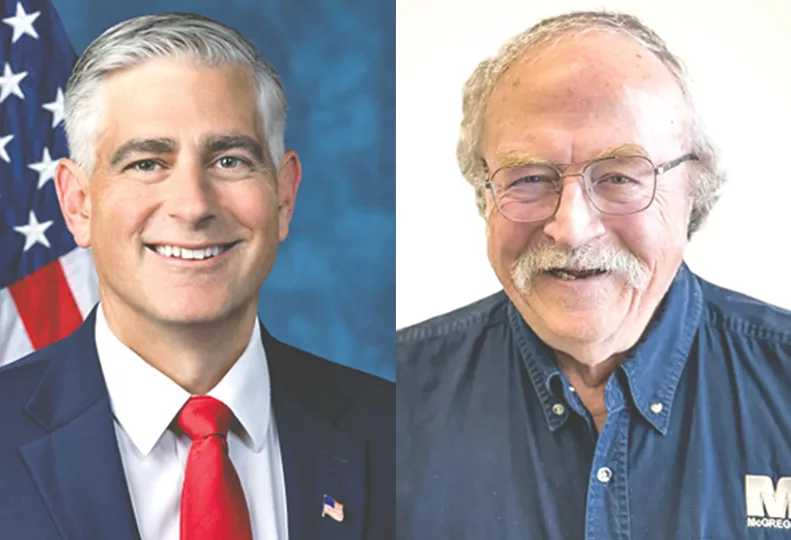
Congressman Michael Baumgartner is currently serving his first term in the U.S. House of Representatives where he represents Washington State’s 5th Congressional District. Before joining Congress, Baumgartner served as a Washington State Senator, diplomat, and as the Treasurer of Spokane County.
Alex McGregor is chairman at The McGregor Co., a Colfax, Washington-based agricultural retailer. McGregor lends his voice in support of the Pacific Northwest agricultural sector, including farming families and their communities.
Eastern Washington’s prosperity depends on agricultural producers. Profitable farming depends on access to global markets, fair rules, and long-term planning.
For Washington state, trade isn’t an abstraction. It’s key to our economic strength and vitality of rural communities. Nearly 90% of Washington wheat is targeted to overseas customers. Our farm economy depends on inputs from abroad and on relationships built over generations. At its heart, agricultural trade is between people and markets — not nations. When trade policy becomes unpredictable, it’s those relationships, and those families, that pay the price.
Farming is a long-cycle business. You plant months before you sell. You borrow before you earn. That means reliability isn’t a luxury — it’s the condition for survival. Washington farmers are under intense strain: volatile export markets, rising equipment and operating costs, tighter credit, and uncertainty layered on top of uncertainty.
Producers also rely on global inputs. In the Pacific Northwest, more than 75% of the nitrogen fertilizer farmers use comes from Alberta and Saskatchewan. Many raw materials for crop protection products come from China. When the war in Gaza disrupted Israeli natural gas flows to Egypt, fertilizer production in the region slowed, tightening global supply. Trade disruptions abroad raise input costs, squeeze farm margins, and ripple into consumer prices at the grocery store.
Farmers are absorbing new state-level regulatory burdens — shifting mandates, expanding liability, and litigation-driven policymaking that often feels adversarial rather than collaborative. That strain compounds the uncertainty they already face, and it is unnecessary.
Farmers are conservationists at their core. For generations, Washington families have increased production while dramatically reducing soil erosion, dust, and field burning. They live on the land they steward. They drink the water they protect.
In Washington, 94% of our farm and rangeland are cared for by family enterprises. They’re the backbone of Eastern Washington communities who work the land, steward it, and keep it productive for the next generation.
We’ve seen how quickly market share can slip away when trade relationships fracture. Once a foreign buyer turns elsewhere, winning them back is slow, costly, and sometimes impossible. That’s why the right test for trade policy isn’t whether it sounds tough on television. It’s whether it keeps markets open, keeps rules fair, and keeps Washington producers competitive.
Policy should be guided by three market-access priorities.
First, Congress should strengthen proven export promotion tools that expand markets rather than close them. Programs like Food for Peace, Market Access Program, and the Foreign Market Development program help American producers build customer relationships and compete abroad. Used well, these programs aren’t permanent subsidies; they’re partnerships that open doors and deliver results. When customers return year after year because they trust American producers, that is durable growth — the kind that supports rural communities without turning farmers into dependents of Washington, D.C.
Second, we need to defend access to overseas markets with science-based standards and credible enforcement. The U.S. should use trade agreements and dispute mechanisms to insist on objective, verifiable, and enforceable rules — and respond precisely to the offending barrier, rather than resorting to broad tariffs that invite retaliation against American agriculture.
Third, we must reengage in serious trade diplomacy. This administration has shown the importance of tariffs to global trade. We should ensure long-term trade relationships are preserved. When the U.S. steps back from trade frameworks, others step forward. Competitors sign agreements, lock in preferences, and secure supply relationships. Market share lost in agriculture is rarely recovered easily. A reset means pursuing agreements that lower barriers, enforce science-based rules, and provide reliable access to growing markets across Asia and beyond — with agriculture at the center, not as an afterthought.
This is not abstract theory. It's about whether crops planted in the Palouse or the Columbia Basin can move predictably to customers overseas — and whether families can count on stable prices and steady supply chains.
Washington’s farm families have endured cycles before. They combine optimism, tenacity, and stewardship of the land. But resilience is not a substitute for predictable rules. Trade policy should be designed so farmers can plan, invest, and compete — not brace for the next sudden shift.
Eastern Washington is rooted in the land — but connected to the world. Our producers compete on a global stage and succeed because they are innovative, efficient, and trusted.
Our international relationship matters. Our market access matters. The stability of the rules matter. If we want rural communities to thrive for the next generation, trade policy must recognize just how deeply connected our prosperity is to the world.
Congressman Michael Baumgartner is currently serving his first term in the U.S. House of Representatives where he represents Washington State’s 5th Congressional District. Before joining Congress, Baumgartner served as a Washington State Senator, diplomat, and as the Treasurer of Spokane County.
Alex McGregor is chairman at The McGregor Co., a Colfax, Washington-based agricultural retailer. McGregor lends his voice in support of the Pacific Northwest agricultural sector, including farming families and their communities.