
Specificity is key to prevent legal pitfalls
Common mistakes small business owners make at launch can turn costly
Proactive legal planning, detailed documentation, and intellectual property awareness can shield new Spokane businesses from significant financial, time-consuming, and legal pitfalls, according to some Spokane-area attorneys.
“I always tell people, ‘You need to talk about decision making, death, divorce, disability, and disputes,’” says Christal Lam, owner and managing attorney at Spokane Business Attorneys, a division of Liberty Lake-based Kairos Law PLLC. “If you can figure out those pieces, that gives you a really good framework to be good business partners.”
Much of Lam’s work involves helping new business owners prepare for ownership and assisting established business owners in fixing often inadvertent legal mistakes they make when first founding a company, Lam says.
Common issues include drawing up vague operating agreements or choosing an incorrect type of company structure, which can cause problems for owners down the road. For instance, when a new business owner realizes the company’s name is already trademarked, the business is forced to change its branding and spend money reprinting signage. Or, if a contractor is informed by the state that the company is out of compliance with labor laws, it may owe employees months of back pay. Another example is when an entrepreneur’s contract with a supplier wasn’t specific enough and costly litigation is required to determine appropriate compensation for services owed.
In these cases and more, specificity in contracts and operating agreements can help alleviate future legal issues. The less specific the agreement is, the more likely disagreements between partners will result in future litigation, Lam says. Attorney’s fees for litigation could start at $5,000 and increase depending on the complexity of the case, she adds.
Spokane Business Attorneys has two attorneys, including Lam, and two additional staff who serve over 200 business clients. About 80% of its clients are in the Spokane-Coeur d'Alene area. Construction and trade companies make up the majority of the firm's clients, she adds.
“I get a lot of calls on the lawsuit side, and the first question I always ask is, ‘Do you have a partnership agreement or operating agreement?’ A lot of times, the answer is ‘no,’ or it's, ‘yes, but it’s one page and there’s really no substance to it,’” she explains. “Now, we don’t know how this business is supposed to make decisions or how disputes are going to be handled.”
Legal contracts between clients, vendors, subcontractors, or employees can also be pain points for new business owners, Lam says. Sound contracts are specific enough to identify what the expected outcome for both parties will be and include dispute resolution clauses, which can resolve disagreements before they reach litigation.
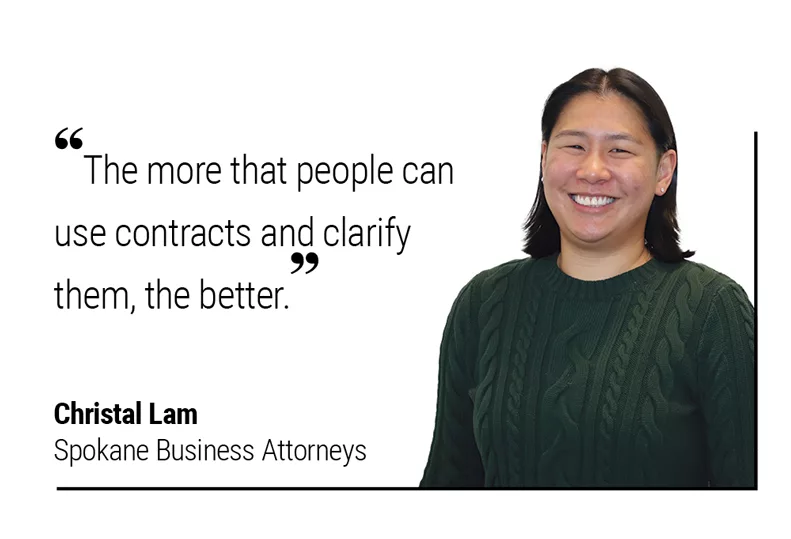
“People don’t get the right contracts, or they don’t want to use contracts, or their contracts don’t have enough detail to them. It leaves them in a gray area,” she says. “The more that people can use contracts and clarify them, the better.”
Another legal pitfall businesses can experience involves being uninformed about the latest labor laws and regulations. Lam advises business owners to keep track of these rules, including minimum wage requirements, or hire a business manager, adviser, or attorney to oversee compliance in these areas. Failing to compensate contractors correctly and noncompliance with state Labor & Industries laws can result in fines starting around $1,000, Lam explains.
“Small business owners run into issues because they aren’t aware that the law has changed; we’ve seen some people underpaying on minimum wage because they weren’t paying attention,” says Lam. “Sometimes small business owners just get so focused on running the business that they miss out on some of the compliance and legal pieces, and that can cost a business some money.”
Underpaid employees are entitled to back pay plus interest, usually starting at 10%, she adds.
An additional source of liability for new business owners involves intellectual property, says Rob Hartman, partner and CEO at Spokane-based intellectual property law firm Lee & Hayes PC.
Most companies file for at least a trademark to protect the company’s name and branding, while other companies that produce products or technologies might also file for several patents, trade secrets, or copyrights, he explains.
Choosing a company or product name without first checking if a trademark has been established is surprisingly common and can be an expensive mistake to fix, he says. Fighting trademark infringement claims in court or reprinting signage and rebranding are both costly options that many new businesses can’t afford.
“You (might not) want to fight back, but you also don’t want to change your name because you’re very attached to it and you’ve created a ton of signage, which for small businesses starting up, are big capital expenditures,” Hartman says. “Now something that was a very simple problem, which was that name is taken, has now become a big problem."
Entrepreneurs and startup companies that rely on proprietary technology should consider their intellectual property as a company asset, adds Nick Somers, a patent attorney and partner at Lee & Hayes. Businesses that wait too long to protect intellectual property, don’t document ownership of inventions or creative work, or assume ideas are protected without formal intellectual property rights risk losing out on valuable assets that can be sold or attract investors.
Patent fees can range from about $100 dollars to over $30,000. Due to costs, some business leaders might not choose to pursue a patent immediately, but would benefit from keeping intellectual property opportunities in mind, Somers explains.
“At a high level, the biggest lesson for entrepreneurs is that (intellectual property) strategy should start early, ideally alongside business formation and product development, rather than being treated as an afterthought,” he says. “Even if you don’t act on that strategy, it’s good to be thinking about it from the start.”

Stay Informed. It’s Free.
Subscribe to our newsletters and get the latest news and insights delivered to your inbox.
We respect your privacy.
Unsubscribe anytime.
Thank you!
You’re subscribed. Keep an eye on your inbox for the latest updates.