Behind Bloomsday: The club that helped shape Spokane's iconic 12K
Bloomsday Road Runners Club created to sidestep sanctioning issue in early years of the race
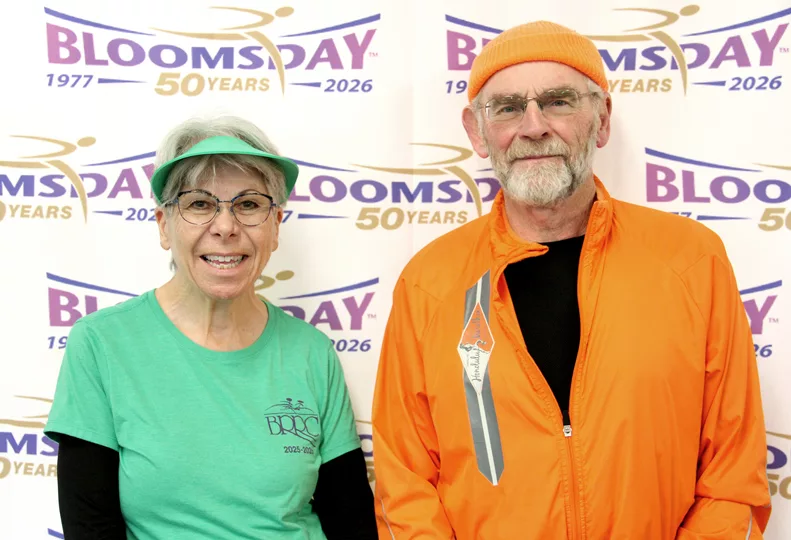
Sue and Paul Fitzpatrick joined the Bloomsday Road Runners Club in 2000 after moving to Spokane.
| Jase PicansoFor 50 years, Spokane’s Bloomsday has transformed Riverside Avenue into a buzzing gathering spot each May. Families warm up near the start line, elite runners take their places at the front, and thousands more fill the blocks behind them, shedding jackets worn against the morning chill as they wait.
When the 12K race begins, downtown Spokane and surrounding areas fill with a wave of runners, walkers, wheelchair racers, and spectators, turning the city’s streets into a shared course for tens of thousands of people.
The tradition traces back to Bloomsday creator Don Kardong, an Olympic marathoner whose experience during the 1970s running boom helped shape what would become one of the largest road races in the United States.
After finishing fourth in the marathon at the 1976 Summer Olympics, Kardong traveled to races around the country and was inspired by community events such as the Peachtree Road Race, in Atlanta, where elite and recreational runners shared the same streets. He began imagining a similar event in Spokane that would open downtown roads to runners of all abilities.
Back in Spokane, Kardong shared the idea publicly, and support grew quickly. City leaders expressed interest, volunteers stepped forward, and planning for the first race began.
Early organizers soon ran into issues with the structure governing road racing at the time.
“In the old days, elite athletes were controlled by the governing body, (Amateur Athletic Union),” says Dori Whitford, president of the Bloomsday Road Runners Club. “They said elite runners could not compete with people who were not AAU.”
The rule required all participants in a sanctioned race to belong to the same governing body. To work around it, organizers created the Bloomsday Road Runners Club in 1978.
Whitford says the race quickly gained momentum, helped in part by the publicity surrounding the AAU dispute. Participation grew from about 1,000 runners in the first year to more than 5,000 in the second.
“Everybody who ran Bloomsday became a member of BRRC,” Whitford explains. “We immediately had about 5,000 members, which is the biggest it has ever been.”
Volunteer Sue Fitzpatrick says the club's structure also helped reduce financial barriers tied to race sanctioning.
“People had to pay a fee to run unless they were part of a club,” she says. “So they created the Bloomsday Road Runners Club, and that allowed everyone to participate.”
As awareness spread, the race continued to expand, eventually becoming one of the largest timed road races in the country. At its peak, Bloomsday has drawn more than 60,000 participants.
Though the club shares a name with the race, the two now operate as separate entities, with the race being organized by the Lilac Bloomsday Association. The Bloomsday Road Runners Club functions as a nonprofit running club that organizes races, publishes a monthly newsletter, and supports Spokane’s broader running community.
The club has also undergone recent leadership changes. Whitford has returned as president of the club after stepping down from her role as president of the Lilac Bloomsday Association, where she served from 2022 to 2024. She has previously held leadership roles within the club and is now guiding it into a first-year partnership with the for-profit fitness event management company Negative Split.
The partnership is intended to support race operations such as registration and logistics, giving the volunteer organization additional capacity to manage events.
“They’re really truly just in to promote a good experience for the runners,” Whitford says.
Sue Fitzpatrick says the club continues to rely on volunteer-driven outreach and communication.
“We publish the Race Rag monthly,” she says. “It lists our races and promotes smaller community events. Those groups pay a small fee for ads, which helps cover printing costs.”
According to its mission statement, the club aims to promote running and walking by creating an inclusive environment while organizing events throughout the year.
“That’s our main purpose — getting people out and active,” says Paul Fitzpatrick, the club’s secretary.
The Fitzpatricks joined the club in 2000 after moving to Spokane. Paul Fitzpatrick discovered the group through a local publication while temporarily living in a hotel for work, and Sue Fitzpatrick soon joined him, volunteering at Bloomsday events before they had settled in permanently.
“We worked our first sticker party before we even had a house here,” Sue Fitzpatrick says.
The “sticker party” involved preparing race materials by hand, including placing runners’ names on bibs before packet pickup, a process now handled digitally. Despite those changes, longtime volunteers say the culture behind the work has remained consistent.
After briefly moving to western Washington in 2005, the couple returned to Spokane, drawn back by the running community.
“We wanted to come back to Spokane and be with our running friends,” Sue Fitzpatrick says. “I sent an email saying we were moving back, and the response was, ‘Welcome home.’”
“Nobody gets paid to do this,” she says. “We do it because we want to.”
As Spokane’s running community has grown, the club is no longer the only organization shaping it. Multiple groups now operate across the region, many coordinating with Bloomsday-related events.
“Before COVID, this was the main club,” Paul Fitzpatrick says. “Now there are probably 10 to 12 other groups that collaborate with Bloomsday.”
The club highlights those groups through its newsletter, promoting weekly runs and community gatherings across Spokane.
Even as the structure of the running community evolves, Bloomsday remains a constant each spring, reshaping a portion of Spokane into a shared public course.
What began as an idea inspired by an Olympic runner and a national running movement has become a civic tradition that continues to define the city.