The Silver Surge
North Idaho mines benefit from rising prices, demand
North Idaho’s silver mining corporations are expecting to benefit from faster permitting and increased demand since the U.S. Geological Survey added the precious metal to its 2025 List of Critical Minerals late last year.
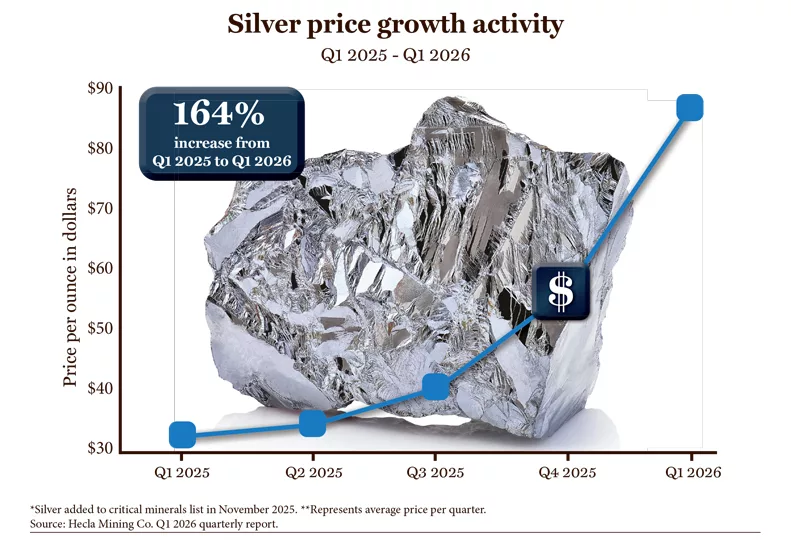
The average price of silver has increased 164%, to $84.39 in the first quarter of 2026, up from $31.91 per ounce in year-earlier quarter, according to Coeur d’Alene-based Hecla Mining Co.’s first-quarter report. The value of silver at time of publication was about $77 an ounce.
“The demand for silver has increasingly gone up over the years, not just as a metal, but as a strategic and manufacturing material in the industrial space, so as the demand is going up, supply is also going down,” says Benjamin Davenport, executive vice president of Boise, Idaho-based Idaho Mining Association. “Because supply has struggled to keep up with that demand, at least from North Idaho's perspective, where we've been producing silver for over 100 years, that would benefit our current members who produce silver up in the Silver Valley.”
The U.S. Geological Survey added silver, along with nine other minerals, to the critical minerals list in November 2025 due to its importance to the country’s technology and defense industries, the organization says in a press release. Minerals are considered critical if access to them is essential to the country’s economic health and national security.
Silver is commonly valued in the technology industry for its high thermal and electrical conductivity and is used in computer components, data centers, semiconductors, electric vehicles, antibacterial medical uses, and solar panels, Davenport explains.
Surging silver prices are attributed to supply constraints and the mineral’s use in high-end electronics, combined with its status as a critical mineral, Davenport says.
Now that the mineral is considered a critical to the U.S. economy, some silver producers are hoping to benefit from faster project permitting. Title 41 of the Fixing America’s Surface Transportation Act is a program that may help streamline major infrastructure projects, says Mike Satre, director of governmental affairs at Hecla Mining.
“It opens up opportunities for federal funding of some of our initiatives,” says Satre, adding that this streamlined permitting process underscores the mining industry’s importance to the U.S. economy, ensuring that regulators understand its necessity while fostering an environment for new partnerships.
Some mining operations in North Idaho’s Silver Valley, a region about 40 miles east of Coeur d’Alene known for its silver deposits, reported significantly higher gross silver sales revenue due to increased prices and higher production rates.
Hecla’s Lucky Friday mine — which produces silver, lead, and zinc at a site east of Mullan, Idaho — produced 5.26 million ounces of silver in 2025, Satre says. The mine has been in operation since 1942.
Production at Lucky Friday decreased slightly to 1.24 million ounces in Q1 2026, from 1.33 million ounces of silver produced in Q1 2025. However, cash flow from the mine nearly tripled to $64.6 million in the first quarter, from $23.8 million in the year-earlier quarter, according to the company’s financial and operating report.
“Production on a quarter-by-quarter basis can be impacted by many things,” Satre explains. “Sometimes you're in a slightly lower grade area of the mine, but you can be a higher-grade place later. We look at that annual production, but we're also now producing more silver at the Lucky Friday than we ever had in its history.”
Hecla’s 2025 annual revenue increased to $411 million in Q1 2026 — a 100% jump from Q1 2025, according to the company’s report.
Toronto, Canada-based Americas Gold & Silver Corp. operates the Galena Complex, a silver mine about a mile southwest of Silverton, Idaho. That mine also reported an increase in revenue from silver sales, which rose to $35.4 million in Q1 2026 from $11.7 million in Q1 2025, the company's financial reporting shows.
Americas Gold & Silver Corp. attributes higher revenue to increased silver production and prices.
The U.S. Geological Survey updates the Critical Minerals List periodically after periods of public feedback, Satre says.
The Idaho Mining Association and its member corporations, including Hecla Mining and Americas Gold & Silver Corp., pushed the U.S. Geological Survey to include silver on it's critical mineral list during the department's public comment period with support from senators from Idaho, Montana, and Alaska.
While high prices are beneficial for mining corporations, Satre says he expects the country’s reliance on critical minerals for defense will result in increased mineral imports from outside the United States, which could be detrimental for the mining industry domestically.
“It's going to continue to be more and more expensive, unless more mines open up,” Satre says. “If you don't have a lot of it, and the world needs it, then the price is going to go up and we are really reliant on foreign sources for our silver.”
Focusing on domestic silver production is expected to lead to additional investment in the small communities that support the North Idaho mining industry, including the cities of Wallace and Kellogg, in the Silver Valley, says Davenport.
“Silver Valley has been a prominent silver producer for over 100 years. In some of these rural towns, a significant number of the people that live there for multiple generations have worked either at the mine or for service industries servicing the mine, so there is a significant impact to the to the local economies and to the local communities,” he contends. “Every one of our member mines contributes back into the communities as well, whether it's (investing in) the schools or the parks, they all give back as well. The increased focus on silver certainly impacts the interest in investment (in the communities).”

Stay Informed. It’s Free.
Subscribe to our newsletters and get the latest news and insights delivered to your inbox.
We respect your privacy.
Unsubscribe anytime.
Thank you!
You’re subscribed. Keep an eye on your inbox for the latest updates.