
Spokane-area builders face higher expenses
Rise in material, fuel costs adds pressure for builders
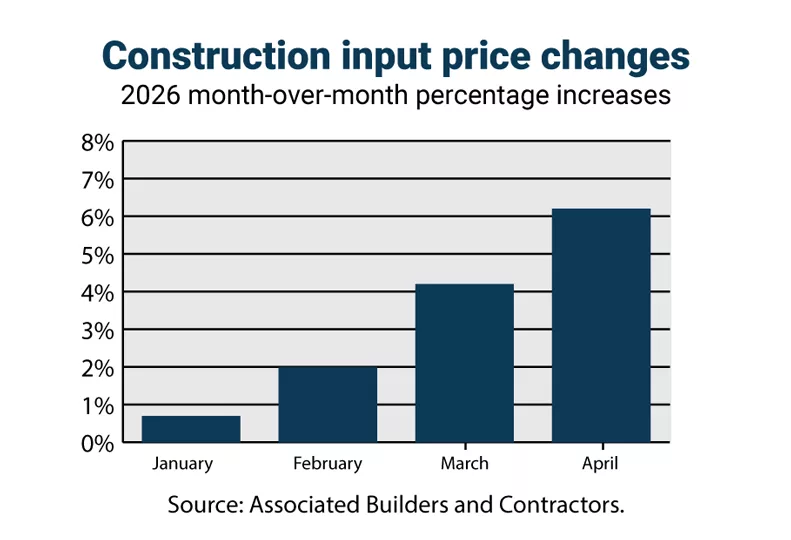
Construction input prices have increased by 1.7% month over month in April and have climbed 6.2% since January, according to the latest data from Associated Builders & Contractors.
| Lily SidorenkoThe construction industry is currently facing a significant surge in expenses driven by rising material costs, fuel prices, and complex regulatory requirements leading to challenges in balancing tighter margins with affordability, some builders say.
Construction input prices have increased by 1.7% month over month in April and have climbed 6.2% since January, according to the latest data from Associated Builders & Contractors, a national trade association representing more than 24,000 contractors, subcontractors, and construction-related companies.
"Input prices have now risen more during the first four months of 2026 than over the prior three years," says Associated Builders & Contractors chief economist Anirban Basu in a press release.
Much of the recent rise can be traced to soaring oil prices in addition to tariff-affected materials, such as iron and steel, which are posting large price increases, explains Basu. Overall, construction input prices were 7% higher in April compared with the year-earlier month, ABC data shows.
The National Association of Homebuilders also points to continuing material inflation despite a slower housing market. Data from the group shows building material prices rose 3.7% in April, the fastest annual pace in three years, with elevated costs in multiple material categories. The National Association of Homebuilders represents over 140,000 home builders, remodelers, and associated industry professionals, and advocates for pro-housing policies while providing industry education.
For some companies including Spokane Valley-based HUG Services Inc., which does business as HUG Construction, national trends are playing out in the company's day-to-day operations.
The issue goes beyond a single category or temporary increase, says Titus Hug, owner and president of HUG Construction.
"There are a lot of external pressures, costs, and challenges that are very real," Hug says. "Contractors have to adapt to elevated costs and find the opportunities in a shrinking market."
He attributes current expenses to a widespread escalation across all operational levels rather than a single, isolated cost increase.
"Current pricing reflects the sum of the whole as permitting prices, state regulations, and taxes, and now federal policies, have all added a little bit more to the overall equation," Hug says.
The challenge for many contractors in this market is managing an array of cost increases from multiple angles, with Hug noting that material prices are volatile due to shifts in manufacturing and supply chain stability. Fuel costs are impacting transportation and equipment expenses, and permitting and regulatory requirements are increasing costs before a project ever begins, Hug explains.
Based on his experience with past price hikes, Hug warns that material costs are expected to remain elevated, even when other overhead expenses, such as fuel, begin to normalize.
"We will definitely see some of these external prices like fuel come back down," Hug says. "Unfortunately, the rest of the prices will stay a bit higher because the end prices tend to stay up even when other costs come down."
Rising costs for land, labor, and materials are stifling builder confidence, which is currently low due to weakened demand, according to national data from the National Association of Homebuilders. Hug notes that this high-pressure environment is impacting the industry, effectively driving out builders who struggle to manage these multifaceted costs.
"Some companies just don't want to deal with the added stress and have pulled back," Hug says.
Higher fuel costs are creating another layer of pressure for construction companies here and nationwide that rely on fleets of trucks and equipment. Transportation expenses have become a more significant challenge for his company due to elevated diesel prices, Hug says.
"Having 30 trucks running materials around on increased fuel costs has added significant pressure," he says.
Further compounding the pressure on builders is a demand for expanded service areas — some, up to two hours away. Hug explains that his work crews previously traveled within 20 minutes of the company's office, add the address.
"We are actually doing more work in Idaho," Hug says. "The permitting and policy structure over there is cheaper and friendlier for builders, so we have become more competitive in the Idaho market as well."
Rich Veltri, director of commercial construction for HUG Construction, says fluctuating price increases have become difficult to predict.
"Some of the vendors have doubled material prices," Veltri says, adding that concrete represents one of the most noticeable increases.
"Concrete flat work used to be assessed at about $5 to $6 per square foot, but now it is $10 per square foot across the board," Veltri explains. "Lately, we have also had $400 surcharges attached to 60- to 70-mile concrete deliveries."
National data supports their concerns, as the National Association of Homebuilders reports building material inflation has remained above 3% for much of the past year.
Rising costs are creating significant hurdles for contractors when bidding on future work; as Veltri points out, these long-lead quotes often force builders to choose between absorbing financial losses or risking customer satisfaction.
To manage expectations, many builders are using escalation clauses that allow contract pricing to increase if material costs rise significantly during a project. For HUG Construction, however, the company follows a fixed-bid approach rather than an escalation clause.
"We are a fixed-bid company, so if we give a bid, that is the agreed to price," Hug explains. "Sometimes we take financial losses because of that, but customer satisfaction is most important to me."
Looking ahead, Hug says increasing housing inventory here could help address long-term affordability concerns in the Spokane market, he says, adding that land expansion could provide opportunities for home construction and could help alleviate some pressure created by a limited supply.
"Supply and demand comes into play as well and I am all about aggressive land expansion beyond Spokane's current plan to help increase inventory and drive down costs," Hug says. "That's also above my pay grade, and I don't plan on running for office."