
Kootenai Health debuts new surgical robot
North Idaho provider adds tool to recent technology upgrades
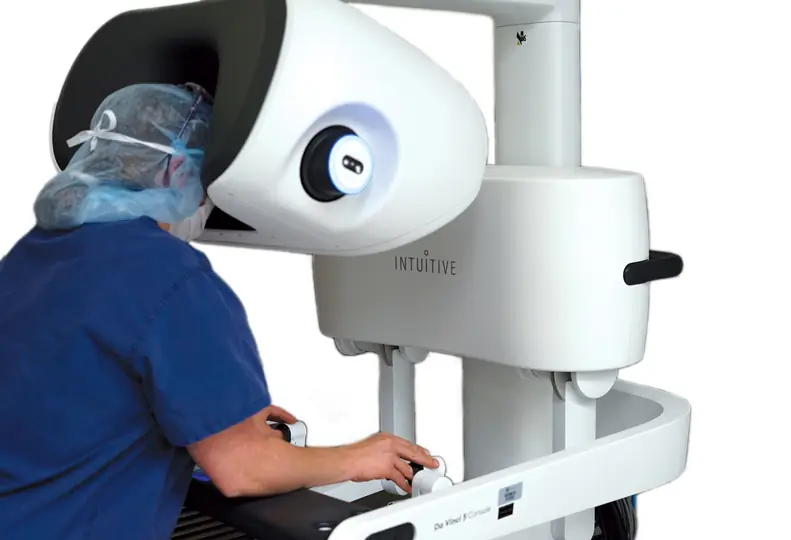
Amy Leland, a certified surgical technologist, looks into the headpiece of the da Vinci 5 surgery robot Kootenai Health unveiled in April.
| Matt StephensKootenai Health has added one of the most advanced robotic-assisted surgical platforms available today to its main campus in Coeur d'Alene as part of a strategy to expand specialized care and invest in emerging medical technologies.
The North Idaho-based health system has installed the da Vinci 5, the newest generation of the robotic surgery platform developed by Sunnyvale, California-based Intuitive Surgical Inc. The addition, which was unveiled in April, places Kootenai Health among a growing number of hospitals nationwide adopting the latest robotic-assisted surgical technology, according to Intuitive's website.
The investment represents a significant commitment to advanced health care infrastructure. A new da Vinci 5 system carries an average total cost exceeding $3 million, depending on configuration and support services, says Andrea Kalas-Nagel, communications, media, and public relations manager at Kootenai Health. The new system is the third da Vinci installation at Kootenai Health.
Kalas-Nagel declines to disclose estimated return-on-investment projections, and says Kootenai Health evaluates major capital expenditures based on long-term value, including improved clinical outcomes, expanded access to advanced care, enhanced patient experiences, and growth opportunities across service lines.
"Our approach to these investments is centered on long-term value," says Kalas-Nagel. "Improving clinical outcomes, expanding access to advanced care locally, and enhancing the overall patient experience help strengthen sustainability and growth across our service lines."
Kootenai Health serves as a regional referral center for North Idaho, Eastern Washington, and western Montana. The organization's leadership views advanced technology investments as a way to keep patients closer to home while reducing the need to travel to larger metropolitan medical centers for specialized treatment, says Dr. Ethan Ferrel, general surgeon at North Idaho Endoscopy & Surgical Specialists PLLC, which is part of Kootenai Health's provider network.
The da Vinci 5 platform represents the latest evolution of robotic-assisted surgery and includes more than 150 enhancements over previous generations of the technology, according to the manufacturer's website. The tool works through surgeons, who control robotic instruments from a console while viewing the surgical field through a headset showing high-definition, three-dimensional imagery, Ferrel says. The system translates the surgeon's hand movements into highly precise movements inside the patient's body, he adds.
The platform also improves visualization and precision while reducing physical strain on surgeons during lengthy operations, explains Ferrel, who says robotic-assisted surgery provides surgeons with greater dexterity and control than many conventional laparoscopic approaches.
The enhanced maneuverability allows physicians to perform increasingly complex procedures through minimally invasive techniques, creating benefits for both surgeons and patients. It allows the surgeon to directly control the camera as well, meaning fewer people are needed in the operating room, allowing staff to be available to help elsewhere.
One of the more notable advancements in the tool is the addition of force-feedback technology, commonly referred to as haptic feedback.
Dr. Edward deTar, a surgeon at Kootenai Clinic - General Surgery, says previous generations of robotic surgery systems relied primarily on visual cues, but the da Vinci 5 provides real-time feedback that allows surgeons to feel how much force is being applied to tissue during procedures. The added layer of information gives surgeons greater awareness while operating and can improve precision when working around delicate anatomical structures.
"The haptic feedback is a significant advancement," says deTar. "It gives surgeons additional information during procedures that simply wasn't available on previous systems."
The technology also offers benefits for patients undergoing surgery.
Valerie Carpenter, director of perioperative services at Kootenai Health, says robotic-assisted surgery often allows procedures to be performed through smaller incisions, resulting in less pain, reduced blood loss, lower infection risk, and shorter hospital stays for patients. Shorter stays can contribute to lower cost for overall care.
Patients frequently experience faster recovery times and a quicker return to their normal activities compared with traditional open surgical procedures, says Carpenter.
The new installation reflects broader growth occurring throughout the robotic surgery industry. Intuitive reported first-quarter 2026 revenue of $2.77 billion, a 23% increase compared to the year-earlier quarter. The company attributes growth to increased sales of instruments, accessories, and services associated with its growing number of installations of robotic surgery systems.
The company's growth has mirrored increasing adoption of robotic-assisted surgery throughout the health care industry. Intuitive announced earlier this year that more than 20 million procedures have been performed worldwide using da Vinci systems since the platform was introduced, and over 3 million procedures were completed in 2025.
For Kootenai Health, the da Vinci 5 is only one component of a broader technology investment strategy aimed at expanding specialized care throughout the region.
The health system currently is upgrading multiple MRI and CT imaging systems with newer equipment that's capable of producing higher-quality images while reducing scan times. The upgrades also include patient-focused features, such as in-room video screens designed to improve comfort during imaging procedures, says Kalas-Nagel.
Kootenai Health recently became the first hospital in Idaho to offer NeuroPace Responsive Neurostimulation technology for epilepsy patients whose seizures cannot be adequately controlled through medication, Kalas-Nagel contends.
The organization is continuing to expand cardiovascular services through upgrades to cardiac catheterization laboratories and interventional radiology capabilities while adding Pulsed Field Ablation technology for patients with atrial fibrillation, she adds.
Rehabilitation services also have benefited from investments supported by the Kootenai Health Foundation. The health system has recently acquired Xcite2 Functional Electrical Stimulation technology, which helps patients recovering from neurological injuries improve movement and function, says Kalas-Nagel.
Many of the organization's technology advancements have been made possible through philanthropic support from the Kootenai Health Foundation, which helps fund equipment purchases and innovative treatment programs that might otherwise take years to implement, she says.
The investments underscore Kootenai Health's effort to position itself at the forefront of health care innovation in the region while expanding access to advanced medical technologies for patients.

Stay Informed. It’s Free.
Subscribe to our newsletters and get the latest news and insights delivered to your inbox.
We respect your privacy.
Unsubscribe anytime.
Thank you!
You’re subscribed. Keep an eye on your inbox for the latest updates.