
Location changes your buying power
$1M stretches further in Spokane than other key markets in the Northwest

Branden Griffith is a real estate agent and managing broker for Windermere City Group, licensed in both Washington and Idaho. He can be reached at [email protected].
| Windermere City GroupIn the residential real estate sector, crossing the million-dollar purchase threshold in the Northwest varies widely across different markets.
At the median price point for premium homes, the cost per square foot in Seattle is four times higher than in Spokane, creating a staggering divide in what buyers actually own at the top of their respective markets. From 100-year-old Craftsmen-style homes in Seattle's Phinney Ridge neighborhood to sprawling 3,000-square-foot new-construction homes in Coeur d'Alene, the "million-dollar home" is a moving target that depends entirely on its location.
Imagine for a moment a "million-dollar home." What does it look like? Does it sit on a tree-lined street in an established neighborhood? Does it have 100 feet of waterfront on your favorite lake? Maybe it's a well-appointed condo in the city. What you picture will likely depend more on where and when you grew up and less on recent market trends.
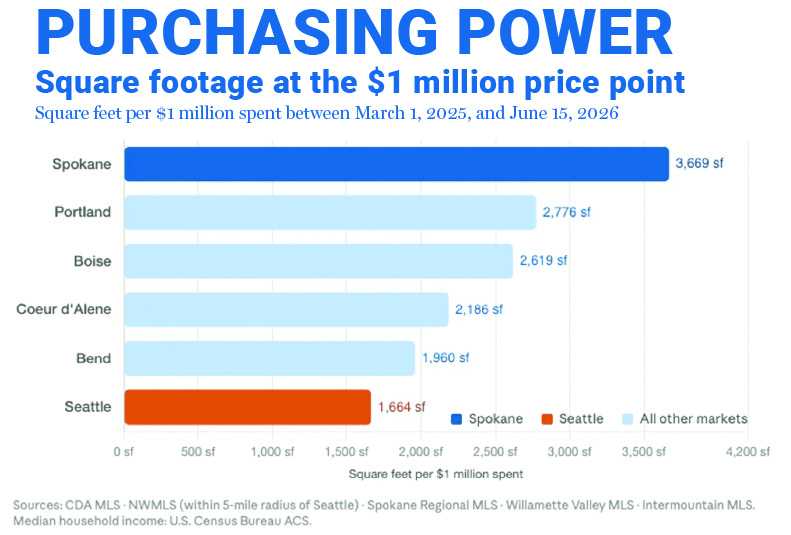
Across the Pacific Northwest, crossing that price point yields wildly different results. In some markets, a million dollars buys an exceptional home; in others, it buys an average residence. For example, Seattle's median million-dollar home would cost roughly $735,000 at Spokane prices. In Spokane, $1 million buys you roughly 3,700 square feet. In Seattle, that same budget delivers only about 1,700 square feet.
To understand how wide that gap really is, I looked at what buyers actually get at the top end of the price spectrum using data from Multiple Listing Services in six Northwest markets: Spokane; Seattle; Coeur d'Alene; Boise, Idaho; Portland, Oregon; and Bend, Oregon.
The market share of where $1 million-plus sales are concentrated tells us a lot about each market before we look at the homes themselves. In Seattle, roughly 42% of homes within a 5-mile radius of the city are sold for over $1 million. In Bend, Oregon, more than 1 in 4 homes are sold at $1 million-plus.
Spokane has the fewest number of sales above the mark with only 3% of all homes sold valued at $1 million or more. But that number has climbed steadily since Spokane County’s earliest million-dollar residential sale and has spiked dramatically during the pandemic from 47 sales in 2020 to 171 sales in 2021.
It's one thing to cross the $1 million threshold, but without context, that number is arbitrary. In some markets, crossing the $1 million price tag gets you in the door of a home nicer than average. In others, the door to truly premium properties is open wide.
Of homes valued over $1 million in the cities of Seattle, Bend, and Coeur d'Alene, the median price exceeds $1.4 million.
Compared to all homes sold in their respective markets, the differences become clear.
From March 1, 2025, to June 15, 2026, Seattle buyers faced a relatively modest 60% markup to move from the $896,500 citywide median price point into the $1.4 million upper tier. In inland markets, however, the barrier to premium homes is much higher.
In Coeur d'Alene, where the median home price is $549,900, the premium tier represents a 164% jump above the midpoint market price. In Spokane, that premium jump is even higher with a median sales price of $430,000 overall. Buyers are paying 183% more than the median-priced home when purchasing in the premium market.
How a home actually feels across these markets is where the "million-dollar divide" becomes a reality. Spend $896,500 in Seattle, and you’ll likely get a 1,600-square-foot, three-bedroom home. Spend that same amount in Spokane, and the results are significantly different: 92 buyers here did just that over the last five quarters, landing four-bedroom, three-bathroom homes averaging 3,500 square feet. In the trade-off between the coast and the Inland Northwest, the difference isn't just a few hundred feet — it's an entire 1,900-square-foot wing of a house.
Coeur d'Alene actually edges out Seattle for the median sold price above $1 million, but delivers 800 more square feet than in Seattle. In both metropolitan areas, you can get a four-bedroom, three-bathroom home, but in Coeur d'Alene, the median home will be over 3,000 square feet on 0.72 acres including a three-car garage in a newer subdivision. In Seattle, the median home over $1 million looks more like a nicely updated Craftsman-style with 2,500 square feet in an older neighborhood, such as Phinney Ridge.
In other Northwest markets including Boise and Portland, Oregon, both cities sit at the midpoint of nearly every metric in this comparison. Both markets offer buyers a middle path with lower median prices and more square footage per dollar than every market except Spokane. At this price point, the homes are nearly identical — four bedrooms, roughly 3,400 square feet — with one notable exception: The house in Boise is likely on a lot more than twice the size of its Portland equivalent.
Meanwhile, Bend, Oregon, emerges as an outlier in the Northwest market. Despite being the smallest city in this group, Bend has the second-highest price-per-square-foot behind only Seattle, with home prices driven up primarily due to pandemic-era migration and the lifestyle premium attached to its access to outdoor recreation.
While the price premium is steeper in the inland markets, as the price scales up, so does what you receive for it. Beyond square footage and lot size, the age of the home tells a similar story. The median home in Spokane, Boise, and Coeur d’Alene is roughly 40 years newer than comparable homes in Seattle and Portland.
The future of these higher-end properties across the region is uncertain. Following a pandemic-driven boom of remote work driving wealthier tech workers into smaller cities, recent waves of layoffs across the tech industry may shape where — and at what price — premium buyers land next. A million-dollar home likely doesn't look like it did when you were a kid, but how it looks moving forward is also a moving target.
Branden Griffith is a real estate agent and managing broker for Windermere City Group, licensed in both Washington and Idaho. Readers with questions about the Spokane or North Idaho markets can reach him at [email protected]
Stay Informed. It’s Free.
Subscribe to our newsletters and get the latest news and insights delivered to your inbox.
We respect your privacy.
Unsubscribe anytime.
Thank you!
You’re subscribed. Keep an eye on your inbox for the latest updates.