Giving while living gains popularity in the INW
More donors choose to make charitable donations while alive, able to see results of their gifts
Estate planning attorney Julie Olds says she is seeing a growing number of clients who don’t want to wait until they're gone to begin making a charitable impact.
Instead, they are choosing to give during their lifetimes, allowing them to see the results of their philanthropy and involve family members in decisions about where their money goes.
“What I have heard from clients in my estate planning practice is they want to teach generational generosity,” says Olds, owner of Spokane-based Julie H. Olds Law PLLC.
One charitable giving vehicle helping them do that is a donor-advised fund, which allows donors to make charitable contributions now, while recommending grants to nonprofits over time and creating a lasting philanthropic legacy.
That interest in giving while living is reflected locally at the Innovia Foundation, where newly created donor-advised funds have accounted for 38% of new funds in fiscal year 2026, up from 27% in fiscal 2024. Over the past five years, an average of one-third of new funds established at the Spokane-based community foundation have been donor-advised funds, says Chief Philanthropy Officer Dave Sonntag.
The cohort of donors creating donor-advised funds is not siloed to a single age group, but is a mix of donors ranging from their late 30s to 70s, Sonntag says. Typically, people who are opening donor-advised funds are those who have hit their stride in their career and have more control over their finances, he says.
"We have many people that come in and say, 'You know what? I want to experience the joy of giving and making a difference,'" Sonntag says. "They get to experience the difference it can make while they’re alive. And then as an endowed fund, they’ve established a legacy, so when they are gone, the fund will continue to fund the things they care about."
The trend extends beyond the Inland Northwest. According to the Donor Advised Fund Research Collaboratives Annual DAF Report, donor-advised funds continued to grow nationwide in fiscal year 2024, with more than 3.5 million accounts holding nearly $328 billion in charitable assets. Donors also recommended a record $64.6 billion in grants to charitable organizations during the year.
DAFgiving360, the Charles Schwab & Co. Inc. nonprofit arm that provides donor-advised fund services, reported its most active year on record with donors granting $9.9 billion in 2025. The increase in 2025 is the organization's fourth consecutive year of double-digit growth in grants by DAF donors.
While many donors are motivated by a desire to make a charitable impact during their lifetimes, donor-advised funds also offer practical advantages.
Matthew Luedke, owner and managing attorney of Spokane Valley-based Elevated Estate Planning PS, says the accounts allow donors to make a larger charitable contribution in a single year, potentially maximizing tax benefits, while recommending grants to nonprofits over time.
“(People) know they want to give,” Luedke says. “But they want to do so over many years and retain that control of who and how much and how often.”
Donor-advised funds also allow donors to give more while not having to worry about the administrative aspects, says Olds. Donors can give up to 60% of their adjusted gross income, and the deduction limit for gifts of appreciated property — a way to reduce an individual’s tax burden — is limited to 30% of their adjusted gross income, Olds says.
“The other piece of a donor-advised fund is you can name successor advisers,” Olds says.
For Olds, the growing interest in charitable giving during a donor’s lifetime also reflects broader conversations about how wealth will be passed to future generations as the nation’s historic transfer of wealth from baby boomers to their heirs takes hold.
Across Eastern Washington and North Idaho, baby boomers are expected to leave $42 billion to their beneficiaries from 2019 to 2029, according to a transfer of wealth study conducted by Locus Impact Investing and commissioned by the Innovia Foundation, Sonntag says.
The Innovia Foundation hopes to channel a portion of that wealth into charitable giving through its 5% Campaign, which encourages people to designate at least 5% of their estates for philanthropy. If just 5% of that wealth transfer is committed to local philanthropy, it would equal a $2 billion investment back into the communities the foundation serves, Sonntag says.
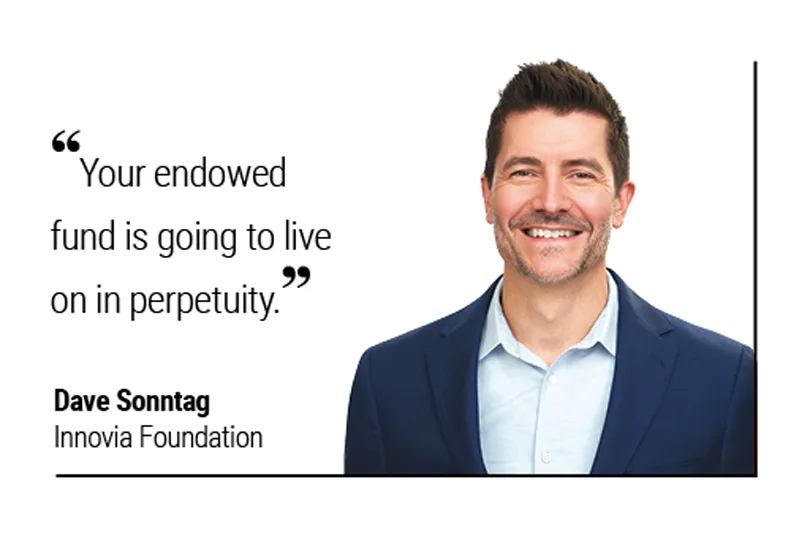
“The whole idea of this $42 billion transfer in our region is let’s come together as a community and capture some of that to uplift the community for the future,” Sonntag says. “Your endowed fund is going to live on in perpetuity, … and for other people that don’t have a lot of liquid assets while they’re alive, it can make a lot of sense.”